

alb3670191
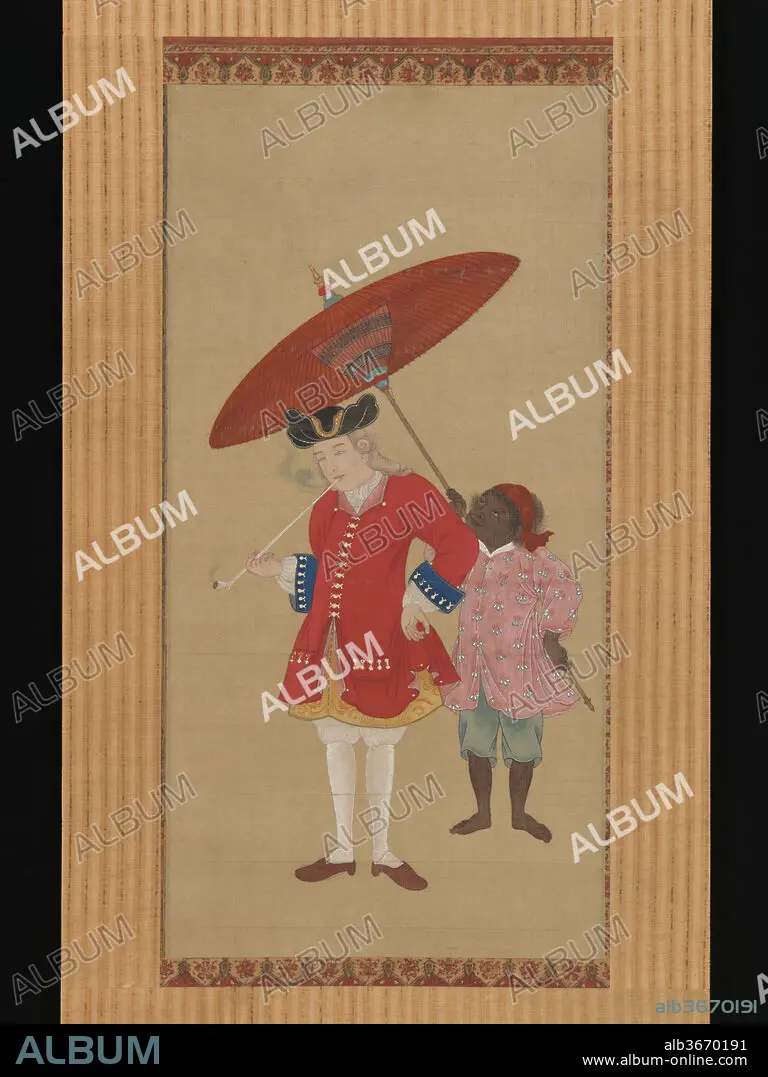
ATTRIBUTED TO KAWAHARA KEIGA. Dutchman with a Servant
| Share |
|---|
 Pinterest Pinterest |
 Twitter Twitter |
 Facebook Facebook |
 Copy link Copy link |
 Email Email |
|
Add to another lightbox |
|
Add to another lightbox |


Buy this image.
Select the use:

Title:
Dutchman with a Servant
Caption:
Dutchman with a Servant. Artist: Attributed to Kawahara Keiga (Japanese, 1786-1860). Culture: Japan. Dimensions: Image: 19 3/4 x 9 7/8 in. (50.2 x 25.1 cm). Date: early 19th century.
This is painting was inspired by an early print of the 1750s entitled "Hollander" (Orandajin no zu) that was produced by the publisher Hariya in Nagasaki, the only port foreigners were allowed to enter Japan for most of the Edo period. That print, which became a template for countless subsequent prints and paintings of Dutch figures, identifies the dandily dressed figure with bright blue eyes and long, curly blond hair as the kapitan, referring to the opperhoofd, the manager of the Dutch factory on the island of Deshima (off the shore of Nagasaki). He puffs on a long clay pipe, reminding us that tobacco and its consumption was an insidious import from Europe in the mid to late sixteenth century, and then was grown locally. The opperhoofd wears tight leggings and an overly fancy long jacket of Dutch colonialists, manufactured in Asia by local tailors. His Javanese servant holding the parasol in the early print is referred to as a kurobo, a derogatory term used for black slaves abducted in the East Indies. Though not signed, the work is in the meticulous but stiff Western style of painting associated with Kawahara Keiga, the most prolific portraitist of the Dutch community in Deshima.
Technique/material:
Hanging scroll; ink and color on silk, negoro lacquer roller knobs
Period:
Edo period (1615-1868)
Museum:
Metropolitan Museum of Art, New York, USA
Credit:
Album
Releases:
Image size:
3148 x 4200 px | 37.8 MB
Print size:
26.7 x 35.6 cm | 10.5 x 14.0 in (300 dpi)
Keywords:
ASIA • ASIAN ART • ATTRIBUTED TO KAWAHARA KEIGA • EDO PERIOD (1615-1868) • HANGING SCROLL; INK AND COLOR ON SILK, NEGORO LACQUER ROLLER KNOBS • HANGING SCROLLS • INK • JAPAN • LACQUER • LUGS • METROPOLITAN MUSEUM OF ART, NEW YORK, USA • NEGORO • PAINTINGS • SCROLL PAINTINGS • SCROLLS • SILK • TEXTILES: SILK
