

alb4859440
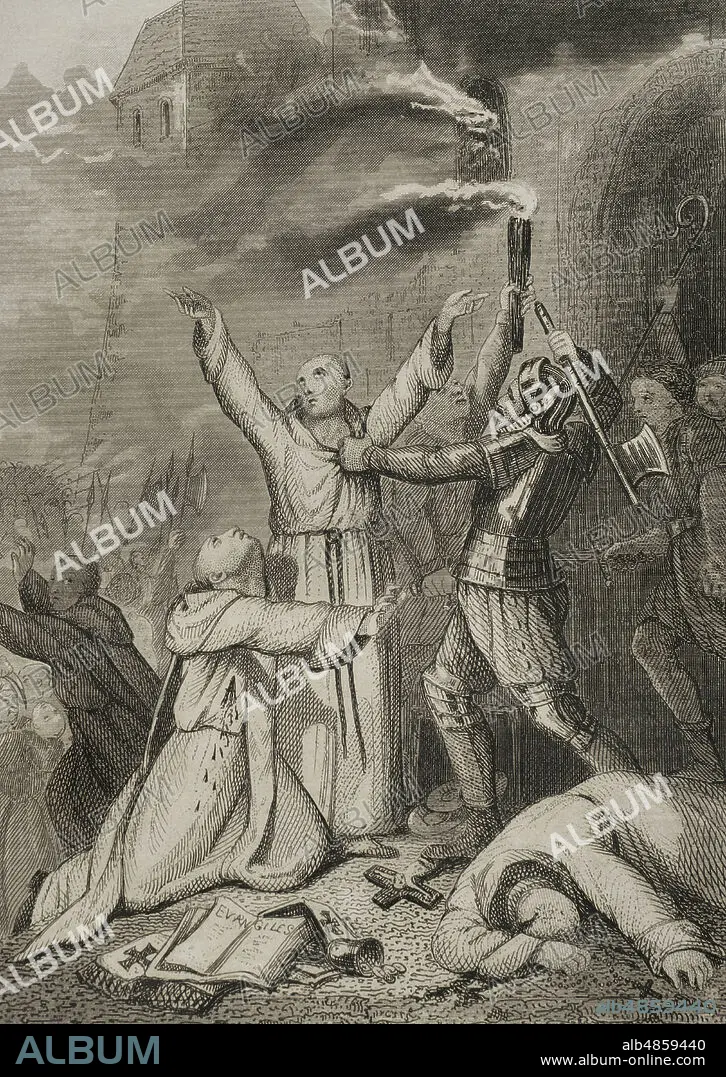
Massacre of Cashel (15 September 1647). Irish Confederate Wars (1641-1653). These were a series of civil wars in the kingdoms of Ireland, England and Scotland, all under the rule of King Charles I, which took place in Irish territory. The conflict had political, religious and ethnic aspects, being fought over issues of governance, land ownership and religious freedom. The main issues were whether Irish Catholics or British Protestants held the greater political power and owned most of the territory, and whether Ireland would be a self-governing kingdom under Charles I or subordinate to the English parliament. The papal nuncio, Giovanni Battista Rinuccini (1592-1653), and his clergy celebrated as their own the victory in 1647 of Michael Jones's Parliamentary army over Thomas Preston's (Royalist) Catholics at Dungan's Hill. Owen Roe O'Neill (1590-1649), the nuncio's general, took command of most of the troops. Murrough O'Brien (1614-1674), 1st Earl of Inchiquin, leading the Parliamentarians, seized Cahir Castle and marched into County Tipperary, reaching Cashel, whose inhabitants were fortified on the Rock of Cashel, a place more protected than the town itself. Arriving with his army at the Rock of Cashel, Inchiquin demanded surrender within the hour. The defenders offered to enter into negotiations, but Inchiquin refused. On the afternoon of 15 September 1647, the storming began. All the soldiers protecting the Rock of Cashel and most of the civilians were killed by the attackers. Among those whose throats were slit in the church on top of the Rock were twenty clergymen. Slaughter of Catholic priests. Engraving. Historia de las persecuciones políticas y religiosas en Europa (History of political and religious persecutions in Europe). Volume III. Published in Barcelona, 1864.
| Share |
|---|
 Pinterest Pinterest |
 Twitter Twitter |
 Facebook Facebook |
 Copy link Copy link |
 Email Email |
|
Add to another lightbox |
|
Add to another lightbox |


Buy this image.
Select the use:

Caption: Massacre of Cashel (15 September 1647). Irish Confederate Wars (1641-1653). These were a series of civil wars in the kingdoms of Ireland, England and Scotland, all under the rule of King Charles I, which took place in Irish territory. The conflict had political, religious and ethnic aspects, being fought over issues of governance, land ownership and religious freedom. The main issues were whether Irish Catholics or British Protestants held the greater political power and owned most of the territory, and whether Ireland would be a self-governing kingdom under Charles I or subordinate to the English parliament. The papal nuncio, Giovanni Battista Rinuccini (1592-1653), and his clergy celebrated as their own the victory in 1647 of Michael Jones's Parliamentary army over Thomas Preston's (Royalist) Catholics at Dungan's Hill. Owen Roe O'Neill (1590-1649), the nuncio's general, took command of most of the troops. Murrough O'Brien (1614-1674), 1st Earl of Inchiquin, leading the Parliamentarians, seized Cahir Castle and marched into County Tipperary, reaching Cashel, whose inhabitants were fortified on the Rock of Cashel, a place more protected than the town itself. Arriving with his army at the Rock of Cashel, Inchiquin demanded surrender within the hour. The defenders offered to enter into negotiations, but Inchiquin refused. On the afternoon of 15 September 1647, the storming began. All the soldiers protecting the Rock of Cashel and most of the civilians were killed by the attackers. Among those whose throats were slit in the church on top of the Rock were twenty clergymen. Slaughter of Catholic priests. Engraving. Historia de las persecuciones políticas y religiosas en Europa (History of political and religious persecutions in Europe). Volume III. Published in Barcelona, 1864.
Location: PRIVATE COLLECTION
Credit: Album / Prisma
Releases: ? Model Release: No - ? Property Release: No
Rights questions?
Rights questions?
Image size: 3307 × 4663 px | 44.1 MB
Print size: 28.0 × 39.5 cm | 1302.0 × 1835.8 in (300 dpi)
Keywords: 1647 • ANGER • ARMS RAISED • ARMS TO SKY • ARMY: SOLDIER • ASSASSINATION • AX • AXE • BARON OF INCHIQUIN • BATTLE AX • BATTLE AXE • BATTLE-AXE • BEHEAD • BEHEADING • BELIEF • BELIEFS • BLAST • BLAZE • BLOOD • BODY • BOOK • BOOKS • BRITISH SETTLERS • CADAVER • CASHEL OF THE KINGS • CASHEL • CATHOLIC CHURCH • CATHOLIC RELIGION • CATHOLIC • CATHOLICISM • CATHOLICS • CATHOLIC_CHURCH • CHURCH • CHURCHES • CIVIL WAR • CIVIL WARS • CLERGYMAN • CLERIC • CONFEDERATE IRELAND • CORPS • CORPSE • COUNT OF INCHIQUIN • COUNTY TIPPERARY • DEAD BODY • DEAD • DEATH • DECAPITATE • DECAPITATION • DEGOLLACION • DOCTRINE • EARL OF INCHIQUIN • ECCLESIA • ECCLESIASTICAL • EIRE • ELEVEN YEARS WAR • ENGRAVED • ENGRAVING (ARTWORK) • ENGRAVING • ENGRAVING. • ENGRAVINGS • ETCHING • EVANGELIUM • EXPLODING • EXPLOSION • FAITH • FIRE • FIRES • FLAMBEAU • FRIAR • FRIARS • FURY • GOSPEL • GOSPELS • GUERRA • HACHETTE • HANDS TO HEAVEN • HATE • HATRED • HISTORIA UNIVERSAL • HISTORIA • HISTORY • HISTORY. • HOMICIDE • HUNDRED YEARS WAR • IGLESIA • INCHIQUIN • IRELAND • IRISH CATHOLIC CONFEDERATION • IRISH CONFEDERATE WARS • KILL • KILLING • KILLS • LIBRO • LIBROS • MASSACRE OF CASHEL • MASSACRE • MONK • MURCHADH NA DOITEAIN • MURDER • MURDERING • MURDERS • MURROUGH O BRIEN • MURROUGH O'BRIEN • MURROUGH • NATIVE CATHOLICS • PEOPLE'S ARMY SOLDIER • PRIEST • PRIESTS • PRINT • PRIVATE COLLECTION • PROTESTANT SETTLERS • PROTESTANT • PROTESTANTISM • PROTESTANTS • RAGE • RAISE ARMS • RAISING ARMS • REFUGE • REFUGEE • REFUGEES • RELIGION • RELIGIOUS PERSECUTION • RELIGIOUS PERSECUTIONS • RELIGIOUS • RITE • ROCK OF CASHEL • ROCK • ROCKS • ROCKY • SACK OF CASHEL • SANGUINE • SCENE • SEPTEMBER 15 • SHELTER • SLAUGHTER • SLAUGHTERING • SOLDIER SOLDIERS • SOLDIER • SOLDIERS • SOLIDER • ST. PATRICK ROCK • ST. PATRICK'S ROCK • ST. PATRICKS ROCK • STAGE • STONE • STONES • THEATER • THEATRE • THROAT-CUTTING • TORCH • TORCHES • TROOPS • WAR • WARFARE • WARRIOR • WARRIORS • WARS OF THE THREE KINGDOMS • WARS • WRATH
