

alb1646904
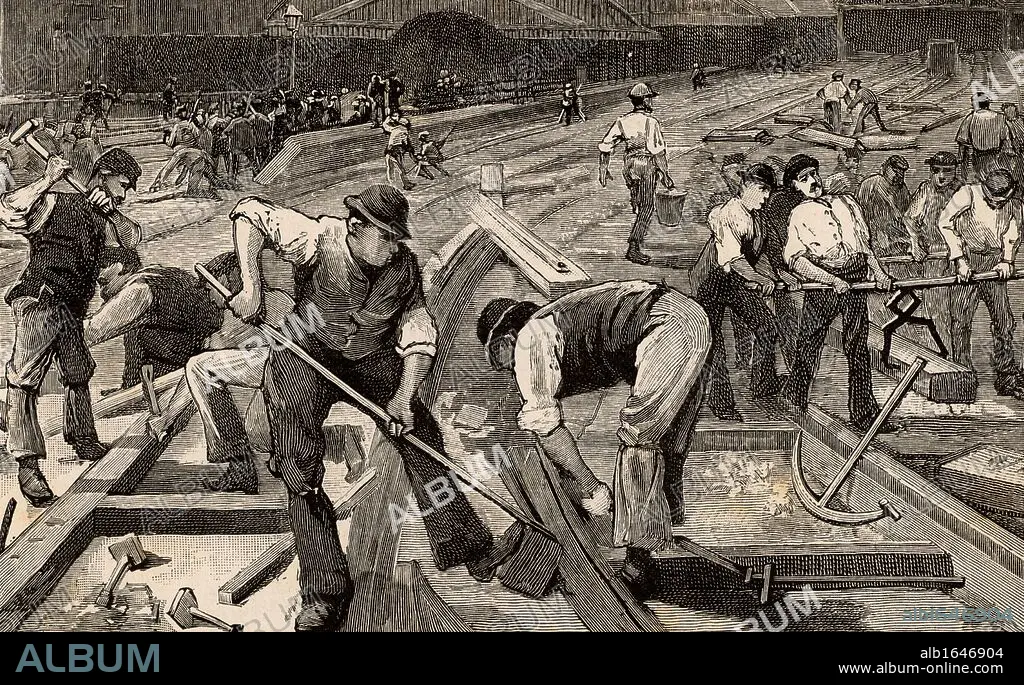
The end of broad gauge, 1892
| Share |
|---|
 Pinterest Pinterest |
 Twitter Twitter |
 Facebook Facebook |
 Copy link Copy link |
 Email Email |
|
Add to another lightbox |
|
Add to another lightbox |


Buy this image.
Select the use:

Title: The end of broad gauge, 1892
Caption: The end of broad gauge, 1892. Work in progress at Plymouth station, Devonshire, to change from broad gauge to standard gauge railway track. Isambard Kingdom Brunel (1806-1859) favoured broad gauge 7ft 1/4inch (2.2m) and designed the Great Westerrn Railway accordingly. However, in the Gauge Act of 1846 Parliament declared that all future railway track should be of the standard 4ft 8 1/2inch (1.44m) gauge introduced by George Stephenson (1781-1848) on the Liverpool & Manchester Railway. It was not until 1892 that the last broad gauge track was lifted. From "The Romance of Engineering" by Henry Frith. (London, 1892). (Photo by: Universal History Archive/UIG via Getty Images)
Category: UIG HISTORY
Credit: Album / Universal Images Group / Universal History Images \ UIG
Releases: ? Model Release: No - ? Property Release: No
Rights questions?
Rights questions?
Image size: 5100 × 3149 px | 45.9 MB
Print size: 43.2 × 26.7 cm | 2007.9 × 1239.8 in (300 dpi)
Keywords: 1892 • BRITISH CULTURE • BROAD GAUGE • BUILDING • BUILDING. • BUILDINGS • CONSTRUCTION • CONSTRUCTIONS • DAY • DESIGN • DEVONSHIRE • EDIFICIO • EDIFICIOS • END, THE • ENGINEERING • HENRY FRITH • HISTORIA UNIVERSAL • HISTORIA • HISTORY • HISTORY. • HORIZONTAL • ILLUSTRATION AND PAINTING • INDUSTRY • LARGE GROUP OF PEOPLE • OUTDOOR • OUTDOORS • OUTSIDE • PLYMOUTH • PUBLIC TRANSPORT • PUBLIC TRANSPORTATION • RAILROAD STATION • RAILROAD • RAILWAY STATION • ROMANCE OF ENGINEERING, THE • TRAIN STATION • TRAIN STATIONS • TRANSPORTE PUBLICO • UIG HISTORY • UK • WORKING
