

alb9618866
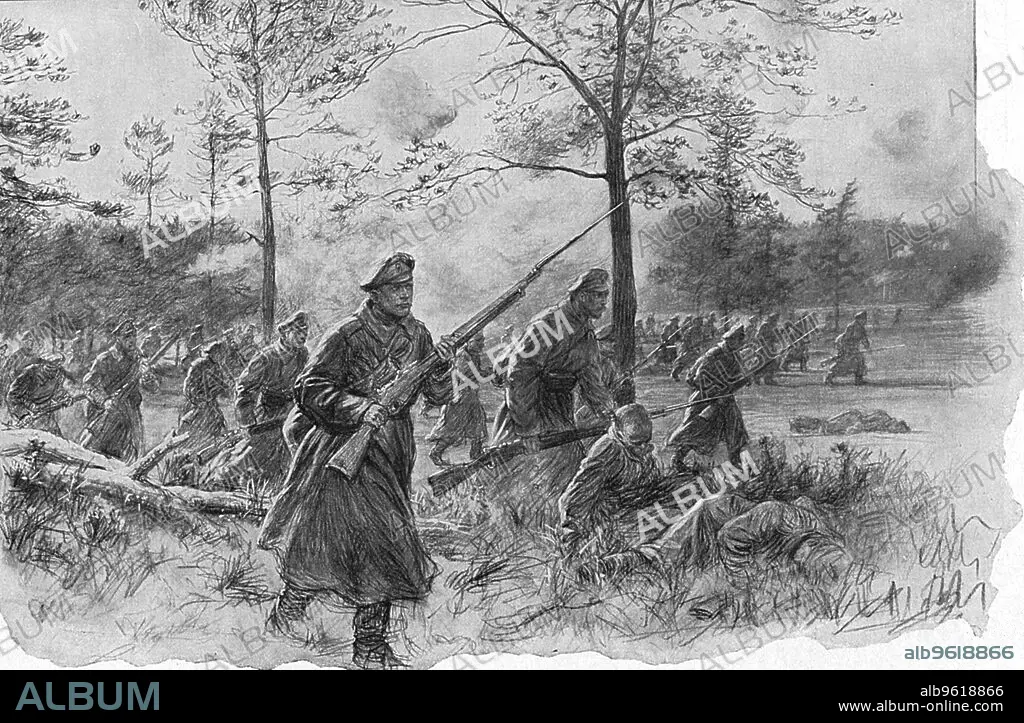
Russian infantry charging during Brusilov's offensive against Austria-Hungary, World War I, 1916. Artist: Unknown
| Share |
|---|
 Pinterest Pinterest |
 Twitter Twitter |
 Facebook Facebook |
 Copy link Copy link |
 Email Email |
|
Add to another lightbox |
|
Add to another lightbox |


Buy this image.
Select the use:

Title: Russian infantry charging during Brusilov's offensive against Austria-Hungary, World War I, 1916. Artist: Unknown
Caption: Russian infantry charging during Brusilov's offensive against Austria-Hungary, World War I, 1916. Russian general Alexei Brusilov (1856-1926) planned and commanded a major offensive against Austria-Hungary in 1916, the strategic purpose of which was to weaken the German forces on the Western front by forcing them to transfer units to the Eastern front to assist the Austro-Hungarians. The advance broke through the Austro-Hungarian lines, and was not halted until the Germans sent considerable reinforcements. Strategically it did have the effect of causing the Germans to halt their assault on Verdun, and inflicted massive casualties on the Austrians, severely weakening their contribution to the Central Powers' war effort. A feature of the offensive was Brusilov's tactics of using small elite squads of specialist troops to attack and breach identified weak points in the Austrian lines, a contrast with the more common mass assaults of the time. The Brusilov offensive marked the high point of the Russian army's contribution to the war. Afterwards the Germans advanced, and morale eroded, culminating in the Russian Revolution in 1917.
Credit: Album / Ann Ronan Picture Library/Heritage-Images
Releases: ? Model Release: No - ? Property Release: No
Rights questions?
Rights questions?
Image size: 3999 × 2615 px | 29.9 MB
Print size: 33.9 × 22.1 cm | 1574.4 × 1029.5 in (300 dpi)
Keywords: 1910S • 1ST WORLD WAR • 20TH CENTURY • ADVANCE • ADVANCING • ALEXEI BRUSILOV • ALEXEÏ • ARMES • ARMS • ATTACK • ATTACKING • BAYONET • BRUSILOV OFFENSIVE • BRUSILOV • CENTURY • CONCEPT • COUNTRY • EASTERN FRONT • FIRST WORLD WAR • FOOT SOLDIERS • FRONT • GENERAL BRUSILOV • GUERRA • GUN • GUNS • GUY • HUNDRED YEARS WAR • I WORLD WAR • INFANTERIE • INFANTRY • INFANTRYMEN • LOCATION • MALE • MAN • MEN • MILITARY PERSONNEL • MILITARY UNIFORM • PEOPLE • RIFLE • RUSIA • RUSSIA • RUSSIAN • SOLDIER • SOLDIERS • WAR • WARFARE • WARS • WEAPON • WEAPONARY • WEAPONRY • WEAPONS • WORLD WAR 1 • WORLD WAR I (1914-18) • WORLD WAR I • WORLD WAR ONE • WW1 • WWI
