

alb3662338
pipe organ
| Share |
|---|
 Pinterest Pinterest |
 Twitter Twitter |
 Facebook Facebook |
 Copy link Copy link |
 Email Email |
|
Add to another lightbox |
|
Add to another lightbox |


Buy this image.
Select the use:

Title: pipe organ
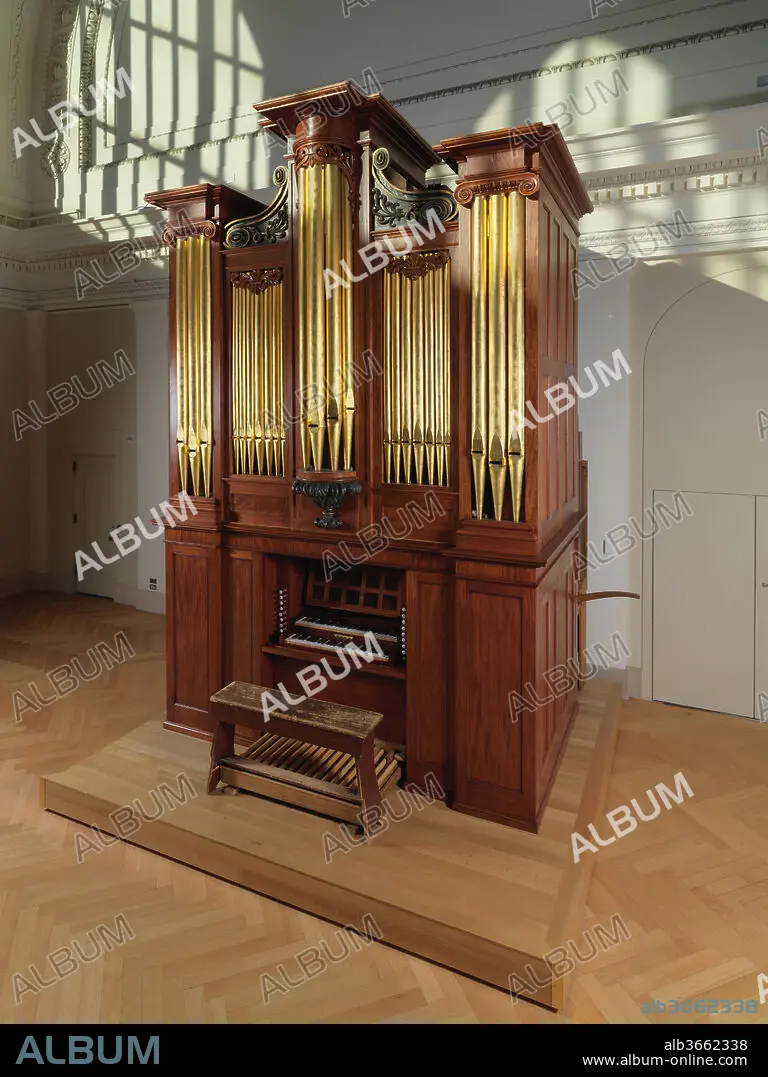
Caption: Pipe Organ. Culture: American. Dimensions: 16 ft. 1 in. × 9 ft. 3 in. × 9 ft. (490.2 × 281.9 × 274.3 cm). Maker: Thomas Appleton (American, 1785-1872). Date: 1830.
This organ is the oldest and finest extant product of the renowned Boston craftsman Thomas Appleton (1785-1872). Built in 1830, probably for South Church in Hartford, Connecticut, it was reinstalled by Emmons Howard in 1883 at Sacred Heart Church in Plains, Pennsylvania, where it was discovered unused and neglected in 1980. The organ's conservative tonal design and mahogany Greek Revival case reflect British models of the late 18th century. Standing over 15 feet tall, with gold-leafed façade pipes (diapasons), the organ comprises 16 ranks totaling 836 pipes, two 58-note manuals, and a 27-note pedalboard added when it was reinstalled (1883). Wind is supplied by hand- pumped bellows. The pipes of the upper manual are mainly enclosed in an elevated box with louvers that can be opened by means of a pedal for dynamic expression. The rest of the manual pipes are disposed above the recessed console, while the blowing apparatus and key and stop mechanisms occupy the lower part of the case. The pedal rank rests on a separate windchest behind the case. The tuning employed is Young temperament (1800) pitched at A=435.7 Hz.
Appleton's carving and joinery are particularly skillful. Before being hired by the prominent organ builder William Goodrich in 1807, Appleton had served an apprenticeship with the cabinet maker Elisha Larned, doubtless under the influence of his father, a house carpenter. Following a period of partnership with the piano makers Hayt and Alpheus Babcock, Appleton opened his own shop in 1820. In 1839 the Massachusetts Charitable Mechanic Association awarded him a gold medal, and his reputation continued to grow until he retired in 1869, by which time his numerous instruments were serving churches as distant as California and South Carolina.
Stop list:
Great (lower manual)
Open diapason 8'
Stopt diapason 8'
Stopt diapason bass 8'
Dulciana 8'
Principal 4'
Flute 4'
Twelfth 2-2/3'
Fifteenth 2'
Sesquialtera III
Trumpet treble 8'
Trumpet bass 8'
Swell (upper manual)
Open diapason 8'
Stopt diapason 8'
Stopt diapason bass 8'
(unenclosed)
Principal 4'
Hautboy 8'
Pedal
Subbass 16'
Couplers
Swell to Great
Swell to Pedal
Great to Pedal.
Technique/material: Mahogany veneer, rosewood veneer, pine, gilt, ivory, ebony, maple, walnut, chestnut
Museum: Metropolitan Museum of Art, New York, USA
Maker: Thomas Appleton (American, 1785-1872)
Credit: Album
Releases: ? Model Release: No - ? Property Release: No
Rights questions?
Rights questions?
Image size: 3150 × 4200 px | 37.9 MB
Print size: 26.7 × 35.6 cm | 1240.2 × 1653.5 in (300 dpi)
Keywords: AEROPHONE-ORGAN • AEROPHONES • ANATOMY: BONES • BODIES • BONE • BOSTON • BOSTON, MASSACHUSETTS, UNITED STATES • CHESTNUT • EBONY • GILT • IVORY • MAHOGANY VENEER, ROSEWOOD VENEER, PINE, GILT, IVORY, EBONY, MAPLE, WALNUT, CHESTNUT • MAHOGANY • MAPLE • MAPLEWOOD • MASSACHUSETTS • METROPOLITAN MUSEUM OF ART, NEW YORK, USA • MUSIC INSTRUMENTS • MUSICAL INSTRUMENTS • MUSICAL_INSTRUMENTS • NORTH AND CENTRAL AMERICA • ORGANS • PINE • PIPES • ROSEWOOD • SOFTWOOD • THOMAS APPLETON (AMERICAN, 1785-1872) • UNITED STATES • VENEER • WALNUT • WOOD
