

alb3604881
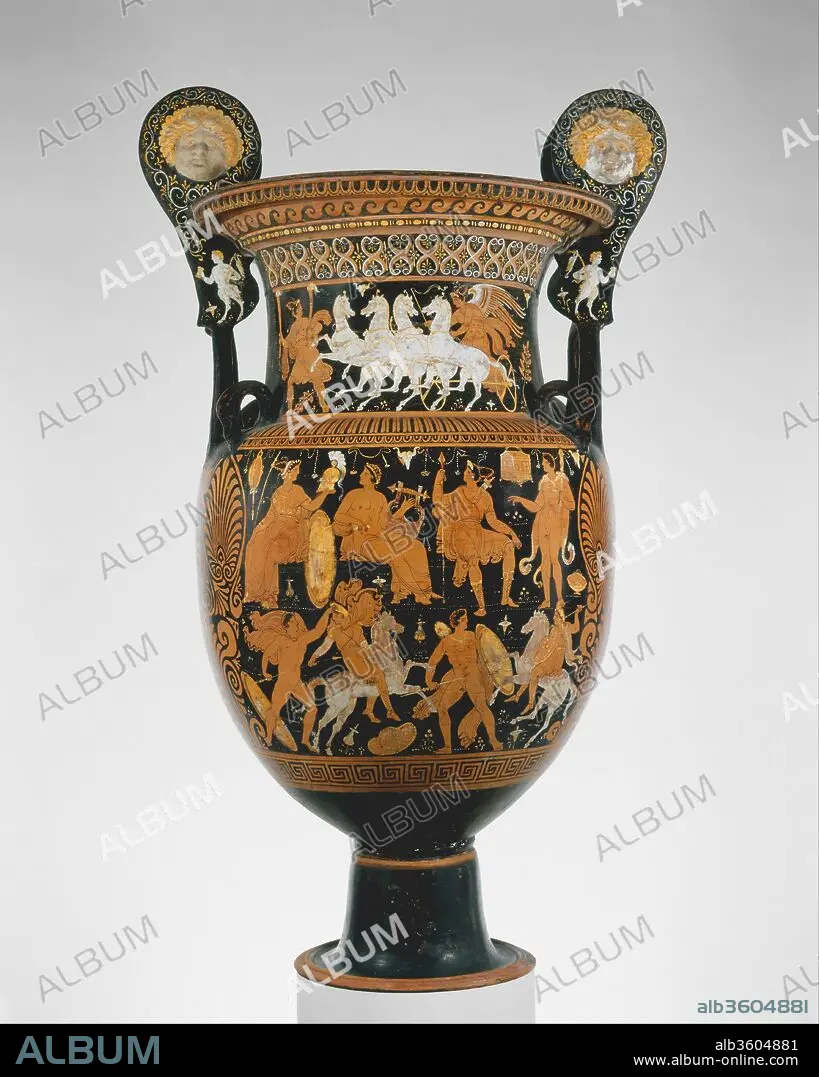
Terracotta volute-krater (vase for mixing wine and water)
| Share |
|---|
 Pinterest Pinterest |
 Twitter Twitter |
 Facebook Facebook |
 Copy link Copy link |
 Email Email |
|
Add to another lightbox |
|
Add to another lightbox |


Buy this image.
Select the use:

Title: Terracotta volute-krater (vase for mixing wine and water)
Caption: Terracotta volute-krater (vase for mixing wine and water). Culture: Greek, South Italian, Apulian. Dimensions: H. without handles: 36 1/16 in. (91.59 cm). Date: ca. 320-310 B.C..
On the body, obverse, assembly of gods above Amazonomachy
Reverse, youth in naiskos (shrine) between youths and women
On the neck, obverse, woman with torches leading Nike in chariot
On the handles, heads of Io and young Pans
The Capodimonte Painter was a follower of the Baltimore Painter, one of the most prolific late Apulian artists. Although they produced vases of diverse shapes and
sizes, these artists are associated most often with large works virtually the whole surface of which is decorated. The vase becomes a kind of compendium of iconography and patternwork. It is important to recall that antiquarians of the eighteenth century first encountered Greek vasepainting in examples such as this one, discovered in 1785 and acquired by the king of Naples for his palace at
Capodimonte. Although imperfectly understood, the vases were recognized as ancient and impressive; they quickly became objects of study and acquisition.
Technique/material: Terracotta; red-figure
Period: Hellenistic
Museum: Metropolitan Museum of Art, New York, USA
Credit: Album
Releases: ? Model Release: No - ? Property Release: No
Rights questions?
Rights questions?
Image size: 3276 × 4094 px | 38.4 MB
Print size: 27.7 × 34.7 cm | 1289.8 × 1611.8 in (300 dpi)
Keywords: CLAY • EUROPE • GREECE • GREEK AND ROMAN ART • HELLENISTIC • KRATERS • METROPOLITAN MUSEUM OF ART, NEW YORK, USA • TERRACOTTA • TERRACOTTA; RED-FIGURE • VASES • VESSELS • VOLUTE KRATERS
