

alb5471968
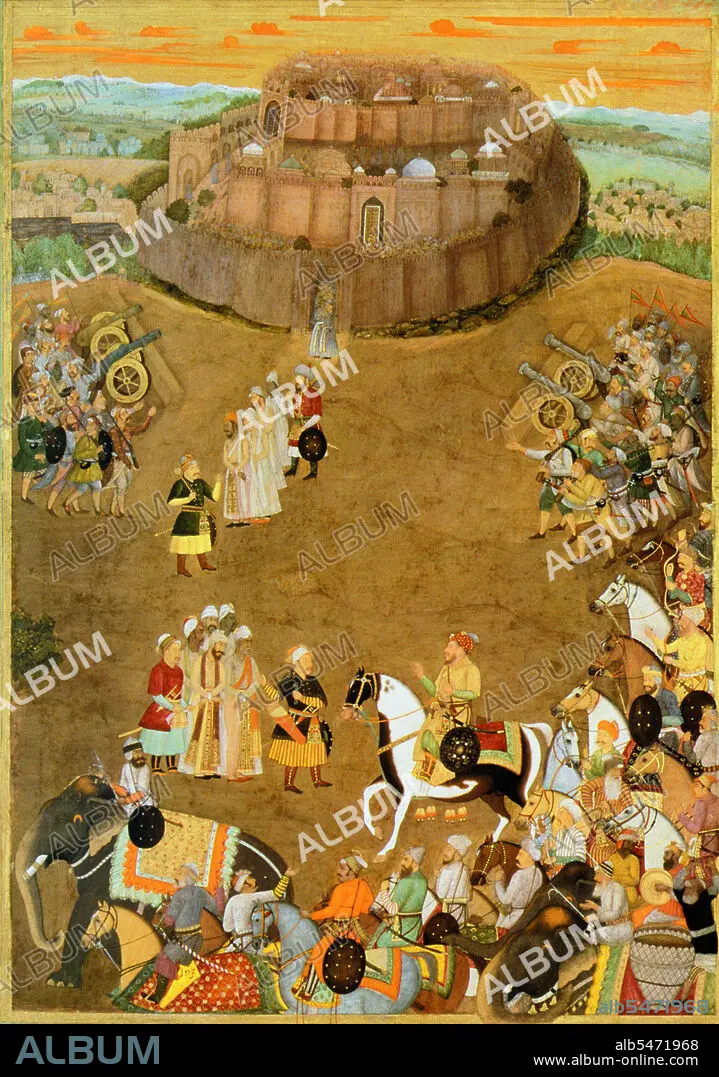
The surrender of the fort of Udgir to Mughal forces of Shah Jahan in October 1636.
| Share |
|---|
 Pinterest Pinterest |
 Twitter Twitter |
 Facebook Facebook |
 Copy link Copy link |
 Email Email |
|
Add to another lightbox |
|
Add to another lightbox |


Buy this image.
Select the use:

Title: The surrender of the fort of Udgir to Mughal forces of Shah Jahan in October 1636.
Caption: Shahab-ud-din Muhammad Khurram Shah Jahan I (1592 -1666), or Shah Jahan, from the Persian meaning 'king of the world', was the fifth Mughal ruler in India and a favourite of his legendary grandfather Akbar the Great. He is best known for commissioning the 'Phadshahnamah' as a chronicle of his reign, and for the building of the Taj Mahal in Agra as a tomb for his wife, Mumtaz Mahal. Under Shah Jahan, the Mughal Empire attained its highest union of strength and magnificence. The opulence of Shah Jahan's court and his famous Peacock Throne was the wonder of all the European travelers and ambassadors. His political efforts encouraged the emergence of large centers of commerce and crafts such as Lahore, Delhi, Agra and Ahmedabad linked by roads and waterways to distant places and ports. He moved the capital from Agra to Delhi. Under Shah Jahan's rule, the Red Fort and Jama Masjid in Delhi were built, the Shalimar Gardens of Lahore, sections of the Lahore Fort and his father's mausoleum.
Credit: Album / Pictures From History/Universal Images Group
Releases: ? Model Release: No - ? Property Release: No
Rights questions?
Rights questions?
Image size: 3530 × 5029 px | 50.8 MB
Print size: 29.9 × 42.6 cm | 1389.8 × 1979.9 in (300 dpi)
Keywords: ARMES • ARMS • ART • ARTS • ASIA • ASIAN • CANNON • ELEFANT • ELEPHANT • ELEPHANTS • EMPIRE • EQUUS CABALLUS • GUERRA • HISTORIA UNIVERSAL • HISTORIA • HISTORICAL • HISTORY • HISTORY. • HORSE'S • HORSE • HORSES HORSE • HORSES • HUNDRED YEARS WAR • INDIA • INDIAN • INDIGENOUS PEOPLES OF THE AMERICAS • INDIO • ISLAM • ISLAMIC • ISLAMISM • LEGEND • MOGHUL • MUGHAL • MUSLIM • PAINT • PAINTING • PAINTINGS • RIDING • SHAH JAHAN • WAR • WARFARE • WARS • WEAPON • WEAPONRY • WEAPONS
