

alb5143558
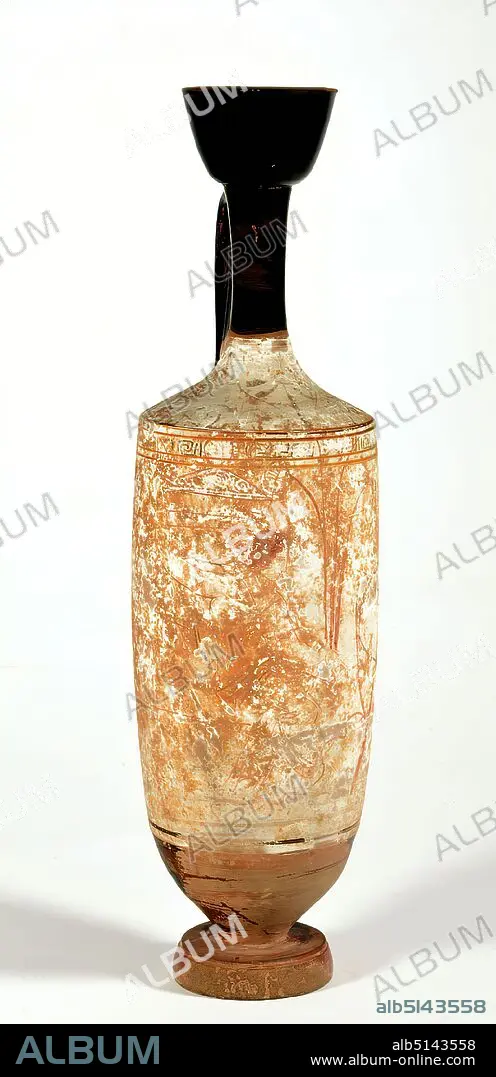
Reed Painter, Lekythos (Charon and deceased), clay, quickly turned, painted (ceramic), alternately fired, cold painting, clay, Total: Height: 42.7 cm; Diameter: 11.2 cm, ceramic, Charon, the ferryman, ship of the dead, styx, death, rich style, In Greek antiquity, all vessels for ointment or perfume oils were called lekyths; today the term is used for this special type of vessel. Around 530/520 BC, the so-called white-ground technique was developed, which probably served to imitate more valuable materials such as marble, alabaster, ostrich eggs or ivory. At the same time, it enabled a multi-colored painting. The iconography of the white-ground lekyths is dominated by depictions of graves and death. The three-figure scene shows Charon, the ferryman of the dead, who translated the deceased via the Styx into the underworld. He is standing in his barge on the bank, indicated by reeds (from which the vase painter got his name). Charon is dressed with a small coat (gr. exomís) and a cap, as found on fishermen and sailors. He is bearded. He holds a staff with both hands. In the center of the scene a woman is sitting at a grave. She is wearing a short-sleeved robe, with her raised right arm she has lifted a veil. The veil may indicate a wedding; it may have been a newly married woman or one who died before the wedding. The grave stele with a triangular gable and lateral acroteres stands on a three-tiered pedestal. On the left is a bearded man dressed with a himation. He is barefoot, his right shoulder is bare. He leans on a staff. The scene is completed towards the shoulder by a meandering band. The shoulder of the vessel is decorated with a palmette motif. The presence of soul guides, e.g. Charon, Hermes or Hypnos and Thanatos, is a frequent motif on Attic-white-ground lekyths. The figures guided and led the deceased in and on their journey to the underworld. In this depiction it is not possible to decide with certainty who the deceased is, the man or the woman lifting the.
| Share |
|---|
 Pinterest Pinterest |
 Twitter Twitter |
 Facebook Facebook |
 Copy link Copy link |
 Email Email |
|
Add to another lightbox |
|
Add to another lightbox |


Buy this image.
Select the use:

Caption:
Reed Painter, Lekythos (Charon and deceased), clay, quickly turned, painted (ceramic), alternately fired, cold painting, clay, Total: Height: 42.7 cm; Diameter: 11.2 cm, ceramic, Charon, the ferryman, ship of the dead, styx, death, rich style, In Greek antiquity, all vessels for ointment or perfume oils were called lekyths; today the term is used for this special type of vessel. Around 530/520 BC, the so-called white-ground technique was developed, which probably served to imitate more valuable materials such as marble, alabaster, ostrich eggs or ivory. At the same time, it enabled a multi-colored painting. The iconography of the white-ground lekyths is dominated by depictions of graves and death. The three-figure scene shows Charon, the ferryman of the dead, who translated the deceased via the Styx into the underworld. He is standing in his barge on the bank, indicated by reeds (from which the vase painter got his name). Charon is dressed with a small coat (gr. exomís) and a cap, as found on fishermen and sailors. He is bearded. He holds a staff with both hands. In the center of the scene a woman is sitting at a grave. She is wearing a short-sleeved robe, with her raised right arm she has lifted a veil. The veil may indicate a wedding; it may have been a newly married woman or one who died before the wedding. The grave stele with a triangular gable and lateral acroteres stands on a three-tiered pedestal. On the left is a bearded man dressed with a himation. He is barefoot, his right shoulder is bare. He leans on a staff. The scene is completed towards the shoulder by a meandering band. The shoulder of the vessel is decorated with a palmette motif. The presence of soul guides, e.g. Charon, Hermes or Hypnos and Thanatos, is a frequent motif on Attic-white-ground lekyths. The figures guided and led the deceased in and on their journey to the underworld. In this depiction it is not possible to decide with certainty who the deceased is, the man or the woman lifting the
Personalities:
Credit:
Album / quintlox
Releases:
Image size:
2092 x 4320 px | 25.9 MB
Print size:
17.7 x 36.6 cm | 7.0 x 14.4 in (300 dpi)
Keywords:
ALABASTER • ALTERNATELY FIRED • AND • AROUND 530 • ATTIC-WHITE-GROUND LEKYTHS • BANK • BANKING • BARE • BAREFOOT • BARGE • BARGES • BEARDED MAN DRESSED • BEARDED • BETROTHAL • BOATMAN • BOATMEN • CAP • CENTER • CERAMIC • CERAMICS • CERTAINTY • CHARON • CHARON, GREEK MYTH • CLAY • CLOTHING: HIMATION • COLD PAINTING • COMPLETED TOWARDS • CONCEIVABLE • CONTEMPORARY • CONTRACTION OF MARRIAGE • COVER (CLOTHES) • DEAD • DEATH • DECEASED VIA • DECEASED • DECIDE • DECORATED • DEPICTION • DEPICTIONS • DEVELOPED • DIAMETER • DIED • DOMINATED • DRESSED • E. G • ENABLED • EXOMIS • FEMALES • FERRYMAN • FIGURES GUIDED • FISHERMEN • FREQUENT MOTIF • GR • GRAVE STELE • GRAVE • GRAVES • GREEK ANTIQUITY • HAND • HAND. • HANDS • HERMES • HIMATION • HIMATION, GEEK VEIL • HOLDS • HUSBAND • HYMATION, CLOAK • HYMATION, GREEK CLOAK • HYPNOS • ICONOGRAPHY • IMITATE • INDICATE • INDICATED • IVORY • JOURNEY • JOURNEYMAN'S TRAVEL • JOURNEYMAN'S TRAVELS • KERAMEIKOS • LATERAL ACROTERES STANDS • LEANS • LED • LEFT • LEISURE • LEKYTHOS • LEKYTHS • LIFTED • LOSS • MAN • MARBLE • MARBRE • MARMOL • MARRIAGE CEREMONY • MARRIAGE • MEANDERING BAND • MEN • MUJER • MUJERES • MULTI-COLORED PAINTING • NAME • NEWLY MARRIED WOMAN • OINTMENT • OSTRICH EGGS • PAINTED • PALMETTE MOTIF • PERFUME OILS • POSSIBLE • POTTERIES • POTTERY • PRESENCE • QUICKLY TURNED • RAISED RIGHT ARM • REALM • REED PAINTER • REEDS • RICH STYLE • RIGHT SHOULDER • SAILORS • SCENE • SEATED • SERVED • SHIP • SHORT-SLEEVED ROBE • SHOULDER • SIT DOWN • SIT • SITS • SITTING • SMALL COAT • SOUL GUIDES • SPECIAL TYPE • STAFF • STANDING • STONEWARE • STYX • TERM • TERRA COTTA • TERRACOTA • TERRACOTTA • THANATOS • THE • THREE-FIGURE SCENE • THREE-TIERED PEDESTAL • THRIP • THUS • TIME • TO TRAVEL • TODAY • TRANSLATED • TRAVEL • TRAVELING • TRAVELS • TRIANGULAR GABLE • TRIP • TRIPS • UNDERWORLD • VALUABLE MATERIALS • VASE PAINTER GOT • VEIL (CLOTHING) • VEIL • VESSEL • VESSELS • VOYAGE • WEARING • WEDDING • WEDDINGS • WHITE-GROUND LEKYTHS • WHITE-GROUND TECHNIQUE • WILL TRANSLATE • WOMAN LIFTING • WOMAN REVEALS • WOMAN WOMEN • WOMAN'S • WOMAN • WOMAN. • WOMANS • WOMEN'S • WOMEN • WOMENS • YOUNG BRIDE MOURNING
