

alb5144731
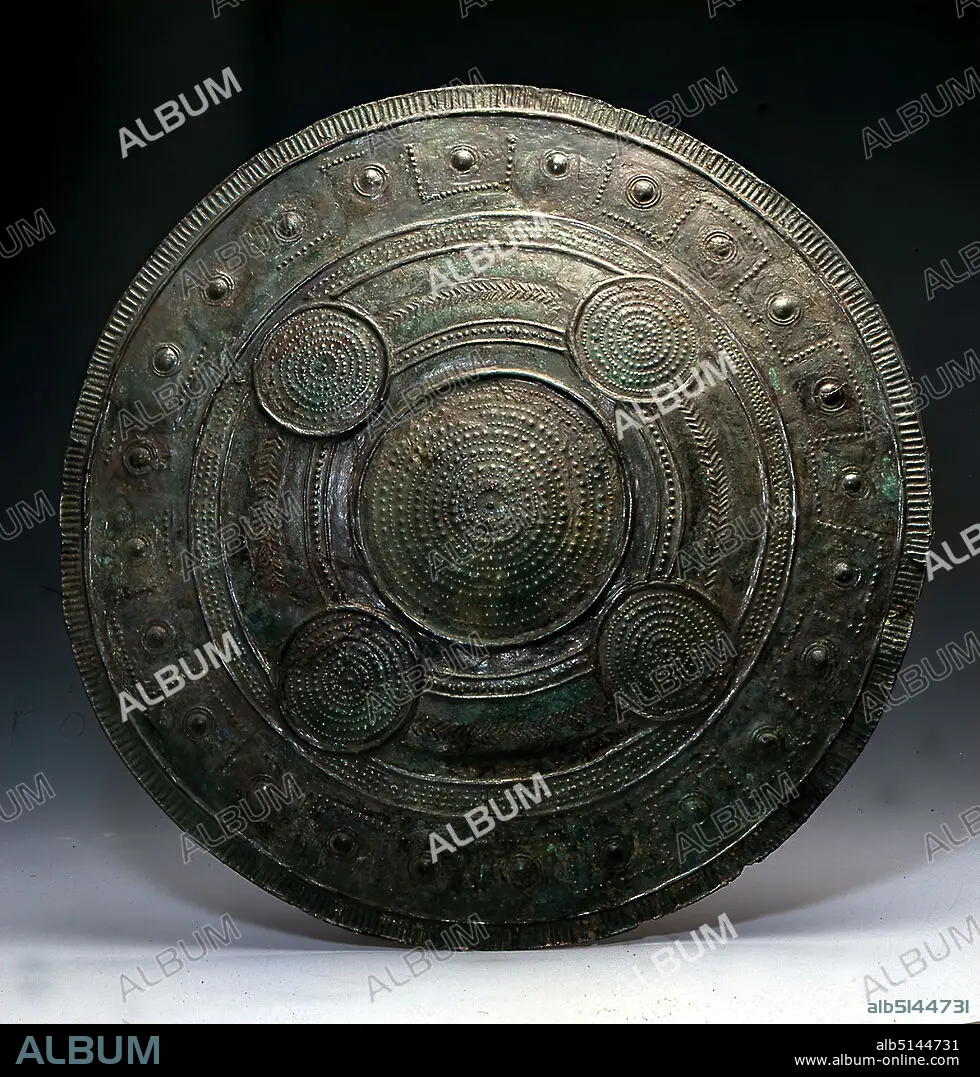
Round Shield, Bronze, chased, Bronze, Total: Diameter: 56.5 cm, Weapons (warfare/military), Armor (warfare/military), Burial objects, Ritual objects and accessories, Antiquity, The flattened shield has a more strongly curved hump in the center. The decoration is chased. On the large shield hump seven rows of dots alternate with six rows of humps. There is a hole in the central circular hump. The same ornamental system is repeated in four circular fields, each of which is surrounded by a strong border strip and arranged in such a way that together with the hump (lat. umbo) they form a five-point arrangement. At the top it cuts through a line of humps running around the entire shield and also framed by border strips, at the bottom they protrude into an identical circular line filled with three rows of smaller humps. Between the four circular fields are angular rows or abstract branches. Towards the edge follows a wide zone of simple meandering, consisting of small humps, in whose individual sections there are large humps surrounded by two circular lines. From this, the border strip is separated by a strip with rays. The earliest bronze shields appear during the late 8th century BC in southern Etruria. They are the typical feature of rich Etruscan chamber tombs and document the transition from the Villanova culture to the Etruscans. The majority of shields from this period were found in warrior tombs with extensive armor.
| Share |
|---|
 Pinterest Pinterest |
 Twitter Twitter |
 Facebook Facebook |
 Copy link Copy link |
 Email Email |
|
Add to another lightbox |
|
Add to another lightbox |


Buy this image.
Select the use:

Caption: Round Shield, Bronze, chased, Bronze, Total: Diameter: 56.5 cm, Weapons (warfare/military), Armor (warfare/military), Burial objects, Ritual objects and accessories, Antiquity, The flattened shield has a more strongly curved hump in the center. The decoration is chased. On the large shield hump seven rows of dots alternate with six rows of humps. There is a hole in the central circular hump. The same ornamental system is repeated in four circular fields, each of which is surrounded by a strong border strip and arranged in such a way that together with the hump (lat. umbo) they form a five-point arrangement. At the top it cuts through a line of humps running around the entire shield and also framed by border strips, at the bottom they protrude into an identical circular line filled with three rows of smaller humps. Between the four circular fields are angular rows or abstract branches. Towards the edge follows a wide zone of simple meandering, consisting of small humps, in whose individual sections there are large humps surrounded by two circular lines. From this, the border strip is separated by a strip with rays. The earliest bronze shields appear during the late 8th century BC in southern Etruria. They are the typical feature of rich Etruscan chamber tombs and document the transition from the Villanova culture to the Etruscans. The majority of shields from this period were found in warrior tombs with extensive armor.
Credit: Album / quintlox
Releases: ? Model Release: No - ? Property Release: No
Rights questions?
Rights questions?
Image size: 4133 × 4320 px | 51.1 MB
Print size: 35.0 × 36.6 cm | 1627.2 × 1700.8 in (300 dpi)
Keywords: ABSTRACT BRANCHES • ACCESSORIES • ACCESSORY • ANCIENT WORLD • ANGULAR ROWS • ANTIGUEDAD • ANTIQUITIES • ANTIQUITY • ARMES • ARMOR • ARMS • ARRANGED • ARTFORM: BRONZEWORK • BACKSIDE • BORDER STRIP • BORDER STRIPS • BOTTOM • BRONCE • BRONZE BRASS • BRONZE • BRONZES • BUCKLER • BURIAL OBJECTS • BUTT • CENTER • CENTRAL CIRCULAR HUMP • CHASED • CONSISTING • CORTES • CUTS • DECORATION • DECORATIONS • DIAMETER • DOCUMENT • DOTS ALTERNATE • EARLIEST BRONZE SHIELDS • EDGE FOLLOWS • ENTIRE SHIELD • ETRUSCANS • EXTENSIVE ARMOR • FIVE-POINT ARRANGEMENT • FLATTENED SHIELD • FORM • FOUR CIRCULAR FIELDS • FRAMED • GUERRA • HOLE • HUMP • HUMPS RUNNING • HUMPS • HUNDRED YEARS WAR • IDENTICAL CIRCULAR LINE FILLED • INDIVIDUAL SECTIONS • LARGE HUMPS SURROUNDED • LARGE SHIELD HUMP SEVEN ROWS • LAT • LATE 8TH CENTURY BC • LINE • MAJORITY • MILITARY • ORNAMENTAL SYSTEM • PERIOD • PROTRUDE • RAYS • REPEATED • RICH ETRUSCAN CHAMBER TOMBS • RITUAL OBJECTS • ROUND SHIELD = BUCKLER • ROUND SHIELD • SEPARATED • SHIELDS • SIMPLE MEANDERING • SIX ROWS • SMALL HUMPS • SMALLER HUMPS • SOUTHERN ETRURIA • STRIP • STRONG BORDER STRIP • STRONGLY CURVED HUMP • SURROUNDED • THREE ROWS • TOGETHER • TOP • TOWARDS • TRANSITION • TWO CIRCULAR LINES • TYPICAL FEATURE • UMBO • VILLANOVA CULTURE • WAR • WARFARE • WARRIOR TOMBS • WARS • WAY • WEAPON • WEAPONRY • WEAPONS • WIDE ZONE
