

alb3798866
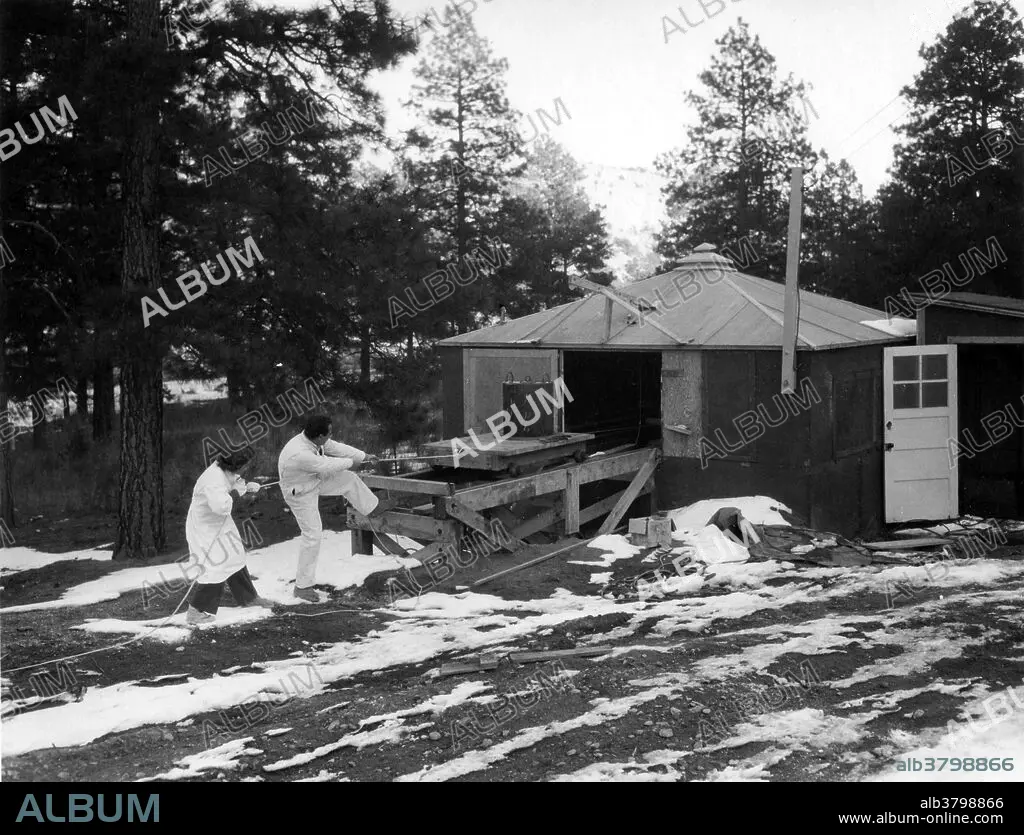
RaLa Bayo Canyon Test Site, Los Alamos
| Share |
|---|
 Pinterest Pinterest |
 Twitter Twitter |
 Facebook Facebook |
 Copy link Copy link |
 Email Email |
|
Add to another lightbox |
|
Add to another lightbox |


Buy this image.
Select the use:

Title: RaLa Bayo Canyon Test Site, Los Alamos
Caption: Remote handling of a kilo curie source of radiolanthanum. The RaLa Experiment, or RaLa, was a series of tests during and after the Manhattan Project designed to study the behavior of converging shock waves to achieve the spherical implosion necessary for compression of the plutonium pit of the nuclear weapon. The experiment used significant amounts of a short-lived radioisotope lanthanum-140, a potent source of gamma radiation; the RaLa is a contraction of Radioactive Lanthanum. The method was proposed by Robert Serber and developed by the team of Bruno Rossi. The experiments were performed in the Bayo Canyon in a location designated TA-10 ("Technical Area 10") in Los Alamos County and close to the border with Santa Fe County, northeast from the Los Alamos townsite. The site had several fixed structures. The lanthanum-140 was being isolated in a radiochemistry building, TA-10-1. The TA-10-21 was the personnel building. There were four firing sites. The instruments for firing the explosives and recording the data were housed in two detonation control buildings (TA-10-13 and TA-10-15).
Category: Science: History
Credit: Album / Science Source / Los Alamos National Laboratory
Releases: ? Model Release: No - ? Property Release: No
Rights questions?
Rights questions?
Image size: 3600 × 2750 px | 28.3 MB
Print size: 30.5 × 23.3 cm | 1417.3 × 1082.7 in (300 dpi)
Keywords: 1940'S • 20 20TH XX XXTH TWENTIETH CENTURY • 20 XX TWENTIETH CENTURY • 20TH CENTURY • 20TH • A-BOMB • ATOM BOMB • ATOMIC BOMB RESEARCH • ATOMIC BOMB • ATOMIC RESEARCH • BW • CELEBRITIES • CELEBRITY • EVENT • EVENTS • FAMOUS PEOPLE • FAMOUS • HILL, THE • HISTORIC • HISTORICAL • HISTORY • II WORLD WAR • IMPORTANT • LANL • LOS ALAMOS LABORATORY • LOS ALAMOS NATIONAL LABORATORY • LOS ALAMOS SCIENTIFIC LABORATORY • LOS ALAMOS • MALE • MAN • MANHATTAN PROJECT • MEN • NOTABLE • NUCLEAR BOMB RESEARCH • NUCLEAR BOMB • NUCLEAR RESEARCH • PHOTO • PHOTOGRAPH • RADIOACTIVE LANTHANUM • RALA BAYO CANYON • REMOTE HANDLING • RESEARCH & DEVELOPMENT • RESEARCH AND DEVELOPMENT • RESEARCH • SCIENCE • SCIENCE: HISTORY • SECOND WORLD WAR • SIEGE • SITE Y • SITE • TA-10 • TECHNICAL AREA 10 • TECHNOLOGY • TEST SITE • TOP SECRET • TWENTIETH CENTURY • WAR (WORLD WORLD 2) • WEAPON RESEARCH • WELL-KNOWN • WORLD WAR 2 • WORLD WAR II • WORLD WAR TWO • WW II • WW2 • WWII
