

alb3822875
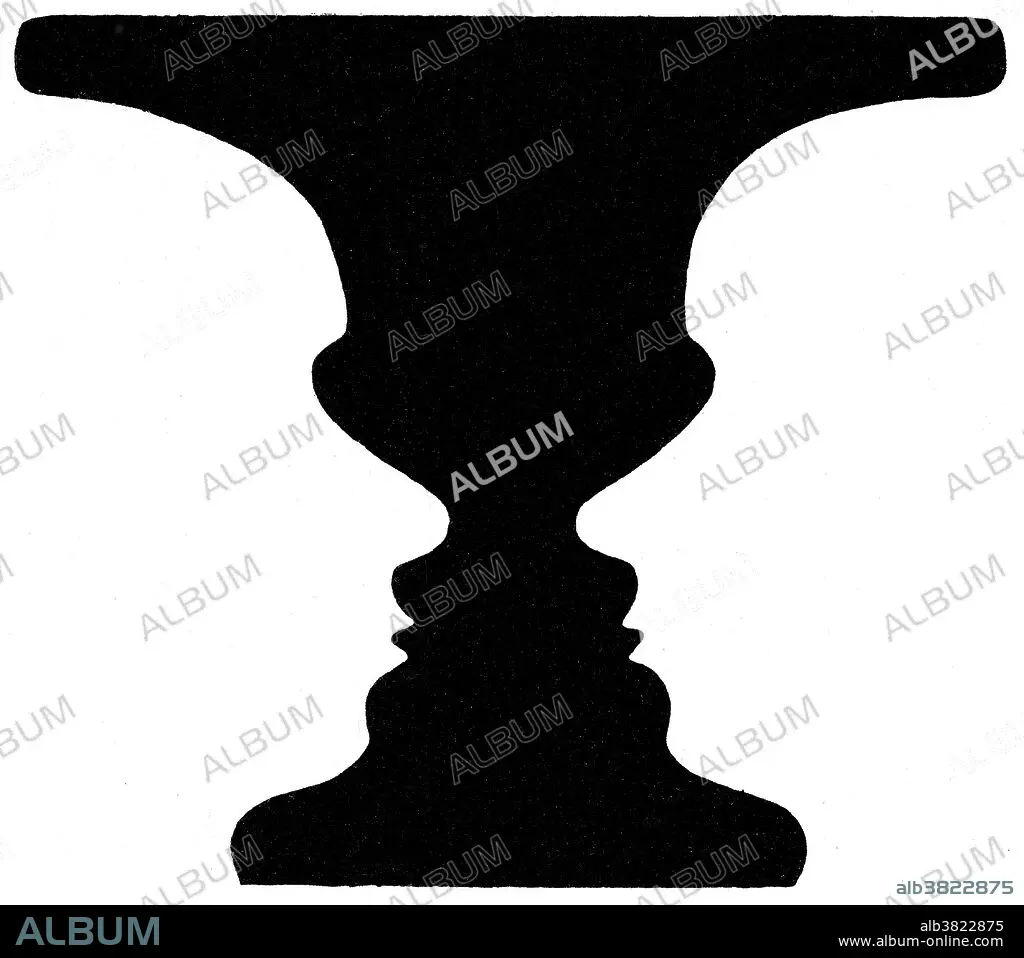
Optical Illusion, Rubin's Vase, 1915
| Share |
|---|
 Pinterest Pinterest |
 Twitter Twitter |
 Facebook Facebook |
 Copy link Copy link |
 Email Email |
|
Add to another lightbox |
|
Add to another lightbox |


Buy this image.
Select the use:

Title: Optical Illusion, Rubin's Vase, 1915
Caption: Rubin's vase is a famous set of ambiguous or bi-stable (i.e., reversing) two-dimensional forms developed around 1915 by the Danish psychologist Edgar Rubin. We see the image: either as two white faces looking at each other in front of a black background, or as a black vase on a white background. The shape of the image depends on the side of the line we chose as part of the figure. This is important because the human brain has in general just one object in the field of perception and the other objects go into the background of perception. The reversal you perceive may happen because you shift your attention from one contour to another or from one color to another.
Category: Science: History
Credit: Album / Science Source / New York Public Library
Releases: ? Model Release: No - ? Property Release: No
Rights questions?
Rights questions?
Image size: 4500 × 3978 px | 51.2 MB
Print size: 38.1 × 33.7 cm | 1771.7 × 1566.1 in (300 dpi)
Keywords: 1915 • 20 20TH XX XXTH TWENTIETH CENTURY • 20 XX TWENTIETH CENTURY • 20TH CENTURY • 20TH • AMBIGUOUS IMAGE • ART • ARTWORK • BW • COGNITIVE ILLUSIONS • DANISH • DRAWING • EDGAR RUBIN • FALSE PERSPECTIVE • FIGURE-GROUND VASE • HISTORIC • HISTORICAL • HISTORY • ILLUSTRATION • ILLUSTRATIONS • ILUSTRATION • MISLEADING IMAGE • OPTIC ILLUSION • OPTICAL ILLUSION • PERCEPTUAL ILLUSION • PERSPECTIVE • PHENOMENA • PHENOMENON • PSYCHOLOGIST (MALE) • PSYCHOLOGIST • PSYCHOLOGY • RUBIN FACE • RUBIN'S VASE • RUBIN • RUBINS VASE • SCIENCE • SCIENCE: HISTORY • TWENTIETH CENTURY • VISUAL ILLUSION • WHITE BACKGROUND
