

alb5478859
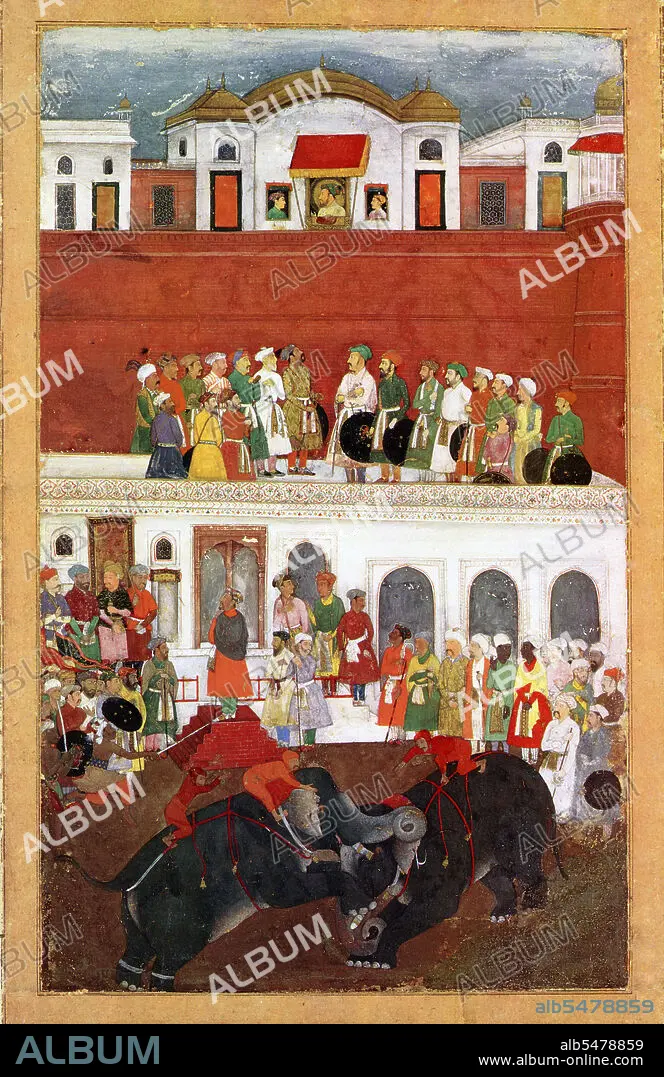
A miniature painting of Shah Jahan the Magnificent and two of his sons watching from windows as elephants battle in the courtyard of the Red Fort in Delhi.
| Share |
|---|
 Pinterest Pinterest |
 Twitter Twitter |
 Facebook Facebook |
 Copy link Copy link |
 Email Email |
|
Add to another lightbox |
|
Add to another lightbox |


Buy this image.
Select the use:

Title: A miniature painting of Shah Jahan the Magnificent and two of his sons watching from windows as elephants battle in the courtyard of the Red Fort in Delhi.
Caption: Shahab-ud-din Muhammad Khurram Shah Jahan I (1592-1666) was the emperor of the Mughal Empire in India from 1628 until 1658. The name Shah Jahan comes from Persian meaning 'king of the world'. He was the fifth Mughal ruler after Babur, Humayun, Akbar and Jahangir. While young, he was a favourite of his legendary grandfather Akbar the Great. Even while very young, he was pointed out to be the successor to the Mughal throne after the death of Emperor Jahangir. He succeeded to the throne upon his father's death in 1627 and is considered to be one of the greatest Mughals. His reign has been called the Golden Age of Mughals. Like Akbar, he was eager to expand his empire. In 1658 he fell ill, and was confined by his son Emperor Aurangzeb in the citadel of Agra until his death in 1666.
Credit: Album / Pictures From History/Universal Images Group
Releases: ? Model Release: No - ? Property Release: No
Rights questions?
Rights questions?
Image size: 3380 × 5211 px | 50.4 MB
Print size: 28.6 × 44.1 cm | 1330.7 × 2051.6 in (300 dpi)
Keywords: ART • ARTS • ASIA • ASIAN • COURTESANS • ELEFANT • ELEPHANT • ELEPHANTS • HISTORIA UNIVERSAL • HISTORIA • HISTORICAL • HISTORY • HISTORY. • INDIA • INDIAN • INDIGENOUS PEOPLES OF THE AMERICAS • INDIO • ISLAM • ISLAMIC • ISLAMISM • JAMA MASJID • LEGEND • MUSLIM • PACHYDERM • PAINT • PAINTING • PAINTINGS • SHAH JEHAN
