

alb4008796
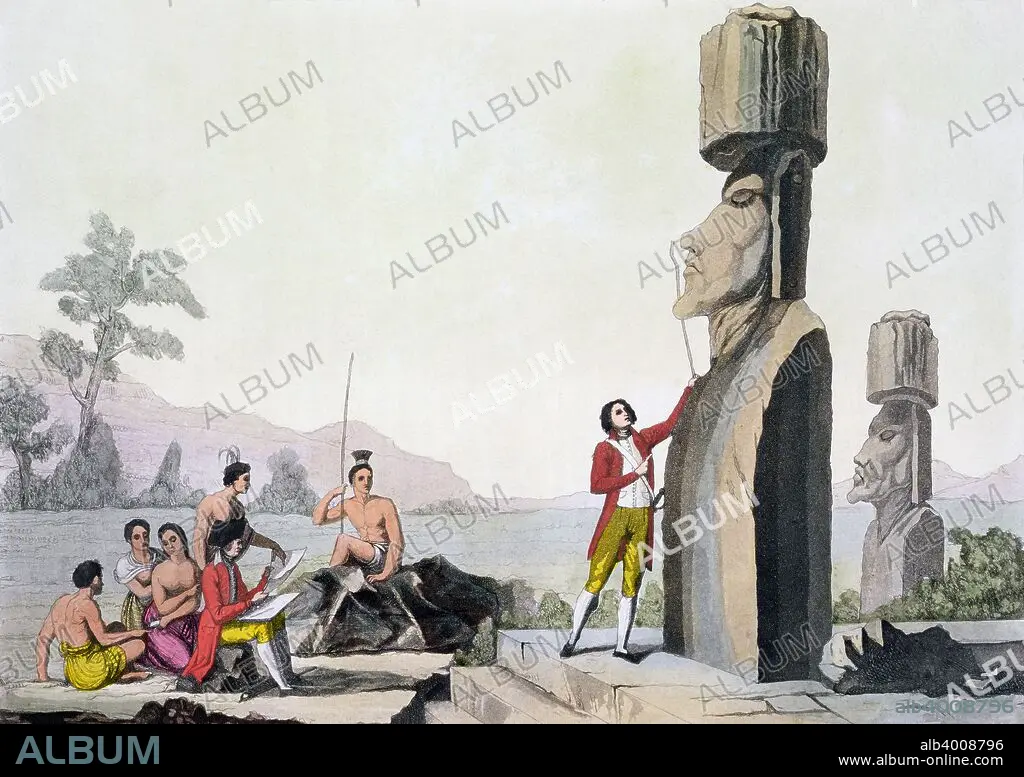
Statues on Easter Island, late 18th century. Artist: C Bottigella
| Share |
|---|
 Pinterest Pinterest |
 Twitter Twitter |
 Facebook Facebook |
 Copy link Copy link |
 Email Email |
|
Add to another lightbox |
|
Add to another lightbox |


Buy this image.
Select the use:

Title: Statues on Easter Island, late 18th century. Artist: C Bottigella
Caption: Statues on Easter Island, late 18th century. Known as Moai, these large stone statues in human form are carved from a type of volcanic rock known as tuff. The statues were carved at a quarry on the island between c1000 and 1600 and transported some distance to the sites where they were to stand. The cult of carving Moai seems to have been abandoned quite abruptly as many of the figures, both finished and unfinished, remain in the quarry. The population of Easter Island declined from the 14th or 15th century, possibly due to the environmental consequences of deforestation, which led to soil erosion and meant that the inhabitants no longer had the material to build fishing boats. War, disease and the consequences of contact with Europeans from the early 18th century accelerated the decline and today the islanders' ancient culture is forgotten and the significance of the mysterious Moai within it is uncertain. From an account of Captain James Cook's visit to the island in 1774.
Credit: Album / Heritage Images / Historica Graphica Collection
Releases: ? Model Release: No - ? Property Release: No
Rights questions?
Rights questions?
Image size: 4976 × 3520 px | 50.1 MB
Print size: 42.1 × 29.8 cm | 1959.1 × 1385.8 in (300 dpi)
Keywords: 18TH CENTURY • 18TH CENTURY, THE • 18TH CENTURY. • 18TH • ARCHAEOLOGY • ARCHEOLOGY • ART • ARTS • BOTTIGELLA • C BOTTIGELLA • C • CAPTAIN COOK • CAPTAIN JAMES COOK • CAPTAIN JAMES • CENTURY • CHILE • COLOR • COLOUR • CONCEPT • COOK • DISCOVERER • EASTER ISLAND • EIGHTEENTH CENTURY • ENGRAVING • EXAMINING • EXPLORATION • EXPLORER • FIGURE • FLUSH • GUY • ISLAND EASTER ISLAND • JAMES COOK • JAMES • LOCATION • MALE • MAN • MEN • MOAI • MYSTERIOUS • MYSTERY • NATIVE • PEOPLE • POLYNESIA • POLYNESIAN • RAPA NUI • RAPA-NUI • RAPANUI • RELIGION • RELIGIOUS • RESEARCHER (MALE) • RESEARCHER • SCULPTURE • SOUTH AMERICA • STATUA • STATUE • STATUES • STUDYING • VALPARAISO • XVIII CENTURY
