

alb9041956
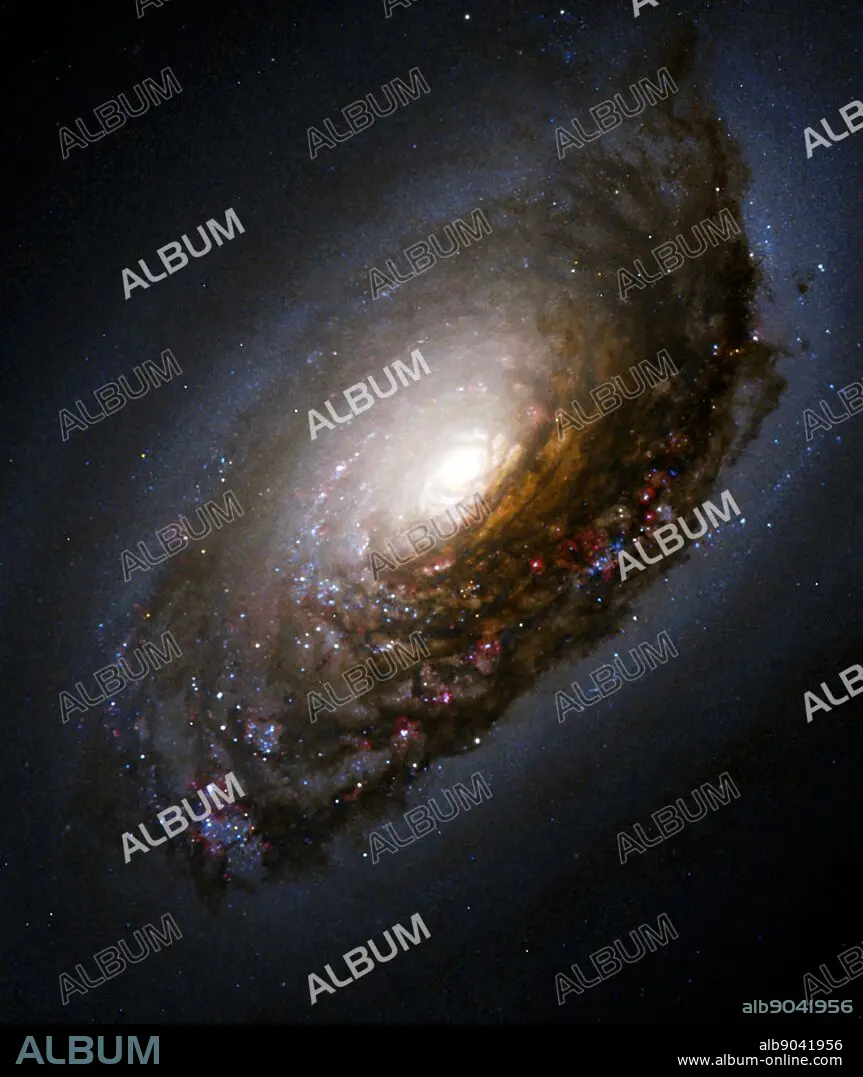
Dust Band Around the Nucleus of 'Black Eye Galaxy' M64. A collision of two galaxies has left a merged star system with an unusual appearance as well as bizarre internal motions. Messier 64 (M64) has a spectacular dark band of absorbing dust in front of the galaxy's bright nucleus, giving rise to its nicknames of the 'Black Eye' or 'Evil Eye' galaxy. M64 resides roughly 17 million light-years from Earth. At first glance, M64 appears to be a fairly normal pinwheel-shaped spiral galaxy. As in the majority of galaxies, all of the stars in M64 are rotating in the same direction, clockwise as seen in the Hubble image. However, detailed studies in the 1990's led to the remarkable discovery that the interstellar gas in the outer regions of M64 rotates in the opposite direction from the gas and stars in the inner regions.
| Share |
|---|
 Pinterest Pinterest |
 Twitter Twitter |
 Facebook Facebook |
 Copy link Copy link |
 Email Email |
|
Add to another lightbox |
|
Add to another lightbox |


Buy this image.
Select the use:

Caption: Dust Band Around the Nucleus of 'Black Eye Galaxy' M64. A collision of two galaxies has left a merged star system with an unusual appearance as well as bizarre internal motions. Messier 64 (M64) has a spectacular dark band of absorbing dust in front of the galaxy's bright nucleus, giving rise to its nicknames of the 'Black Eye' or 'Evil Eye' galaxy. M64 resides roughly 17 million light-years from Earth. At first glance, M64 appears to be a fairly normal pinwheel-shaped spiral galaxy. As in the majority of galaxies, all of the stars in M64 are rotating in the same direction, clockwise as seen in the Hubble image. However, detailed studies in the 1990's led to the remarkable discovery that the interstellar gas in the outer regions of M64 rotates in the opposite direction from the gas and stars in the inner regions.
Credit: Album / NASA/Hubble Heritage Team/(AURA/STScI)/World History Archive
Releases: ? Model Release: No - ? Property Release: No
Rights questions?
Rights questions?
Image size: 3900 × 4630 px | 51.7 MB
Print size: 33.0 × 39.2 cm | 1535.4 × 1822.8 in (300 dpi)
Keywords: ASTRONOMIA • ASTRONOMY
