

alb4846062
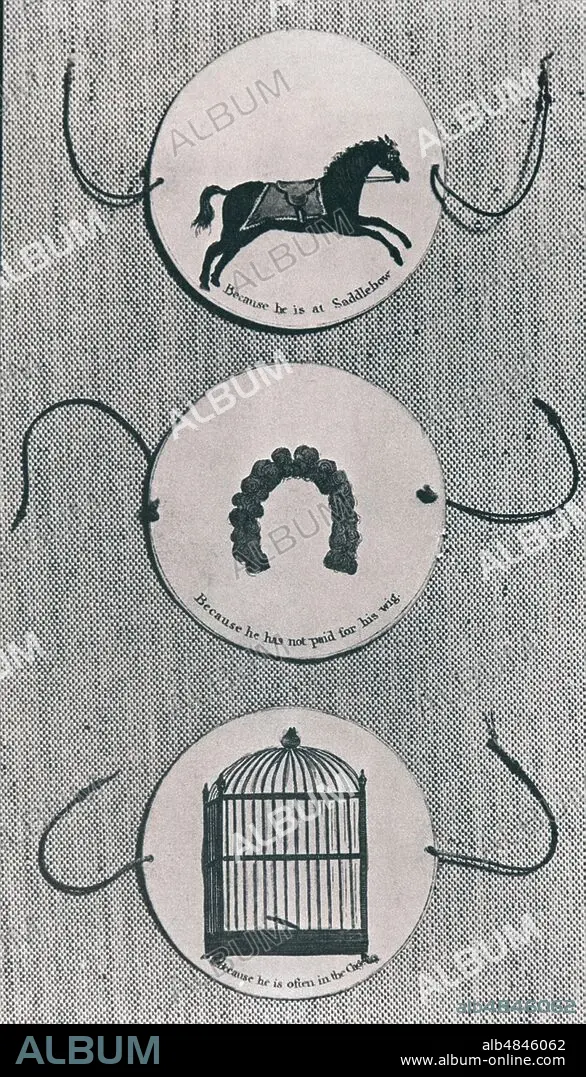
HISTORY OF PHOTOGRAPHY AND CINEMA The 'toy' called taumatropium, described by the British physician dr. John Ayrton Paris (1785-24 December 1856), exploits the phenomenon of image persistence on the retina to amaze the little ones, but also the great ones of the early nineteenth century, completing 'magically' the half images that are on the two sides of a cardboard disc (see the other side in FSNgilardi_52743. jpg). When the lines are rotated quickly with the fingers, the two images seem to merge into one. In the figure above the horse appears the acrobat, in the middle the wig covers the head of the bald, at the bottom of the cage encloses the bird. United Kingdom,1825
| Share |
|---|
 Pinterest Pinterest |
 Twitter Twitter |
 Facebook Facebook |
 Copy link Copy link |
 Email Email |
|
Add to another lightbox |
|
Add to another lightbox |


Buy this image.
Select the use:

Title: HISTORY OF PHOTOGRAPHY AND CINEMA The 'toy' called taumatropium, described by the British physician dr. John Ayrton Paris (1785-24 December 1856), exploits the phenomenon of image persistence on the retina to amaze the little ones, but also the great ones of the early nineteenth century, completing 'magically' the half images that are on the two sides of a cardboard disc (see the other side in FSNgilardi_52743. jpg). When the lines are rotated quickly with the fingers, the two images seem to merge into one. In the figure above the horse appears the acrobat, in the middle the wig covers the head of the bald, at the bottom of the cage encloses the bird. United Kingdom,1825
Caption: HISTORY OF PHOTOGRAPHY AND CINEMA The 'toy' called taumatropium, described by the British physician dr. John Ayrton Paris (1785 - 24 December 1856), exploits the phenomenon of image persistence on the retina to amaze the little ones, but also the great ones of the early nineteenth century, completing 'magically' the half images that are on the two sides of a cardboard disc (see the other side in FSNgilardi_52743.jpg). When the lines are rotated quickly with the fingers, the two images seem to merge into one. In the figure above the horse appears the acrobat, in the middle the wig covers the head of the bald, at the bottom of the cage encloses the bird. United Kingdom, 1825
Credit: Album / Fototeca Gilardi/Universal Images Group
Releases: ? Model Release: No - ? Property Release: No
Rights questions?
Rights questions?
Image size: 2027 × 3543 px | 20.5 MB
Print size: 17.2 × 30.0 cm | 798.0 × 1394.9 in (300 dpi)
Keywords: FIVE SENSES: SIGHT • GAMES • HISTORY OF CINEMA, THE • HISTORY OF PHOTOGRAPHY • ILLUSION • JOHN AYRTON PARIS • KINETICS • MOVEMENT • OPTIC EFFECT • OPTIC ILLUSION • OPTIC • OPTICAL ILLUSION • OPTICAL • OPTICS • PANORAMIC VIEW • PARIS JA • PLAY • SENSES: SIGHT • SIGHT • STANDPOINT • THAUMATROPE • UNITED KINGDOM • VIEW • VIEWPOINT
