

alb3803124
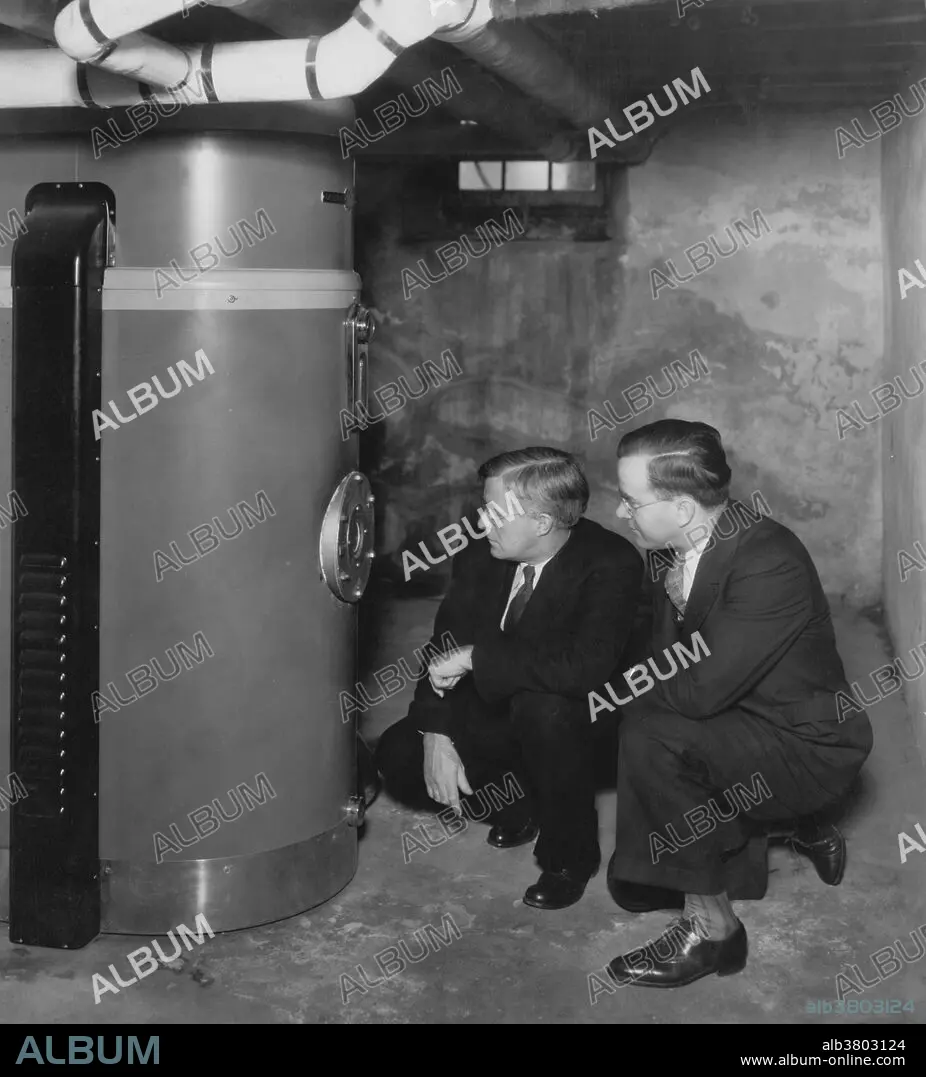
Irving Langmuir with GE Furnace, 1933
| Share |
|---|
 Pinterest Pinterest |
 Twitter Twitter |
 Facebook Facebook |
 Copy link Copy link |
 Email Email |
|
Add to another lightbox |
|
Add to another lightbox |


Buy this image.
Select the use:

Title: Irving Langmuir with GE Furnace, 1933
Caption: Langmuir (left) and J. J. Donovan crouching in front of a General Electric oil burning furnace, 1933. Irving Langmuir ( January 31, 1881 - August 16, 1957) was an American chemist and physicist. His first major development was the improvement of the diffusion pump, which ultimately led to the invention of the high-vacuum tube. A year later, he and colleague Lewi Tonks discovered that the lifetime of a tungsten filament was greatly lengthened by filling the bulb with an inert gas, such as argon. He also discovered that twisting the filament into a tight coil improved its efficiency. He introduced the concept of electron temperature and in 1924 invented the diagnostic method for measuring both temperature and density with an electrostatic probe, now called a Langmuir probe and commonly used in plasma physics. Following WWI he contributed to atomic theory and the understanding of atomic structure by defining the modern concept of valence shells and isotopes. He was awarded the 1932 Nobel Prize in Chemistry for his work in surface chemistry. He died from a heart attack in 1957 at the age of 76. His obituary ran on the front page of The New York Times.
Category: SCIENCE • black & white • Science: Personalities
Credit: Album / Science Source / New York Public Library
Releases: ? Model Release: No - ? Property Release: No
Rights questions?
Rights questions?
Image size: 2524 × 2792 px | 20.2 MB
Print size: 21.4 × 23.6 cm | 993.7 × 1099.2 in (300 dpi)
Keywords: 1933 1930S • 20 20TH XX XXTH TWENTIETH CENTURY • 20 XX TWENTIETH CENTURY • 20TH CENTURY • 20TH • AMERICAN • BLACK & WHITE • BW • CELEBRITIES • CELEBRITY • CHEMIST • CHEMISTRY • FAMOUS PEOPLE • FAMOUS • FIGURE • GE • GENERAL ELECTRIC • HIGH-VACUUM TUBE • HISTORIC • HISTORICAL • HISTORY • I. LANGMUIR • IMPORTANT • INCANDESCENT LIGHT BULB • INVENTION • INVENTOR (MALE) • INVENTOR • IRVING LANGMUIR • LANGMUIR • MALE • MAN • MEN • NOBEL LAUREATE • NOBEL PRIZE LAUREATE • NOBEL PRIZE RECIPIENT • NOBEL PRIZE WINNER • NOBEL PRIZE • NOBEL RECIPIENT • NOBEL WINNER • NOBEL • NOBELIST • NOTABLE • PEOPLE • PERSON • PERSONALITIES • PERSONALITY • PHOTO • PHOTOGRAPH • PHYSICIST • PHYSICS • SAVANT • SCI • SCIENCE AND TECHNOLOGY WISSENSCHAFT SCI • SCIENCE • SCIENCE-TECHNOLOGY • SCIENCE: PERSONALITIES • SCIENCE_AND_TECHNOLOGY WISSENSCHAFT SCI • SCIENTIFIC • SCIENTIST • SURFACE CHEMISTRY • TWENTIETH CENTURY • UNITED STATES • US • USA • WELL-KNOWN
