

alb4575272
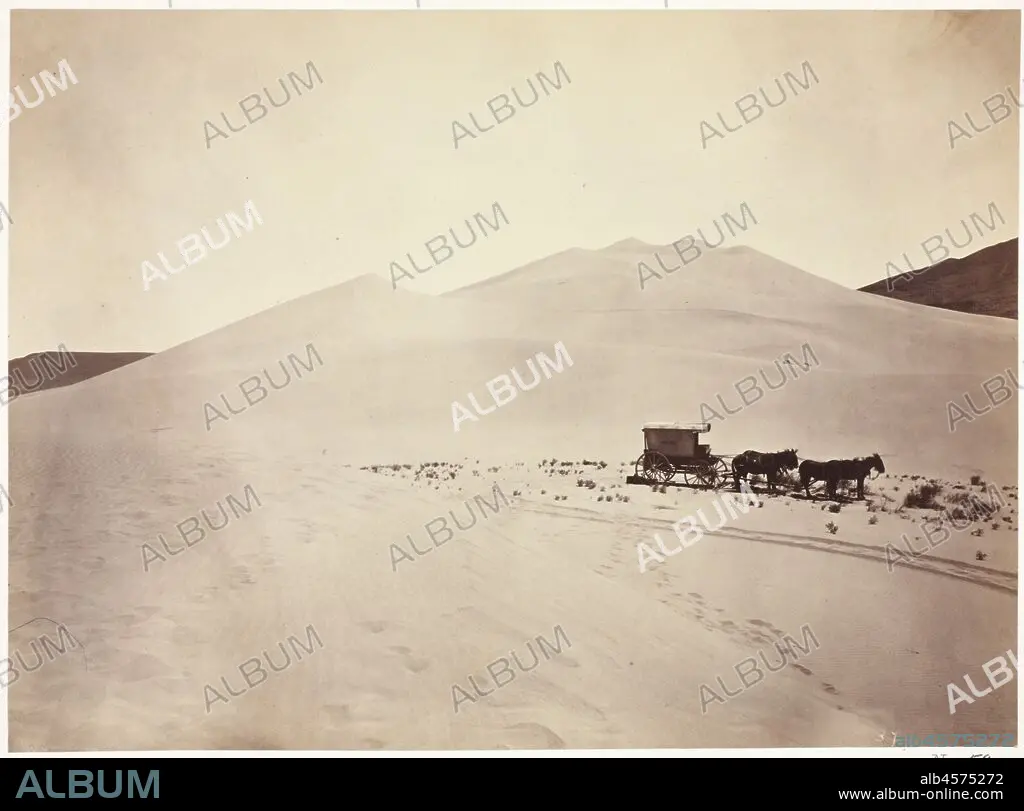
Sand Dunes, Carson Desert, Nevada, 1867. Creator: Timothy H. O'Sullivan (American, 1840-1882) .
| Share |
|---|
 Pinterest Pinterest |
 Twitter Twitter |
 Facebook Facebook |
 Copy link Copy link |
 Email Email |
|
Add to another lightbox |
|
Add to another lightbox |


Buy this image.
Select the use:

Title: Sand Dunes, Carson Desert, Nevada, 1867. Creator: Timothy H. O'Sullivan (American, 1840-1882) .
Caption: Sand Dunes, Carson Desert, Nevada, 1867. Timothy H. OSullivan's Civil War experiences prepared him for the hardship of serving from 1867 to 1869 as photographer for the Geological Exploration of the Fortieth Parallel. Led by geologist Clarence King, the expedition's goal was to map and describe a strip of land along the 40th parallel in California, Nevada, Utah, Idaho, and Wyoming. This territory coincided roughly with the route of the railroad that would link the east and west coasts in 1869. Here, OSullivan recorded the elusive shifting dunes near Sand Springs, Nevada, including the mule-drawn ambulance he used to transport water necessary for his darkroom. OSullivan's work was less picturesque than that of his contemporaries, using light to define form rather than for dramatic effect. Most significantly, he compressed space by focusing on the textures in both the foreground and background, which resulted in a unified visual whole.
Personalities: TIMOTHY H. O'SULLIVAN
Credit: Album / Heritage Art/Heritage Images
Releases: ? Model Release: No - ? Property Release: No
Rights questions?
Rights questions?
Image size: 4248 × 3144 px | 38.2 MB
Print size: 36.0 × 26.6 cm | 1672.4 × 1237.8 in (300 dpi)
