

alb9201960
Cassiopeia A, Neutron Star Superfluid
| Share |
|---|
 Pinterest Pinterest |
 Twitter Twitter |
 Facebook Facebook |
 Copy link Copy link |
 Email Email |
|
Add to another lightbox |
|
Add to another lightbox |


Buy this image.
Select the use:

Title: Cassiopeia A, Neutron Star Superfluid
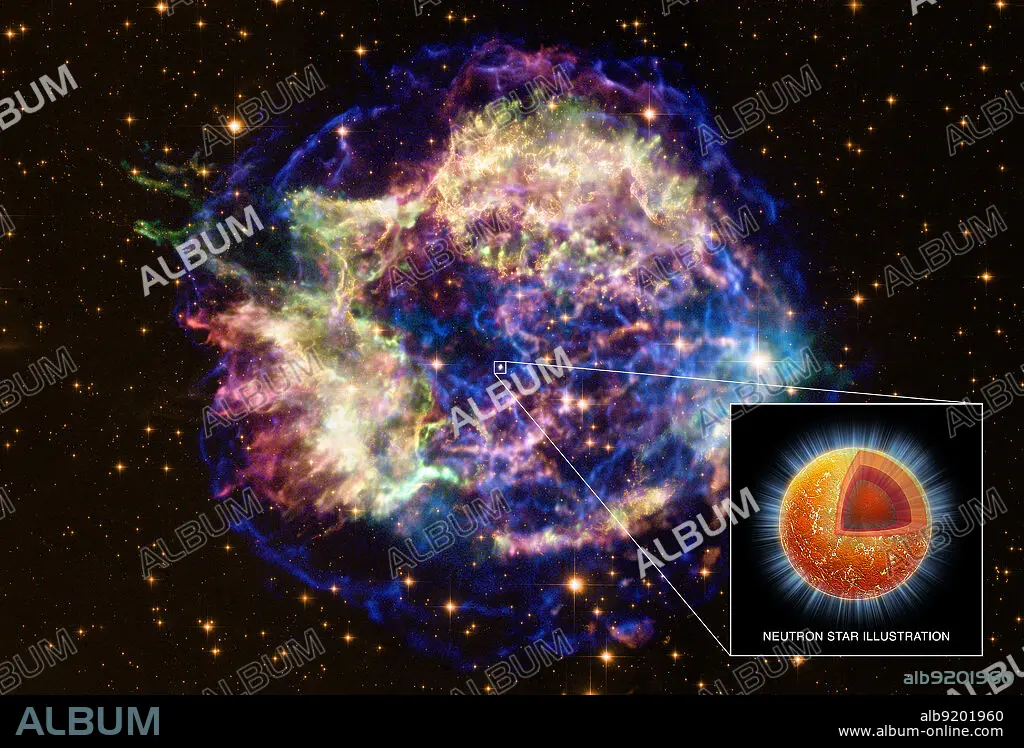
Caption: This composite image shows a beautiful X-ray and optical view of Cassiopeia A (Cas A), a supernova remnant located in our Galaxy about 11,000 light years away. These are the remains of a massive star that exploded about 330 years ago, as measured in Earth's time frame. X-rays from Chandra are shown in red, green and blue along with optical data from Hubble in gold. At the center of the image is a neutron star, an ultra-dense star created by the supernova. Ten years of observations with Chandra have revealed a 4% decline in the temperature of this neutron star, an unexpectedly rapid cooling. Cassiopeia A (Cas A) is a supernova remnant located in our Galaxy about 11,000 light years away in the constellation Cassiopeia. These are the remains of a massive star that exploded about 330 years ago, as measured in Earth's time frame. It is the brightest extrasolar radio source in the sky at frequencies above 1 GHz. At the center of the image is a neutron star, an ultra-dense star created by the supernova. Ten years of observations with Chandra have revealed a 4% decline in the temperature of this neutron star, an unexpectedly rapid cooling. This cooling is likely caused by a neutron superfluid forming in its central regions, the first direct evidence for this bizarre state of matter in the core of a neutron star. Release date February 23, 2011.
Credit: Album / NASA/CXC/M.Weiss/UNAM/STScI / Science Source
Releases: ? Model Release: No - ? Property Release: No
Rights questions?
Rights questions?
Image size: 4200 × 2851 px | 34.3 MB
Print size: 35.6 × 24.1 cm | 1653.5 × 1122.4 in (300 dpi)
Keywords: 2011 • 21ST CENTURY • 21ST • 21TH CENTURY • ART • ARTIST • ARTISTE • ASTRONOMIA • ASTRONOMY • BODY • BRIGHTEST • BURST • BY5056 • CAS • CASSIOPEIA • CELESTIAL • CENTURY • COMPOSITE • CONCEPT • CORE • DEEP • DIAGRAM • EXPLODING • EXPLOSION • EXTRASOLAR • FOUNTAIN • FOUNTAINS • HEAVENLY • ILLUSTRATION • ILLUSTRATIONS • ILUSTRATION • IMAGE • NEUTRON • NUCLEUS • OUTERSPACE • PLATTER • RADIATION • RADIATIONS • RADIO • REMNANT • SKY • SN • SNR • SOURCE • SPACE (COSMOS) • SPACE • SPATIAL • STAR • STELLAR • SUPERFLUID • SUPERNOVA • RADIATIONS
