

alb4358853
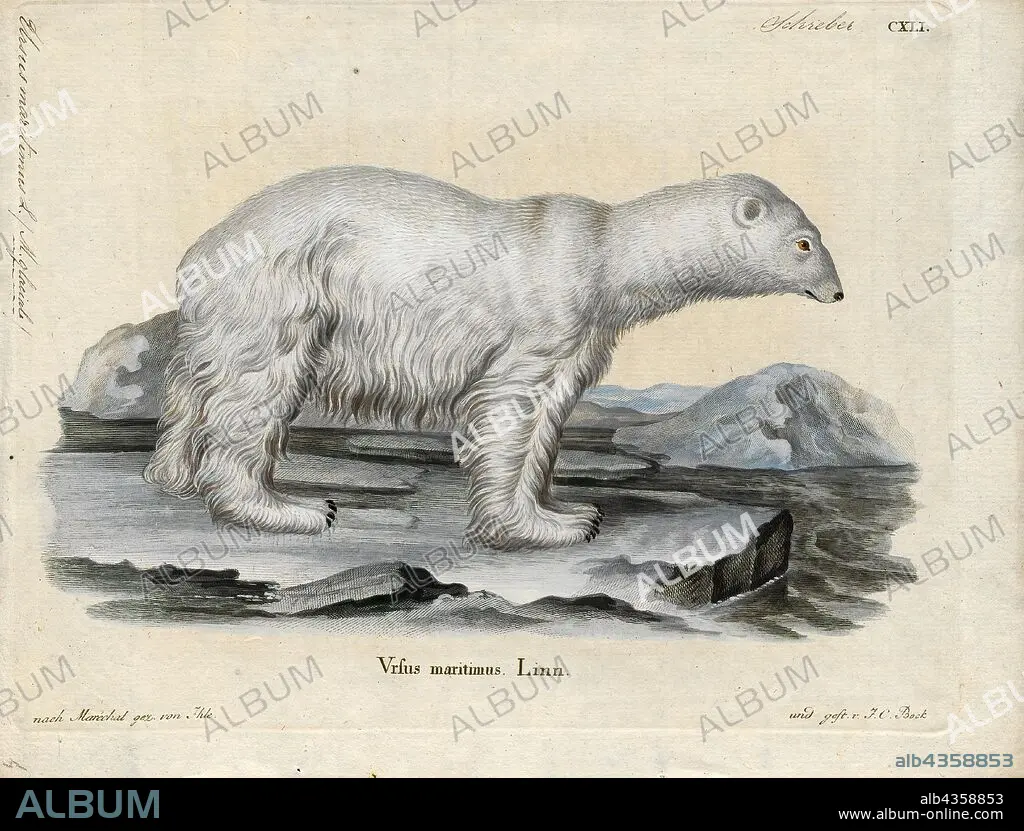
Ursus maritimus, Print, The polar bear (Ursus maritimus) is a hypercarnivorous bear whose native range lies largely within the Arctic Circle, encompassing the Arctic Ocean, its surrounding seas and surrounding land masses. It is a large bear, approximately the same size as the omnivorous Kodiak bear (Ursus arctos middendorffi). A boar (adult male) weighs around 350–700 kg (772–1, 543 lb), while a sow (adult female) is about half that size. Polar bears are the largest land carnivores currently in existence, rivaled only by the Kodiak bear. Although it is the sister species of the brown bear, it has evolved to occupy a narrower ecological niche, with many body characteristics adapted for cold temperatures, for moving across snow, ice and open water, and for hunting seals, which make up most of its diet. Although most polar bears are born on land, they spend most of their time on the sea ice. Their scientific name means "maritime bear" and derives from this fact. Polar bears hunt their preferred food of seals from the edge of sea ice, often living off fat reserves when no sea ice is present. Because of their dependence on the sea ice, polar bears are classified as marine mammals., 1700-1880.
| Share |
|---|
 Pinterest Pinterest |
 Twitter Twitter |
 Facebook Facebook |
 Copy link Copy link |
 Email Email |
|
Add to another lightbox |
|
Add to another lightbox |


Buy this image.
Select the use:

Caption: Ursus maritimus, Print, The polar bear (Ursus maritimus) is a hypercarnivorous bear whose native range lies largely within the Arctic Circle, encompassing the Arctic Ocean, its surrounding seas and surrounding land masses. It is a large bear, approximately the same size as the omnivorous Kodiak bear (Ursus arctos middendorffi). A boar (adult male) weighs around 350–700 kg (772–1, 543 lb), while a sow (adult female) is about half that size. Polar bears are the largest land carnivores currently in existence, rivaled only by the Kodiak bear. Although it is the sister species of the brown bear, it has evolved to occupy a narrower ecological niche, with many body characteristics adapted for cold temperatures, for moving across snow, ice and open water, and for hunting seals, which make up most of its diet. Although most polar bears are born on land, they spend most of their time on the sea ice. Their scientific name means "maritime bear" and derives from this fact. Polar bears hunt their preferred food of seals from the edge of sea ice, often living off fat reserves when no sea ice is present. Because of their dependence on the sea ice, polar bears are classified as marine mammals., 1700-1880
Credit: Album / quintlox
Releases: ? Model Release: No - ? Property Release: No
Rights questions?
Rights questions?
Image size: 4730 × 3593 px | 48.6 MB
Print size: 40.0 × 30.4 cm | 1862.2 × 1414.6 in (300 dpi)
Keywords: 350–700 KG • 543 LB • 772–1 • ADULT FEMALE • ADULT MALE • APPROXIMATELY • ARCTIC CIRCLE • ARCTIC OCEAN • BOAR • BODY CHARACTERISTICS ADAPTED • BORN • BROWN BEAR • COLD TEMPERATURES • DERIVES • DIET • EDGE • ENCOMPASSING • EVOLVED • EXISTENCE • FACT • GLACE • HALF • HUNTING SEALS • HYPERCARNIVOROUS BEAR • ICE (WEATHER) • ICE • ICE, FROZEN LAKES&STREAMS • KODIAK BEAR • LAND • LARGE BEAR • LARGEST LAND CARNIVORES CURRENTLY • MOVING ACROSS SNOW • NARROWER ECOLOGICAL NICHE • NATIVE RANGE LIES LARGELY WITHIN • OCCUPY • OMNIVOROUS KODIAK BEAR • OPEN WATER • POLAR BEAR • POLAR BEARS HUNT • POLAR BEARS • PREFERRED FOOD • PRINT • RIVALED • SCIENTIFIC NAME MEANS MARITIME BEAR • SEA ICE • SEALS • SISTER SPECIES • SIZE • SOW • SPEND • SURROUNDING LAND MASSES • SURROUNDING SEAS • TIME • UP • URSUS ARCTOS MIDDENDORFFI • URSUS MARITIMUS • WEIGHS • WILD BOAR • WILD PIG
