

alb3814764
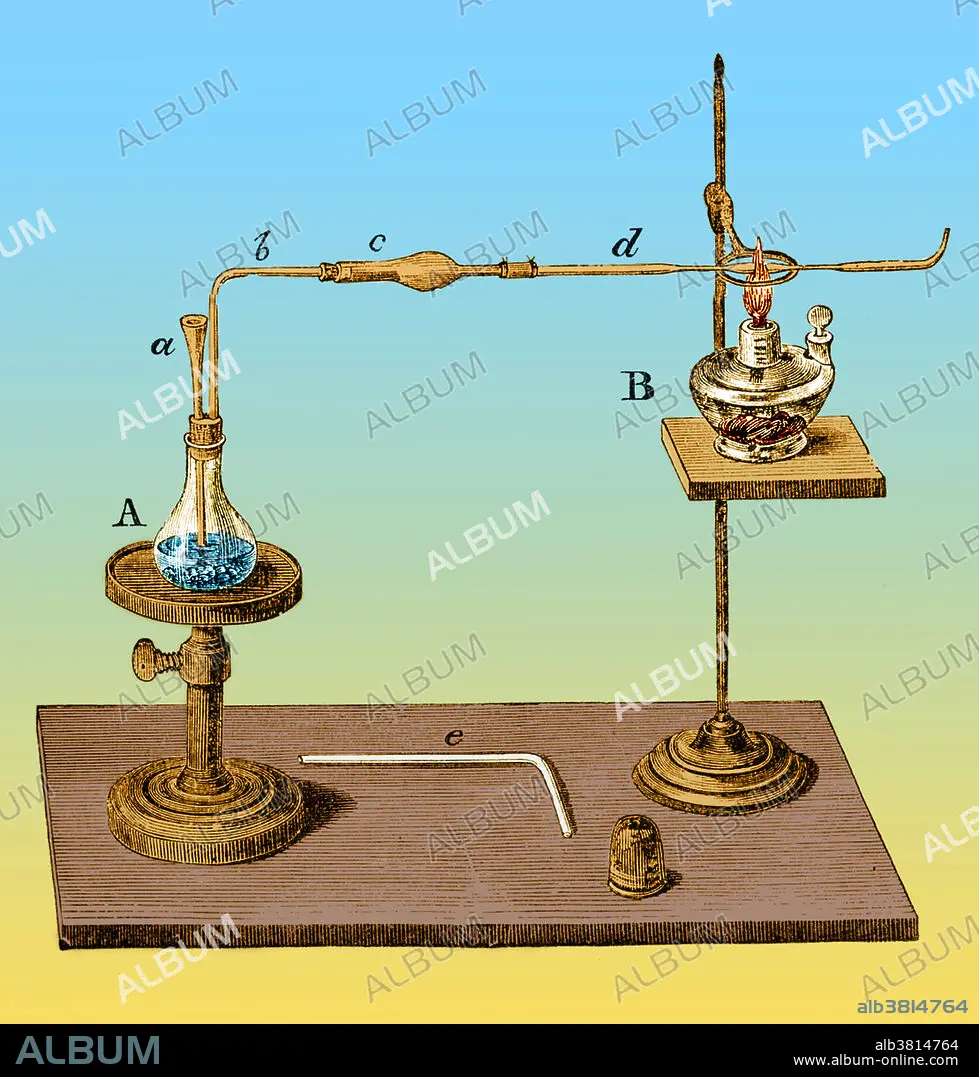
Marsh Test Apparatus, 1867
| Share |
|---|
 Pinterest Pinterest |
 Twitter Twitter |
 Facebook Facebook |
 Copy link Copy link |
 Email Email |
|
Add to another lightbox |
|
Add to another lightbox |


Buy this image.
Select the use:

Title: Marsh Test Apparatus, 1867
Caption: Marsh Test Apparatus, Steel engraving, 1867. The Marsh test is a method for the detection of minute amounts of arsenic in foods (the residue of fruit spray) or in stomach contents. The sample is placed in a flask with arsenic-free zinc and sulfuric acid. Arsine gas (also hydrogen) forms and is led through a drying tube to a hard glass tube in which it is heated. The arsenic is deposited as a mirror just beyond the heated area and on any cold surface held in the burning gas emanating from the jet. Antimony gives a similar test, but the deposit is insoluble in sodium hypochlorite, whereas arsenic will dissolve. The test was named for its inventor, the English chemist James Marsh.
Credit: Album / Science Source
Releases: ? Model Release: No - ? Property Release: No
Rights questions?
Rights questions?
Image size: 3000 × 3138 px | 26.9 MB
Print size: 25.4 × 26.6 cm | 1181.1 × 1235.4 in (300 dpi)
Keywords: 1867 • 19 CENTURY • 19TH CENTURY • 19TH CENTURY. • 19TH • 19TH-CENTURY • ACID • AMOUNT • ANTIMONY • APPARATUS • ARSENIC • ARSENIC-FREE • ARSINE • ART • ARTWORK • BURNING • CENTURY • CHEMISTRY • COLD • COLOR • COLOUR • DEPOSITED • DETECTION • DIAGRAM • DRAWING • DRYING • ENGRAVING • ENHANCE • ENHANCEMENT • FLASK • FLUSH • FORENSIC • GAS • GLASS • HARD • HEATED • HISTORICAL • HISTORY • HYDROGEN • HYPOCHLORITE • ILLUSTRATION • ILLUSTRATIONS • ILUSTRATION • INSOLUBLE • INVENTION • JAMES • MARSH • MEDICAL EXAMINER • METHOD • NINETEENTH CENTURY • RESEARCH • SODIUM • SULFURIC • SURFACE • TECHNIQUE • TEST • TOXICOLOGY • TRACÉ • TUBE • XIX CENTURY • ZINC
