

alb3680395
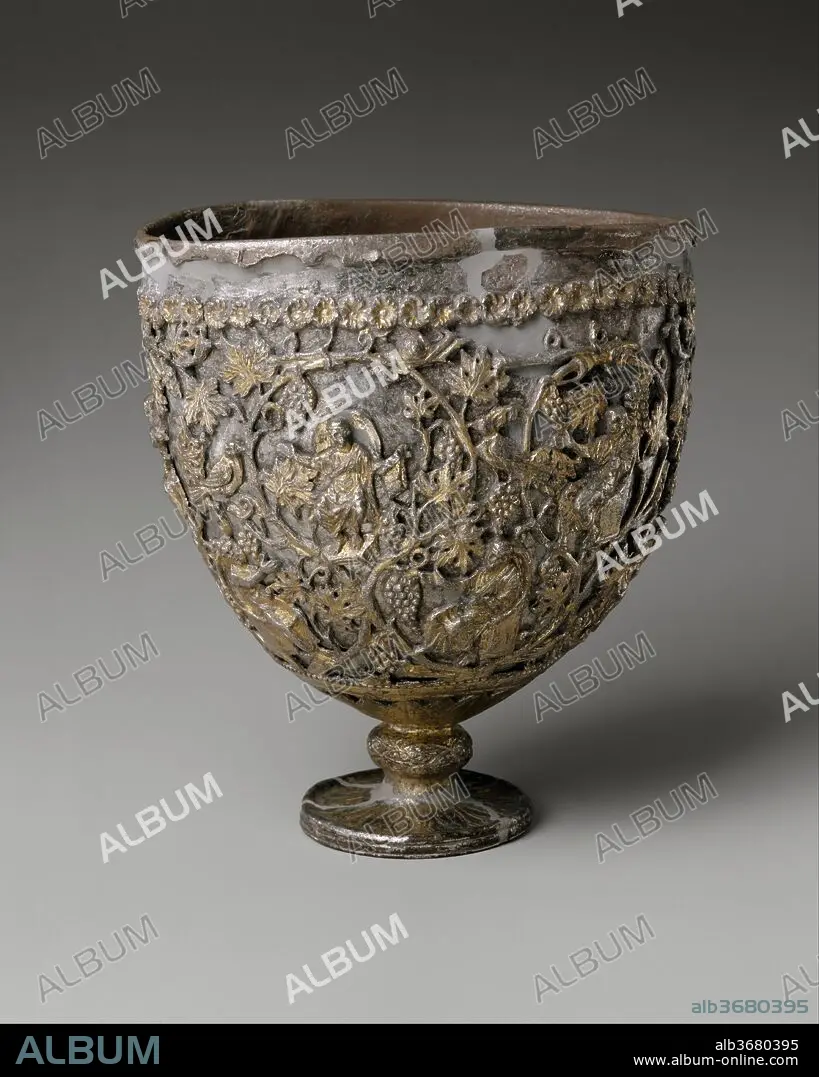
The Antioch "Chalice"
| Share |
|---|
 Pinterest Pinterest |
 Twitter Twitter |
 Facebook Facebook |
 Copy link Copy link |
 Email Email |
|
Add to another lightbox |
|
Add to another lightbox |


Buy this image.
Select the use:

Title: The Antioch "Chalice"
Caption: The Antioch "Chalice". Culture: Byzantine. Dimensions: Overall: 7 11/16 x 7 1/16 x 6 in. (19.6 x 18 x 15.2 cm)
foot: 2 15/16 in. (7.4 cm). Date: 500-550.
When it was discovered at the beginning of the twentieth century, this "chalice" was claimed to have been found in Antioch, a city so important to the early Christians that it was recognized with Rome and Alexandria as one of the great sees of the church. The chalice's plain silver interior bowl was then ambitiously identified as the Holy Grail, the cup used by Christ at the Last Supper. The elaborate footed shell enclosing it was thought to have been made within a century after the death of Christ to encase and honor the Grail. The fruited grapevine forming the rinceau pattern of the gilded shell is inhabited by birds, including an eagle; animals, including a lamb and a rabbit; and twelve human figures holding scrolls and seated in high-backed chairs. Two of the figures are thought to be images of Christ. The other ten figures have been variously identified as ten of the twelve apostles, or philosophers of the classical age, who, like the prophets of the Old Testament, had foretold the coming of Christ. The sixth-century chronicler Malalas of Antioch was among those who sought to make such links between Christianity and classical philosophy.
The identification of the "Antioch Chalice" as the Holy Grail has not been sustained, and even its authenticity has at times been challenged. The work has usually been considered a sixth-century chalice for the Eucharist. Most recently, however, its shape has been recognized as more closely resembling sixth-century standing lamps, its decoration possibly in recognition of Christ's words "I am the light of the world" (John 8:12). It has been argued to be part of a treasure of liturgical objects found in 1908 belonging to the Church of Saint Sergios in the town of Kaper Koraon southeast of Antioch. If so, Saint Sergios' parishioners might well have traveled to Antioch to purchase the object as a donation for their church. Or it may have been used in one of the churches in or near Antioch.
Technique/material: Silver, silver-gilt
Museum: Metropolitan Museum of Art, New York, USA
Credit: Album
Releases: ? Model Release: No - ? Property Release: No
Rights questions?
Rights questions?
Image size: 3276 × 4094 px | 38.4 MB
Print size: 27.7 × 34.7 cm | 1289.8 × 1611.8 in (300 dpi)
Keywords: ANTIOCH • ASIA • CHALICES • CLOISTERS, THE • GILT • MADE IN ANTIOCH OR KAPER KORAON (? ) • METAL • METALWORK • METALWORK-SILVER • METALWORKS • METROPOLITAN MUSEUM OF ART, NEW YORK, USA • SILVER • SILVER, SILVER-GILT • TURKEY
