

alb4193698
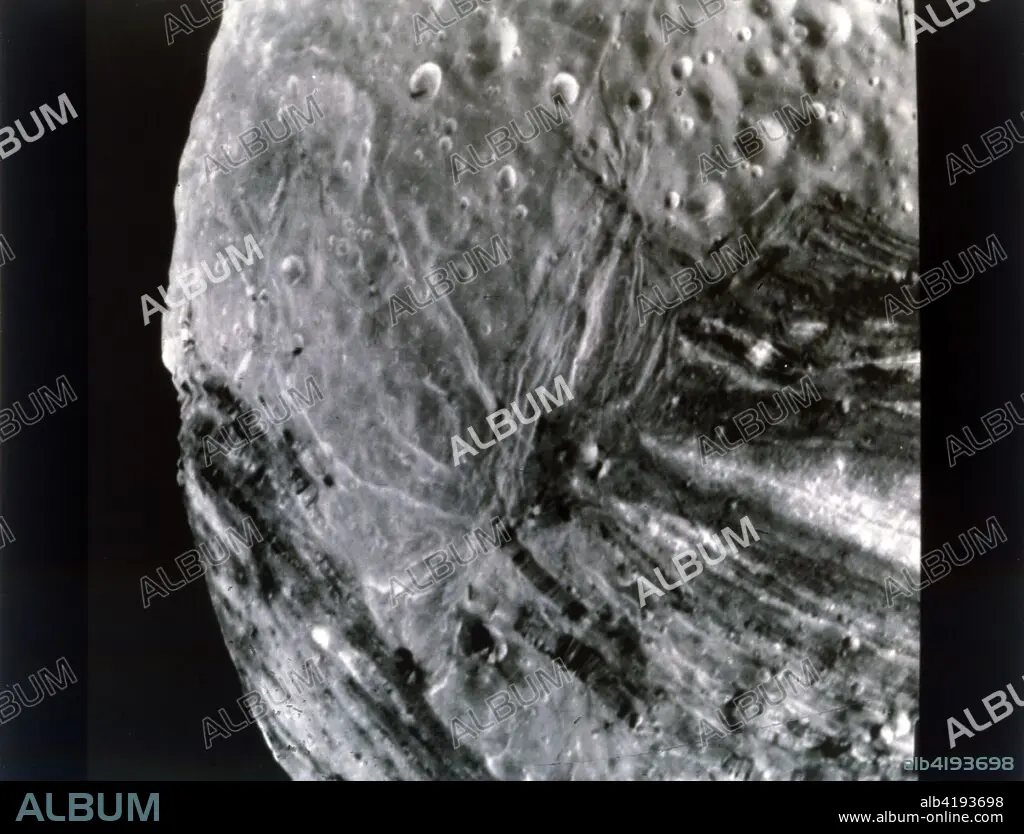
Miranda, one of the moons of Uranus, seen from Voyager 2, 24 January 1986. Creator: NASA.
| Share |
|---|
 Pinterest Pinterest |
 Twitter Twitter |
 Facebook Facebook |
 Copy link Copy link |
 Email Email |
|
Add to another lightbox |
|
Add to another lightbox |


Buy this image.
Select the use:

Title: Miranda, one of the moons of Uranus, seen from Voyager 2, 24 January 1986. Creator: NASA.
Caption: Miranda, one of the moons of Uranus, seen from Voyager 2, 24 January 1986. High-resolution image of Miranda, also designated Uranus V, the smallest and innermost of Uranus' five moons, taken from the Voyager unmanned spacecraft from a distance of approximately 31,000 kilometers (19,000 miles), shortly before the spacecraft's closest approach to the Uranian moon. The high resolution of 600 meters (2,000 feet) reveals fractures, grooves and craters, as well as features of different albedos (reflectancea). This view encompasses areas of older, heavily cratered terrain with a wide variety of forms. The grooves and troughs reach depths of a few kilometers (or miles) and expose materials of different albedos. The great variety of directions of fractures and troughs, and the different densities of impact craters on them, signify a long, complex geologic evolution of this satellite.
Credit: Album / Heritage Images / Heritage Space
Releases: ? Model Release: No - ? Property Release: No
Rights questions?
Rights questions?
Image size: 5301 × 4044 px | 61.3 MB
Print size: 44.9 × 34.2 cm | 2087.0 × 1592.1 in (300 dpi)
Keywords: 1980S • 20TH CENTURY • 80S • AEROSPACE • ASTRONAUTICS • ASTRONOMIA • ASTRONOMY • B & W • B / W • B W • B&W • BLACK & WHITE • BLACK AND WHITE • CENTURY • CRATER (GEOLOGY) • CRATER • CRATER, VOLCANO • CRATERS • DECADE • EIGHTIES • EIGHTIES, THE • GALAXY • GEOGRAFIA • GEOGRAPHICAL FEATURE • GEOGRAPHY • GEOLOGIA • GEOLOGY • LUNA • LUNAR • MIRANDA • MONOCHROMATIC • MONOCHROME • MOON • NASA • NATIONAL AERONAUTICS AND SPACE ADMINISTRATION • OUTERSPACE • PHOTOGRAPH • PLANET • PLANETS • SCIENCE • SOLAR SYSTEM • SPACE (COSMOS) • SPACE EXPLORATION • SPACE TRAVEL • SPACE • SPACECRAFT • SPATIAL • SURFACE • TEXTURE • UNIVERSE • URANUS V • URANUS • VOYAGER 2
