

alb5466483
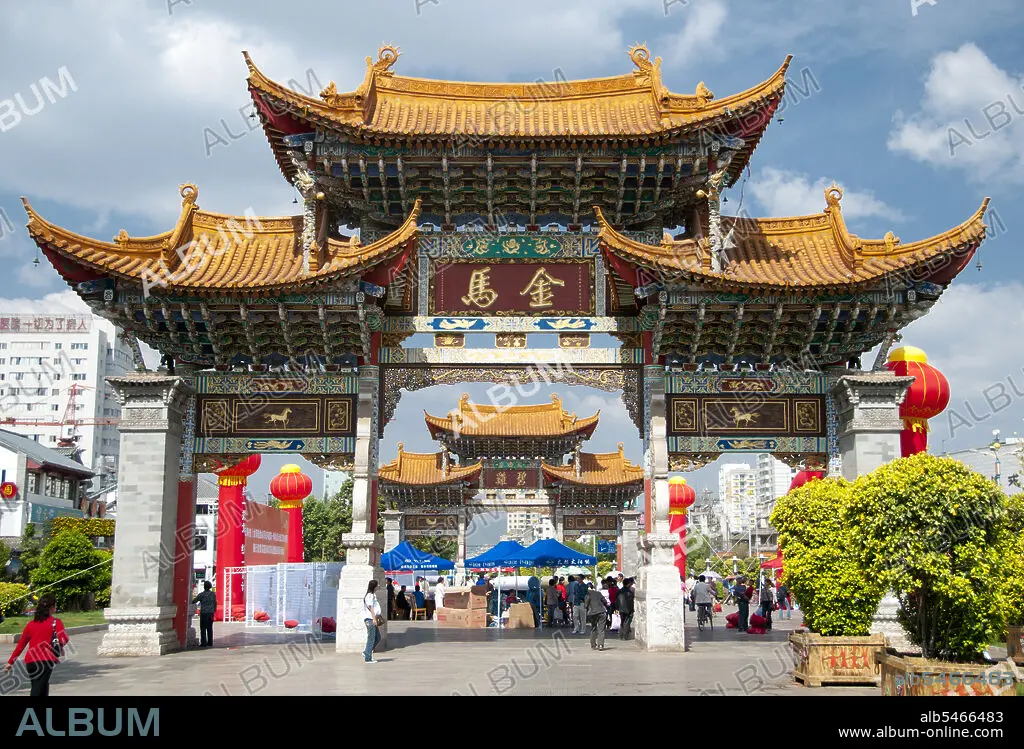
China: The Jinma Biji Archways, Jinma Biji Square, central Kunming, Yunnan Province
| Share |
|---|
 Pinterest Pinterest |
 Twitter Twitter |
 Facebook Facebook |
 Copy link Copy link |
 Email Email |
|
Add to another lightbox |
|
Add to another lightbox |


Buy this image.
Select the use:

Title: China: The Jinma Biji Archways, Jinma Biji Square, central Kunming, Yunnan Province
Caption: The Jinma Biji or Golden Horse Jade Rooster archways stand at the heart of commercial Kunming. The golden horse and the green chicken (rooster) are symbols of the city of Kunming and appear in its emblem. Built on the banks of Lake Dian and surrounded by limestone mountains, Kunming was an important ancient trade route between Tibet, China and Southeast Asia. The city, then called Yunnanfu, suffered at the hands of rebel leader Du Wenxiu, the Sultan of Dali, who attacked and besieged the city several times between 1858 and 1868, razing most of the city's Buddhist temples. In the 1890s, an uprising against working conditions on the Kunming-Haiphong railway line saw 300,000 laborers executed after France shipped in weapons to suppress the revolt. The railway line, only completed in 1911, was built by the French so that they could tap Yunnan's mineral resources for their colonies in Indochina. Today, Kunming is a city of over 6 million people, and is the political, economic, communications and cultural centre of Yunnan.
Credit: Album / Pictures From History/Universal Images Group
Releases: ? Model Release: No - ? Property Release: No
Rights questions?
Rights questions?
Image size: 4933 × 3354 px | 47.3 MB
Print size: 41.8 × 28.4 cm | 1942.1 × 1320.5 in (300 dpi)
Keywords: ARCHITECTURAL • ARCHITECTURE • ARCHITECTURE. • ASIA IMAGES • ASIA PICTURES • ASIA • ASIAN IMAGE • ASIAN IMAGES • ASIAN PICTURES • ASIAN • CHINA • CHINE • CHINESE • DAVID HENLEY • HISTORIA UNIVERSAL • HISTORIA • HISTORICAL IMAGES • HISTORICAL PICTURES • HISTORICAL • HISTORY IMAGES • HISTORY PICTURES • HISTORY • HISTORY. • HUMANS • KUNMING • PEOPLE • PORCELAIN • YUNNAN • YUNNANESE
