

alb3620289
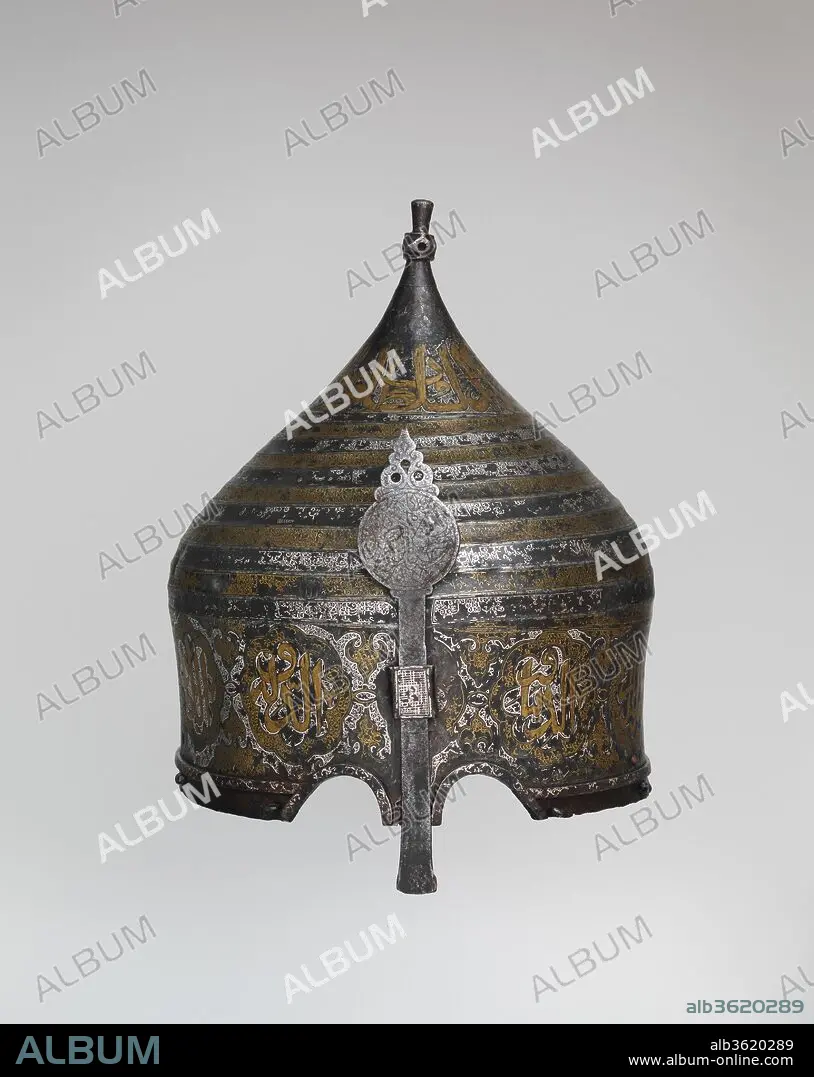
Turban Helmet
| Share |
|---|
 Pinterest Pinterest |
 Twitter Twitter |
 Facebook Facebook |
 Copy link Copy link |
 Email Email |
|
Add to another lightbox |
|
Add to another lightbox |


Buy this image.
Select the use:

Title: Turban Helmet
Caption: Turban Helmet. Culture: Western Iranian, in the style of Turkman armor. Dimensions: H. 11 1/2 in. (29.2 cm); Wt. 3 lb. 5 oz. (1496 g). Date: late 15th century.
Helmets of this type are usually called turban helmets because of their large bulbous shape and the flutings that imitate the folds of a turban. Because certain dervish groups wore turbans wound with a prescribed number of folds to represent an important mystical number, it is likely that turban helmets were regarded not merely as armor but also a kind of religious insignia, their very shape marking the wearer as a fighter in the Holy War. Turban helmets, together with mail-and-plate armor of matching decoration, were intended for the heavy cavalry and are recorded as early as the fourteenth century. This example appears to have belonged to the dynasty of the Ak-Koyunlu (White Sheep Turkoman) that ruled northwestern Iran and Anatolia in the fifteenth century. The inscriptions, damascened with gold and silver, glorify temporal rulers, wish the owner well, or give advice on how to attain virtue.
Technique/material: Steel, iron, silver, copper alloy
Museum: Metropolitan Museum of Art, New York, USA
Credit: Album
Releases: ? Model Release: No - ? Property Release: No
Rights questions?
Rights questions?
Image size: 3339 × 4200 px | 40.1 MB
Print size: 28.3 × 35.6 cm | 1314.6 × 1653.5 in (300 dpi)
Keywords: ARMS AND ARMOR • COPPER ALLOY • COPPER • COPPERWORK • COSTUME • HELMETS • IRON (METAL) • IRON ALLOY • IRON AND IRON ALLOY • IRON AND STEEL • IRON • IRON_AND_STEEL • METAL • METROPOLITAN MUSEUM OF ART, NEW YORK, USA • SILVER • STEEL INDUSTRY • STEEL • STEEL, IRON, SILVER, COPPER ALLOY
