

alb5485119
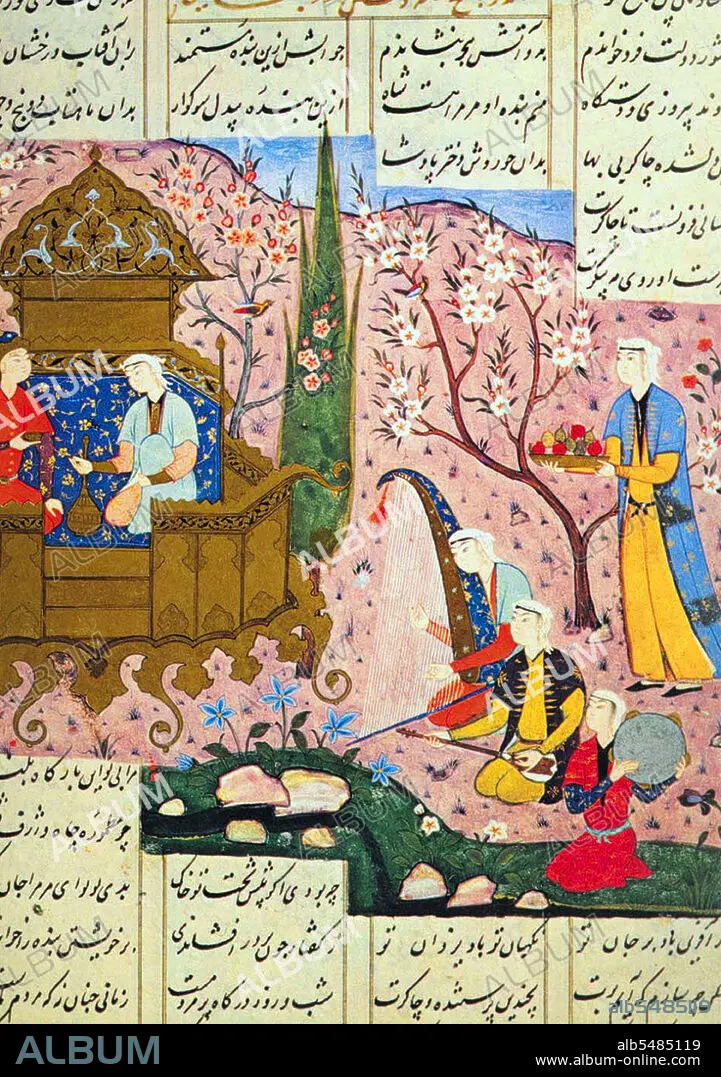
A garden party with wine and music. Safavid,16th-17th century.
| Share |
|---|
 Pinterest Pinterest |
 Twitter Twitter |
 Facebook Facebook |
 Copy link Copy link |
 Email Email |
|
Add to another lightbox |
|
Add to another lightbox |


Buy this image.
Select the use:

Title: A garden party with wine and music. Safavid,16th-17th century.
Caption: A Persian miniature is a small painting on paper, whether a book illustration or a separate work of art intended to be kept in an album of such works called a muraqqa. The techniques are broadly comparable to the Western and Byzantine traditions of miniatures in illuminated manuscripts. Although there is an equally well-established Persian tradition of wall-painting, the survival rate and state of preservation of miniatures is better, and miniatures are much the best-known form of Persian painting in the West, and many of the most important examples are in Western, or Turkish, museums. Miniature painting became a significant Persian genre in the 13th century, receiving Chinese influence after the Mongol conquests, and the highest point in the tradition was reached in the 15th and 16th centuries. The tradition continued, under some Western influence, after this, and has many modern exponents. The Persian miniature was the dominant influence on other Islamic miniature traditions, principally the Ottoman miniature in Turkey, and the Mughal miniature in the Indian sub-continent.
Credit: Album / Pictures From History/Universal Images Group
Releases: ? Model Release: No - ? Property Release: No
Rights questions?
Rights questions?
Image size: 3484 × 4949 px | 49.3 MB
Print size: 29.5 × 41.9 cm | 1371.7 × 1948.4 in (300 dpi)
Keywords: ANT. OR.: IRAN • ART • ARTS • ASIA • ASIAN • CLOTHING: TURBAN • FASHION • FEMALES • HEADGEAR: TURBAN • HISTORIA UNIVERSAL • HISTORIA • HISTORICAL • HISTORY • HISTORY. • IRAN • IRANIAN • LEGEND • MINIATURES • MODA • MODE • MUJER • MUJERES • MYTH: PERSIAN • PAINT • PAINTING • PAINTINGS • PERSIA • PERSIAN ART • PERSIAN MYTH • PERSIAN • STYLE • TURBAN • WOMAN WOMEN • WOMAN'S • WOMAN • WOMAN. • WOMANS • WOMEN'S • WOMEN • WOMENS
