

alb3896209
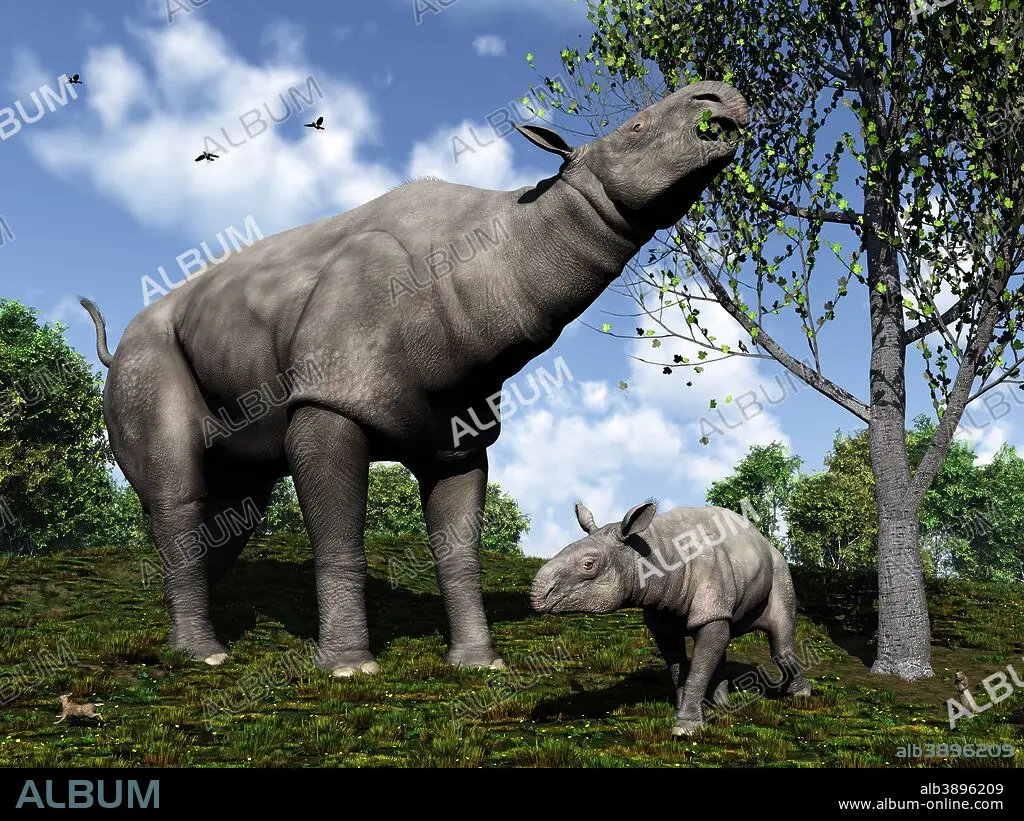
A Paraceratherium mother grazes on leaves and twigs of a poplar tree.
| Share |
|---|
 Pinterest Pinterest |
 Twitter Twitter |
 Facebook Facebook |
 Copy link Copy link |
 Email Email |
|
Add to another lightbox |
|
Add to another lightbox |


Buy this image.
Select the use:

Title: A Paraceratherium mother grazes on leaves and twigs of a poplar tree.
Caption: A Paraceratherium mother grazes on leaves and twigs of a poplar tree while her infant son stands nearby in a scene from 30 million years ago during the Rupelian Stage of the Oligocene Epoch in northwest China. Also in this scene on the lower left is a Palaeolagus, an extinct genus of the order lagomorpha, which includes modern hares, rabbits and pikas. On the lower right is a Palaeosciurus, the earliest known ground squirrel. Flying overhead are passerine ancestors of today's perching songbirds.. . More massive than a modern African elephant, Paraceratherium is believed to be the largest mammal ever to have walked the Earth. Adult Paraceratherium are estimated to have been 18 ft tall at the shoulder with a maximum raised head height of 26 ft. They may have weighed as much as 20 tons. Related to modern rhinoceroses, Paraceratherium became extinct about 23 million years ago.
Category: PALEONTOLOGY
Credit: Album / Walter Myers/Stocktrek Images
Releases: ? Model Release: No - ? Property Release: No
Rights questions?
Rights questions?
Image size: 4920 × 3690 px | 51.9 MB
Print size: 41.7 × 31.2 cm | 1937.0 × 1452.8 in (300 dpi)
Keywords: 2 ANIMALS • ANIMAL THEMES • ANIMAL • ARBOL • BALUCHITHERIUM • BEAST • BRANCH • CENOZOIC ERA • COLOR IMAGE • COLOUR IMAGE • CREATURE • DAY • DECIDUOUS • DIGITALLY GENERATED IMAGE • EARTH • EATING • ENVIRONMENT • EVOLUTION • EXTINCT • FEEDING • FEMALE ANIMAL • FLORA • GRAZING • HERBIVORE • HOOFED MAMMALS • HORIZONTAL • HYRACODONTIDAE • ILLUSTRATION • ILLUSTRATIONS • ILUSTRATION • INDRICOTHERIUM • LAGOMORPH • LEAF • LIFE • MAMMAL • MEGAFAUNA • MOTHER • NATURAL HISTORY • NATURAL SCIENCES • NATURE STUDY • NATURE • NEOZOIC ERA • NO PEOPLE • OLIGOCENE • OUTDOOR • OUTDOORS • OUTSIDE • PALAEOLAGUS • PALAEONTOLOGY • PALEOBOTANY • PALEOGENE • PALEONTOLOGY • PARACERATHERIUM • PARENT • PAST • PREHISTORIC ERA • PRIMITIVE • QUADRUPED • RHINOCEROS • SCIENCE • SCIENCE: EVOLUTION • SPECIES • TERTIARY • TREE LIMBS • TREE • TREES • TWIGS • TWO ANIMALS • WILDERNESS • WILDLIFE • WITHOUT PEOPLE • YOUNG ANIMALS • ZOOLOGY
