

alb8368735
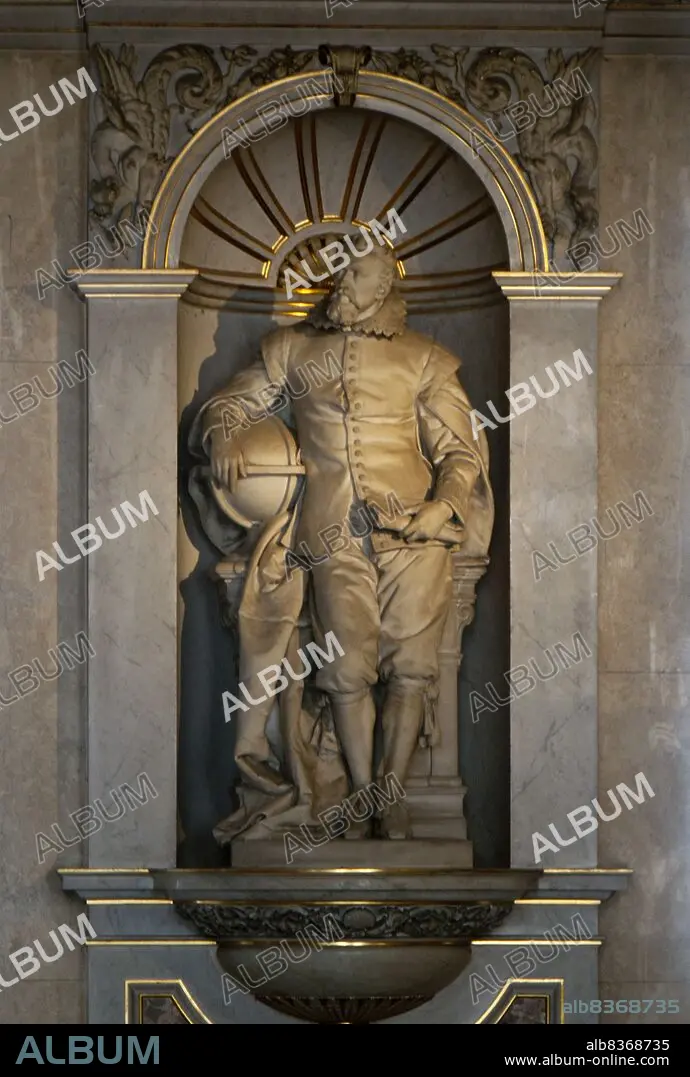
Austria: Johannes Kepler (1571-1630), German mathematician, astronomer and astrologer, Natural History Museum (Naturhistorisches Museum), Vienna. Sculptor, Karl Kundmann (1838-1919)
| Share |
|---|
 Pinterest Pinterest |
 Twitter Twitter |
 Facebook Facebook |
 Copy link Copy link |
 Email Email |
|
Add to another lightbox |
|
Add to another lightbox |


Buy this image.
Select the use:

Title: Austria: Johannes Kepler (1571-1630), German mathematician, astronomer and astrologer, Natural History Museum (Naturhistorisches Museum), Vienna. Sculptor, Karl Kundmann (1838-1919)
Caption: Johannes Kepler (December 27, 1571 November 15, 1630) was a German mathematician, astronomer, and astrologer. A key figure in the 17th century scientific revolution, he is best known for his laws of planetary motion, based on his works Astronomia nova, Harmonices Mundi, and Epitome of Copernican Astronomy. These works also provided one of the foundations for Isaac Newton's theory of universal gravitation.
. During his career, Kepler was a mathematics teacher at a seminary school in Graz, Austria, where he became an associate of Prince Hans Ulrich von Eggenberg. Later he became an assistant to astronomer Tycho Brahe, and eventually the imperial mathematician to Emperor Rudolf II and his two successors Matthias and Ferdinand II. He was also a mathematics teacher in Linz, Austria, and an adviser to General Wallenstein. Additionally, he did fundamental work in the field of optics, invented an improved version of the refracting telescope (the Keplerian Telescope), and mentioned the telescopic discoveries of his contemporary Galileo Galilei.
. During his career, Kepler was a mathematics teacher at a seminary school in Graz, Austria, where he became an associate of Prince Hans Ulrich von Eggenberg. Later he became an assistant to astronomer Tycho Brahe, and eventually the imperial mathematician to Emperor Rudolf II and his two successors Matthias and Ferdinand II. He was also a mathematics teacher in Linz, Austria, and an adviser to General Wallenstein. Additionally, he did fundamental work in the field of optics, invented an improved version of the refracting telescope (the Keplerian Telescope), and mentioned the telescopic discoveries of his contemporary Galileo Galilei.
Credit: Album / Universal Images Group / David Henley / Pictures From History
Releases: ? Model Release: No - ? Property Release: No
Rights questions?
Rights questions?
Image size: 2894 × 4292 px | 35.5 MB
Print size: 24.5 × 36.3 cm | 1139.4 × 1689.8 in (300 dpi)
Keywords: ART • ARTS • ASTROLOGER • ASTROLOGIA • ASTROLOGY • ASTRONOMER • ASTRONOMIA • ASTRONOMY • AUSTRIA • AUSTRIAN • CIENCIA • CLASS • COURSE • DAVID HENLEY • EDUCATING • EDUCATION • EDUCATION. • EUROPA • EUROPE • EUROPEA • EUROPEAN • EUROPEANS • GERMAN • GERMANS • GERMANY • HISTORIA UNIVERSAL • HISTORIA • HISTORY • HISTORY. • INSTRUCTING • INSTRUCTION • KARL • KEPLER • KEPLER, JOHANNES • KUNDMANN • LEARNING • LEGEND • LESSON (SCHOOL) • LESSON • MATHEMATICAL • MATHEMATICIAN • MATHEMATICS • MATHS • MUSEUM • MUSEUMS • NATURAL • PEDAGOGY • PERIOD • SAVANT • SCIENCE • SCIENCES • SCIENTIFIC • SCIENTIST • SCULPTED • SCULPTING • SCULPTURE • SCULPTURE. • SCULPTURES • SCULTURE • SCUPTURE • STATUA • STATUE • STATUES • STUDENT • TEACHING • TEACHING, EDUCATION • TRAINING • UPBRINGING • VIENA • VIENNA • VIENNA: • VIENNE • WIEN
