

alb8348556
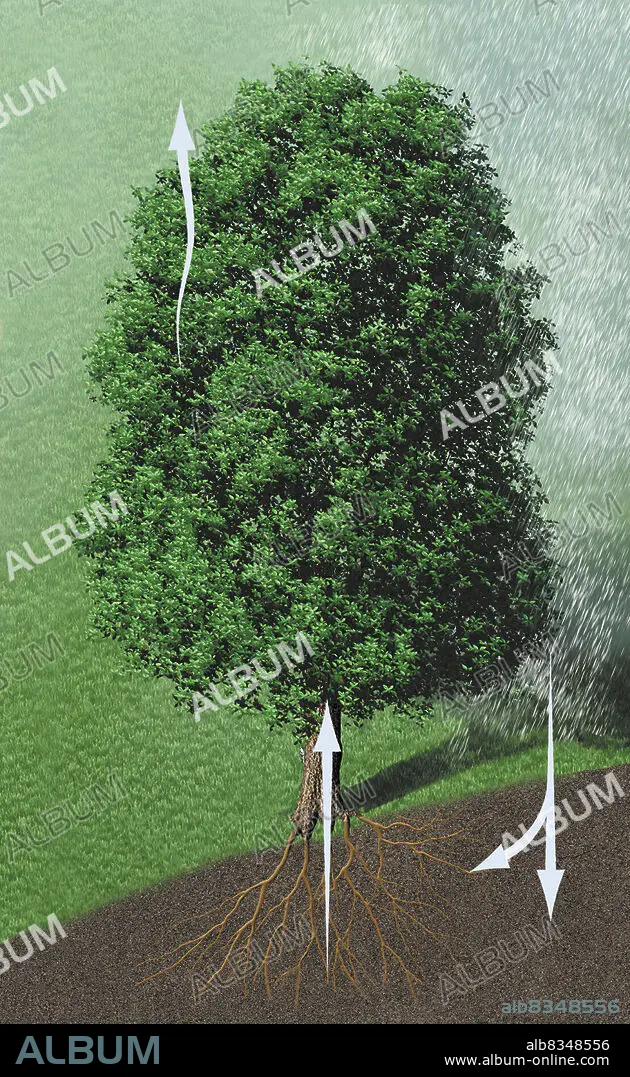
The roots of a plant suck water from the soil and combine it with mineral salts to absorb them more easily. The plant then eliminates the water by transpiration through its stomata, tiny openings on the undersides of its leaves. Each year, a forest transpires a quantity of water vapor equivalent to a layer of water 1.2 m thick covering its area.
| Share |
|---|
 Pinterest Pinterest |
 Twitter Twitter |
 Facebook Facebook |
 Copy link Copy link |
 Email Email |
|
Add to another lightbox |
|
Add to another lightbox |


Buy this image.
Select the use:

Caption: The roots of a plant suck water from the soil and combine it with mineral salts to absorb them more easily. The plant then eliminates the water by transpiration through its stomata, tiny openings on the undersides of its leaves. Each year, a forest transpires a quantity of water vapor equivalent to a layer of water 1.2 m thick covering its area.
Credit: Album / Universal Images Group
Releases: ? Model Release: No - ? Property Release: No
Rights questions?
Rights questions?
Image size: 2216 × 3600 px | 22.8 MB
Print size: 18.8 × 30.5 cm | 872.4 × 1417.3 in (300 dpi)
Keywords: 58294 • ARBOL • COLOR • COLOUR • DIAGRAM • FLUSH • ILLUSTRATION • ILLUSTRATIONS • ILUSTRATION • PLANT • PLANTA • PLANTAE • PLANTS • ROLE OF PLANT • TREE • TREES • WATER CYCLE
