

alb3805773
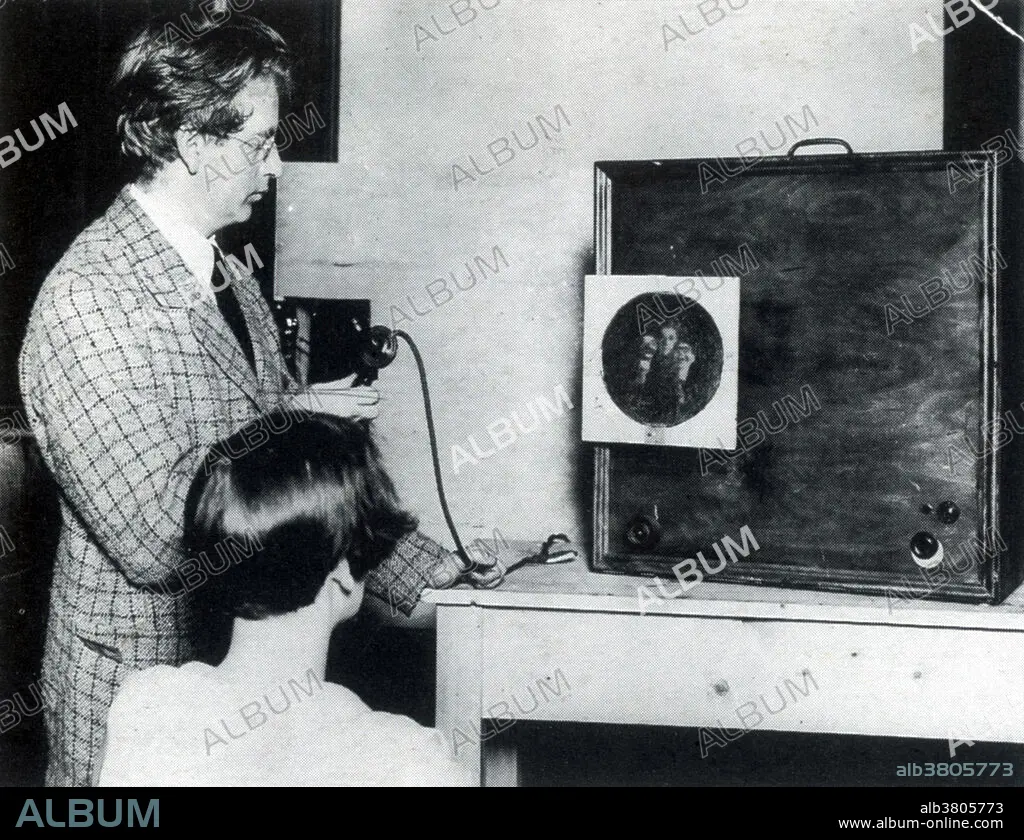
John Logie Baird, Scottish Inventor
| Share |
|---|
 Pinterest Pinterest |
 Twitter Twitter |
 Facebook Facebook |
 Copy link Copy link |
 Email Email |
|
Add to another lightbox |
|
Add to another lightbox |


Buy this image.
Select the use:

Title: John Logie Baird, Scottish Inventor
Caption: Editorial use only . Captioned: Baird demonstrating his television apparatus. (dated 1927) John Logie Baird (1888-1946) was a Scottish scientist, engineer, innovator and inventor of the world's first television. He built what was to become the world's first working television set using items including an old hatbox and a pair of scissors, some darning needles, a few bicycle light lenses, a used tea chest, sealing wax and glue. In 1925, he successfully transmitted the first television picture with a greyscale image: the head of a ventriloquist's dummy nicknamed Stooky Bill. He made many contributions to the field of electronic television after mechanical systems had taken a back seat. In 1939, he showed colour television using a cathode ray tube in front of which revolved a disc fitted with colour filters. In 1944, he gave the world's first demonstration of a fully electronic colour television display.
Credit: Album / Science Source / New York Public Library
Releases: ? Model Release: No - ? Property Release: No
Rights questions?
Rights questions?
Image size: 4200 × 3228 px | 38.8 MB
Print size: 35.6 × 27.3 cm | 1653.5 × 1270.9 in (300 dpi)
Keywords: 1888 • 1946 • 20 20TH XX XXTH TWENTIETH CENTURY • 20 XX TWENTIETH CENTURY • 20TH CENTURY • 20TH • BAIRD • BRITISH • BROADCAST • CELEBRITIES • CELEBRITY • CENTURY • COLOR • COLOUR • COMMUNICATION • DEMONSTRATING • DEMONSTRATION • E-COMMERCE • ELECTRONIC COMMERCE • ELECTRONIC SYSTEM • ELECTRONIC • ELECTRONICS • ENGINEER • EUROPEA • EUROPEAN • EUROPEANS • FAMOUS PEOPLE • FAMOUS • FEMALE • FIGURE • FLUSH • GREYSCALE • HISTORIC • HISTORICAL • HISTORY • IMPORTANT • INNOVATOR • INVENTION • INVENTOR (MALE) • INVENTOR • JOHN • LOGIE • MALE • MAN • MECHANICAL • MEN • NOTABLE • PEOPLE • PERSON • PERSONALITIES • PERSONALITY • PHOTO • PHOTOGRAPH • PHOTOGRAPHIC • SAVANT • SCIENTIFIC • SCIENTIST • SCOTTISH • SHOWING • TECHNOLOGICAL • TECHNOLOGY • TELECOMMUNICATION • TELEVISION (MEDIA) • TELEVISION SET = TV SET = TELLY • TELEVISION SET • TELEVISION • TELLY • TRANSATLANTIC • TRANSMISSION • TV SET • TV • TWENTIETH CENTURY • WELL-KNOWN • WOMAN
