

alb3817474
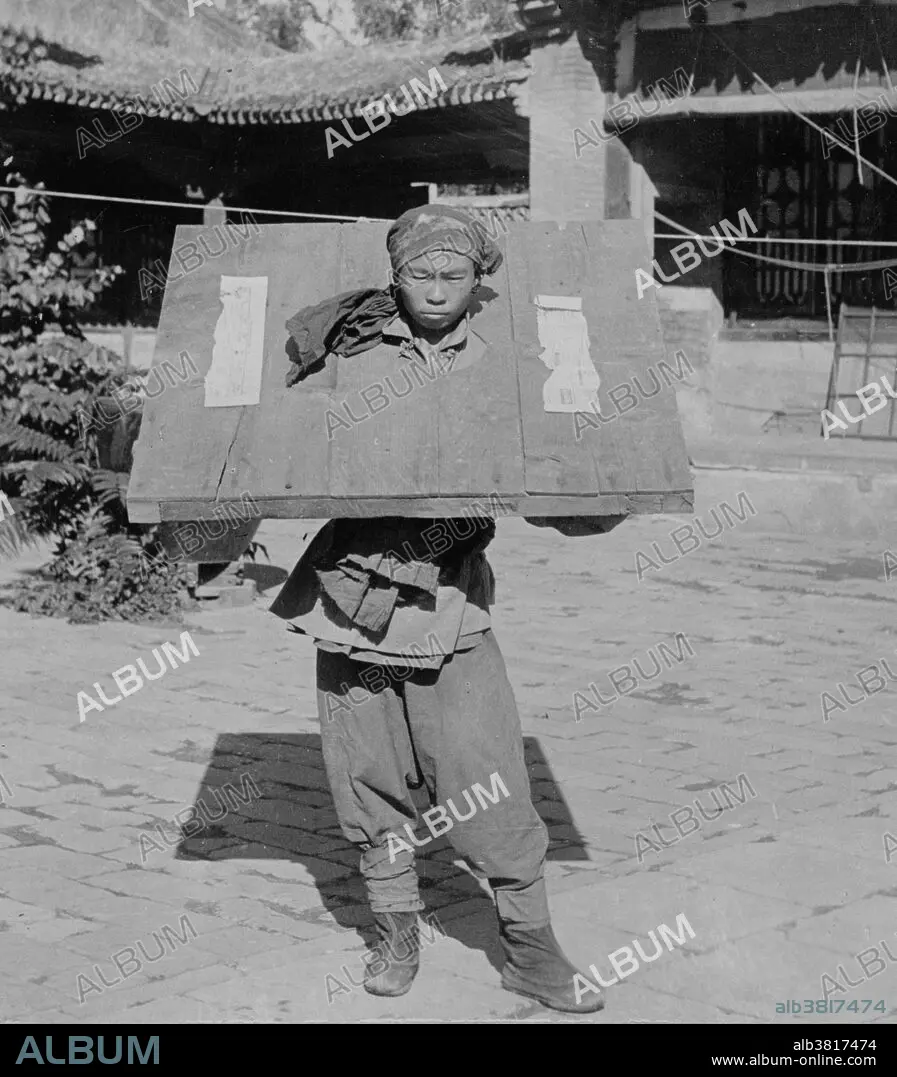
Boxer Rebellion Prisoner in Cangue, 1900
| Share |
|---|
 Pinterest Pinterest |
 Twitter Twitter |
 Facebook Facebook |
 Copy link Copy link |
 Email Email |
|
Add to another lightbox |
|
Add to another lightbox |


Buy this image.
Select the use:

Title: Boxer Rebellion Prisoner in Cangue, 1900
Caption: Entitled: "One of the modes of punishment in China - a Boxer prisoner, Peking, China." The Boxer Rebellion was lead by a Chinese secret organization called the Society of the Righteous and Harmonious Fists against the spread of Western and Japanese influence there. After several months of growing violence against the foreign and Christian presence in Shandong and the North China plain, in June 1900 Boxer fighters, convinced they were invulnerable to foreign weapons, converged on Peking (Beijing), China's capital, until an international force that included American troops subdued the uprising. A cangue is a device that was used for public humiliation and corporal punishment in China and some other parts of East Asia and Southeast Asia until the early years of the 20th century. A typical cangue would consist of a large, heavy flat board with a hole in the center large enough for a person's neck. The board consisted of two pieces. These pieces were closed around a prisoner's neck, and then fastened shut along the edges by locks or hinges. The opening in the center was large enough for the prisoner to breathe and eat, but not large enough for a head to slip through. The prisoner was confined in the cangue for a period of time as a punishment. The size and especially weight were varied as a measure of severity of the punishment. Cropped stereograph card, Keystone View Company, 1900.
Category: History: Modern
Credit: Album / LOC/Science Source
Releases: ? Model Release: No - ? Property Release: No
Rights questions?
Rights questions?
Image size: 3547 × 4050 px | 41.1 MB
Print size: 30.0 × 34.3 cm | 1396.5 × 1594.5 in (300 dpi)
Keywords: 1900 • 20 20TH XX XXTH TWENTIETH CENTURY • 20 XX TWENTIETH CENTURY • 20TH CENTURY • 20TH • ANTI-IMPERIALISM • ANTI-IMPERIALIST • ASIA • ASIAN • BEIJING • BIEJING • BOXER PRISONER • BOXER REBEL • BOXER REBELLION • BOXER UPRISING • BW • CANGUE • CELEBRITIES • CELEBRITY • CHINA • CHINA: BOXER REBELLION • CHINESE • CORPORAL PUNISHMENT • EAST ASIA • EASTERN ASIA • EMPIRE OF THE GREAT QING • EVENT • EVENTS • FAMOUS PEOPLE • FAMOUS • FOREIGN IMPERIALISM • GREAT QING • HISTORIC • HISTORICAL • HISTORY • HISTORY: MODERN • IMPERIAL CHINA • IMPORTANT • KANGUE • MAN • MANCHU DYNASTY • MEN • MILITIA UNITED IN RIGHTEOUSNESS • NORTHERN CHINA • NOTABLE • PEKIN • PEKING • PHOTO • PHOTOGRAPH • PRISONER • PUBLIC HUMILIATION • PUNISH • PUNISHING • PUNISHMENT • QING DYNASTY • SECRET ORGANIZATION • TWENTIETH CENTURY • WELL-KNOWN • YIHETUAN MOVEMENT
