

alb8349252
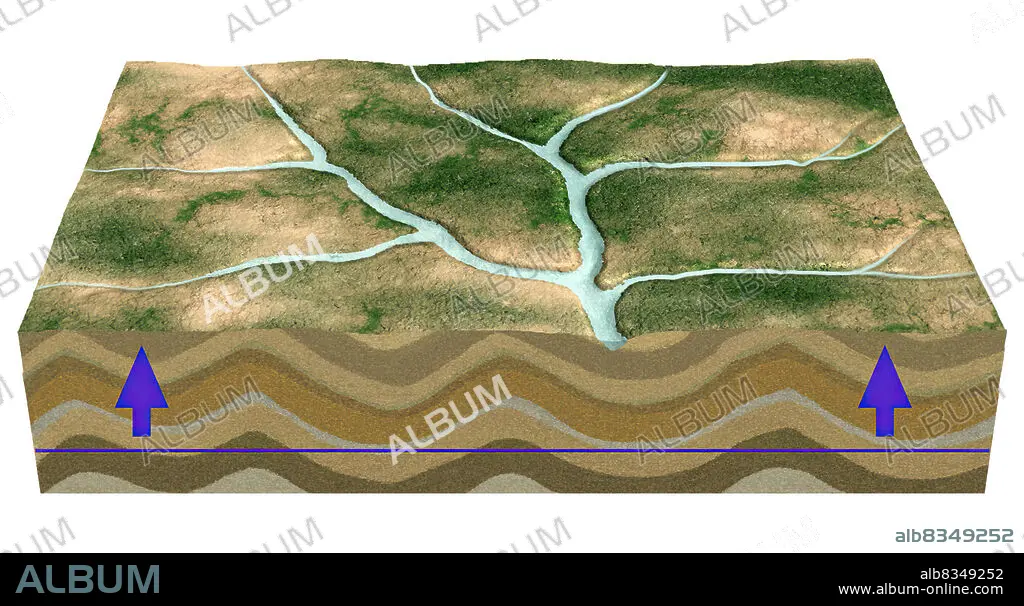
Relief features go through a series of stages. Fluvial landscapes are altered by the erosive action of watercourses. Where the landscape is still very rugged, with high peaks and steep slopes, erosion is very rapid. Watercourses carve out deep V-shaped valleys and carry away much rocky debris. Due to erosion, the topography begins to level out: summits are rounded, slopes become gentler, and watercourses carry less debris and decrease in speed. After several million years of erosion, the landscape becomes a peneplain: its relief is almost completely flat and it rises very little above base level (sea level). The erosion process slows considerably. Geologic and tectonic phenomena can cause a sudden elevation of land. In this case, the peneplain is much higher than base level. At this point, erosion will begin again: watercourses again carve out deep valleys and the landscape is rejuvenated.
| Share |
|---|
 Pinterest Pinterest |
 Twitter Twitter |
 Facebook Facebook |
 Copy link Copy link |
 Email Email |
|
Add to another lightbox |
|
Add to another lightbox |


Buy this image.
Select the use:

Caption: Relief features go through a series of stages. Fluvial landscapes are altered by the erosive action of watercourses. Where the landscape is still very rugged, with high peaks and steep slopes, erosion is very rapid. Watercourses carve out deep V-shaped valleys and carry away much rocky debris. Due to erosion, the topography begins to level out: summits are rounded, slopes become gentler, and watercourses carry less debris and decrease in speed. After several million years of erosion, the landscape becomes a peneplain: its relief is almost completely flat and it rises very little above base level (sea level). The erosion process slows considerably. Geologic and tectonic phenomena can cause a sudden elevation of land. In this case, the peneplain is much higher than base level. At this point, erosion will begin again: watercourses again carve out deep valleys and the landscape is rejuvenated.
Credit: Album / Universal Images Group
Releases: ? Model Release: No - ? Property Release: No
Rights questions?
Rights questions?
Image size: 3538 × 1910 px | 19.3 MB
Print size: 30.0 × 16.2 cm | 1392.9 × 752.0 in (300 dpi)
Keywords: 51355 • COLOR • COLOUR • CYCLE OF EROSION • EARTH • EVOLUTION OF A LANDSCAPE • EVOLVING LANDSCAPE • FLUSH • GEOLOGIA • GEOLOGY • ILLUSTRATION • ILLUSTRATIONS • ILUSTRATION
