

alb9093953
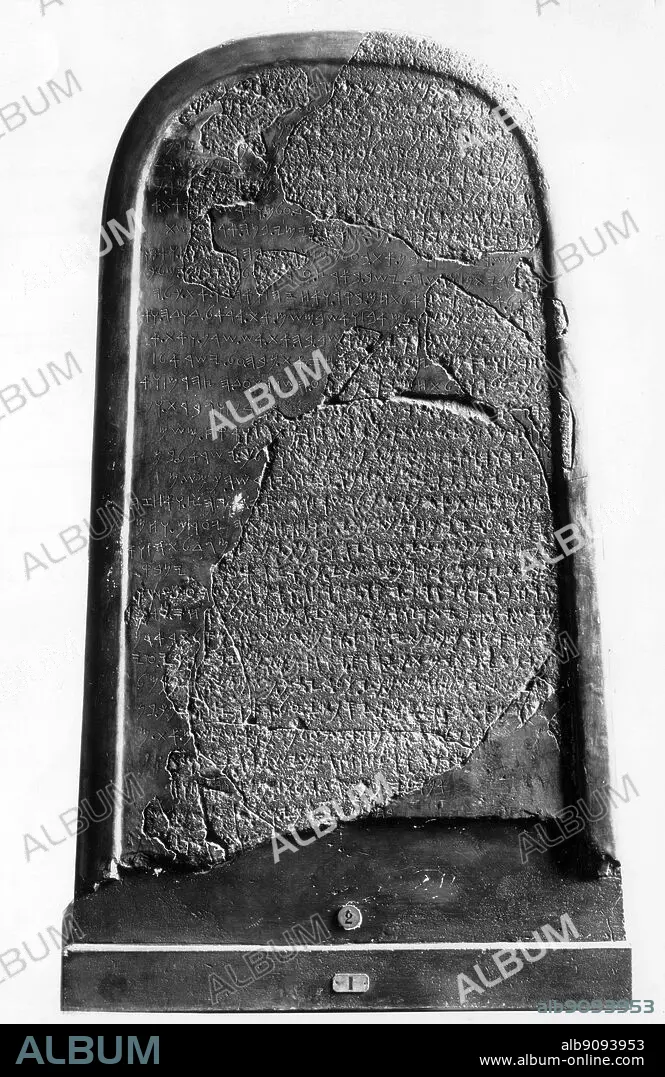
The Stone of Mesha. The Mesha or Moabite Stone, is an ancient Palestinian slab that became the first definite inscribed evidence of an Old Testament event.... . The slab was discovered in Dibon, Jordan (1868) by F. A. Klein, a German clergyman. It was a five foot stone recording, in a dialect similar to Hebrew, the events of Moabite and Israelite history. The inscription dates from c. 850 B.C. It was erected by Mesha, king of Moab, and is often styled the Mesha Stone. When Klein attempted to purchase it from the Arabs, it was broken into fragments. Fortunately, most of the pieces were recovered.. . It tells of the wars of Mesha the Moabite with Omri, king of Israel, and with Omri's successors. It also tells of Mesha's wars with the Stone parallels biblical history recorded in Second Kings, chapters 1 and 3. Numerous places mentioned in the Old Testament occur on the stele (inscribed monument). Among them are Arnon (Num. 21:13; Deut. 2:24), Ataroth (Num. 32:34), Baal-meon or Beth-baal-meon (Josh. 13:17), Beth-hamoth or Bamoth-baal (Josh. 13:17), Beth-diblathaim (Jer. 48:22), Bezor (Josh. 20:8), Dibon (Num. 32:34), Jahaza (Josh. 13:18), Mebeda (Josh. 13:9), and Nebo (Num. 32:38)."
| Share |
|---|
 Pinterest Pinterest |
 Twitter Twitter |
 Facebook Facebook |
 Copy link Copy link |
 Email Email |
|
Add to another lightbox |
|
Add to another lightbox |


Buy this image.
Select the use:

Title: The Stone of Mesha. The Mesha or Moabite Stone, is an ancient Palestinian slab that became the first definite inscribed evidence of an Old Testament event.... . The slab was discovered in Dibon, Jordan (1868) by F. A. Klein, a German clergyman. It was a five foot stone recording, in a dialect similar to Hebrew, the events of Moabite and Israelite history. The inscription dates from c. 850 B.C. It was erected by Mesha, king of Moab, and is often styled the Mesha Stone. When Klein attempted to purchase it from the Arabs, it was broken into fragments. Fortunately, most of the pieces were recovered.. . It tells of the wars of Mesha the Moabite with Omri, king of Israel, and with Omri's successors. It also tells of Mesha's wars with the Stone parallels biblical history recorded in Second Kings, chapters 1 and 3. Numerous places mentioned in the Old Testament occur on the stele (inscribed monument). Among them are Arnon (Num. 21:13; Deut. 2:24), Ataroth (Num. 32:34), Baal-meon or Beth-baal-meon (Josh. 13:17), Beth-hamoth or Bamoth-baal (Josh. 13:17), Beth-diblathaim (Jer. 48:22), Bezor (Josh. 20:8), Dibon (Num. 32:34), Jahaza (Josh. 13:18), Mebeda (Josh. 13:9), and Nebo (Num. 32:38)."
Caption: The Stone of Mesha. The Mesha or Moabite Stone, is an ancient Palestinian slab that became the first definite inscribed evidence of an Old Testament event.... The slab was discovered in Dibon, Jordan (1868) by F. A. Klein, a German clergyman. It was a five foot stone recording, in a dialect similar to Hebrew, the events of Moabite and Israelite history. The inscription dates from c. 850 B.C. It was erected by Mesha, king of Moab, and is often styled the Mesha Stone. When Klein attempted to purchase it from the Arabs, it was broken into fragments. Fortunately, most of the pieces were recovered.. It tells of the wars of Mesha the Moabite with Omri, king of Israel, and with Omri's successors. It also tells of Mesha's wars with the Stone parallels biblical history recorded in Second Kings, chapters 1 and 3. Numerous places mentioned in the Old Testament occur on the stele (inscribed monument). Among them are Arnon (Num. 21:13; Deut. 2:24), Ataroth (Num. 32:34), Baal-meon or Beth-baal-meon (Josh. 13:17), Beth-hamoth or Bamoth-baal (Josh. 13:17), Beth-diblathaim (Jer. 48:22), Bezor (Josh. 20:8), Dibon (Num. 32:34), Jahaza (Josh. 13:18), Mebeda (Josh. 13:9), and Nebo (Num. 32:38)."
Credit: Album / TopFoto
Releases: ? Model Release: No - ? Property Release: No
Rights questions?
Rights questions?
Image size: 4020 × 6188 px | 71.2 MB
Print size: 34.0 × 52.4 cm | 1582.7 × 2436.2 in (300 dpi)
Keywords: BAR MITZVAH • BIBLE COMPANION P39 • DAVID • INSCRIPTION • ISRAEL
