

alb5474514
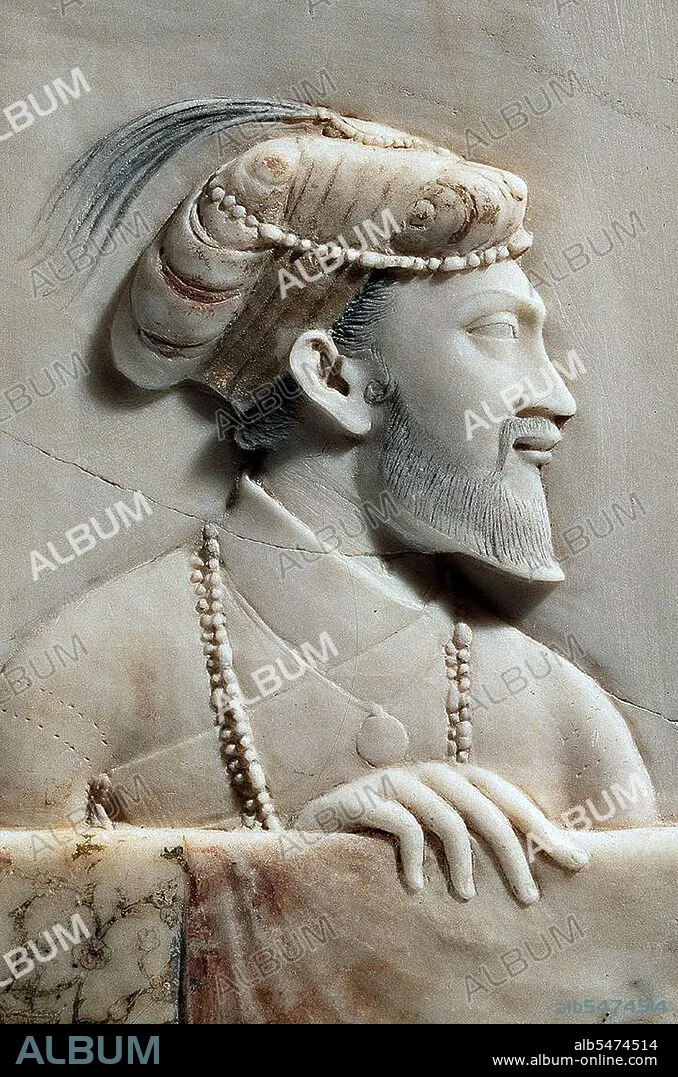
India: An alabaster portrait of Mughal emperor Shah Jahan, sculpted in c.1630.
| Share |
|---|
 Pinterest Pinterest |
 Twitter Twitter |
 Facebook Facebook |
 Copy link Copy link |
 Email Email |
|
Add to another lightbox |
|
Add to another lightbox |


Buy this image.
Select the use:

Title: India: An alabaster portrait of Mughal emperor Shah Jahan, sculpted in c.1630.
Caption: Shan Jahan (1592-1666) was the emperor of the Mughal Empire in the Indian subcontinent from 1628 until 1658. The name Shah Jahan comes from the Persian meaning 'King of the World'. He was the fifth Mughal ruler after Babur, Humayun, Akbar, and Jahangir. While young, he was a favourite of his legendary grandfather Akbar the Great. He is also known as 'Shah Jahan the Magnificent'. The period of his reign is considered the golden age of Mughal expansion—by the end of his reign the Mughal Empire covered 3 million square km and most of India. The Shah Jahan era was also a Golden Age in Mughal architecture. He built many splendid monuments, the most famous of which is the legendary Taj Mahal at Agra, built as a tomb for his wife, Empress Mumtaz Mahal. He also had constructed the Red Fort in Delhi and the Pearl Mosque in the Lahore Fort.
Credit: Album / Pictures From History/Universal Images Group
Releases: ? Model Release: No - ? Property Release: No
Rights questions?
Rights questions?
Image size: 3411 × 5154 px | 50.3 MB
Print size: 28.9 × 43.6 cm | 1342.9 × 2029.1 in (300 dpi)
Keywords: AKBAR • ASIA PICTURES • ASIA • ASIAN IMAGE • ASIAN IMAGES • ASIAN PICTURES • ASIAN • EMPEROR • GREAT MUGHALS • HISTORIA UNIVERSAL • HISTORIA • HISTORICAL IMAGES • HISTORICAL PICTURES • HISTORICAL • HISTORY IMAGES • HISTORY PICTURES • HISTORY • HISTORY. • INDIA • INDIAN • INDIGENOUS PEOPLES OF THE AMERICAS • INDIO • ISLAM • ISLAMIC CULTURE • ISLAMIC • ISLAMISM • JAHANGIR • KAISER • MOGHAL • MOGHUL • MOGUL • MUGHAL • MUSLIM WORLD • MUSLIM • SHAH JAHAN • SHAH • TAJ MAHAL
