

alb3798755
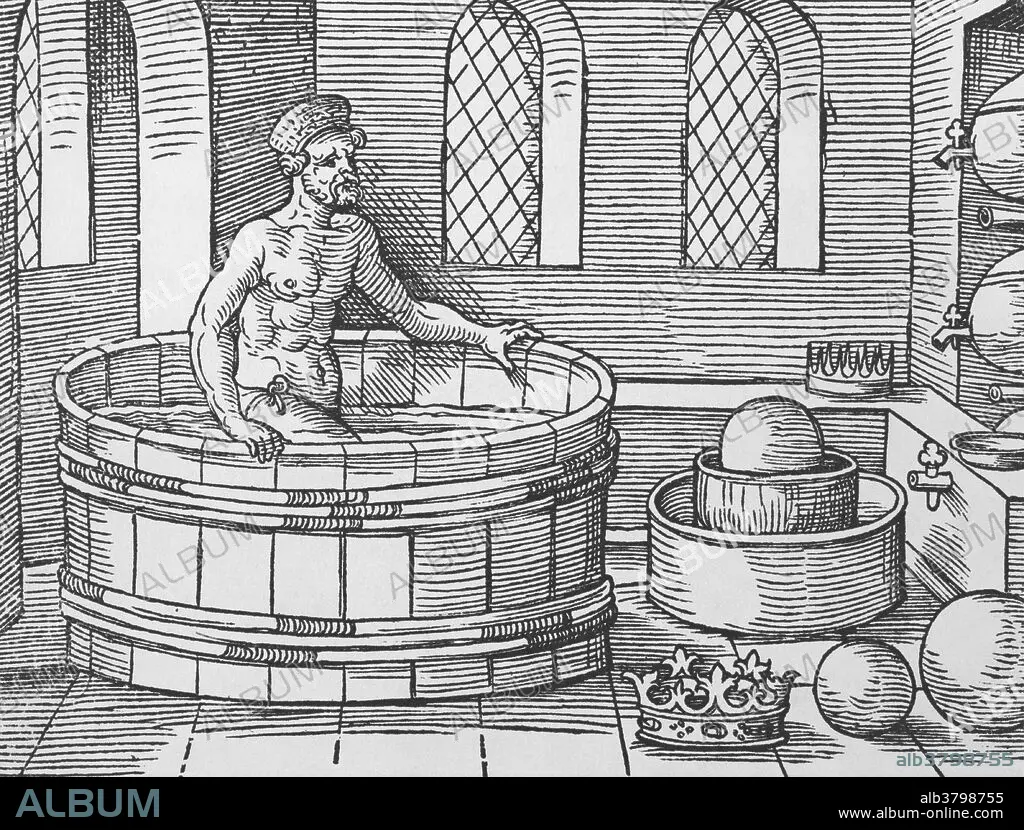
Archimedes and Hydrostatics
| Share |
|---|
 Pinterest Pinterest |
 Twitter Twitter |
 Facebook Facebook |
 Copy link Copy link |
 Email Email |
|
Add to another lightbox |
|
Add to another lightbox |


Buy this image.
Select the use:

Title: Archimedes and Hydrostatics
Caption: Illustration of the discovery of Archimedes' prinicple of hydrostatics. The principle states that a body immersed in a fluid will displace a volume of the fluid equal to the weight of the body. It is said that Archimedes discovered the principle when he stepped into a bath and the water overflowed (woodcut, 1582). Archimedes of Syracuse (287-212 BC) was a Greek mathematician, physicist, engineer, inventor, and astronomer. Few details of his life are known, but he is regarded as one of the leading scientists in classical antiquity. Among his advances in physics are the foundations of hydrostatics, statics and an explanation of the principle of the lever. He is credited with designing innovative machines, including siege engines and the screw pump that bears his name. Archimedes is considered to be the greatest mathematician of antiquity and one of the greatest of all time. He used the method of exhaustion (method of finding the area of a shape by inscribing inside it a sequence of polygons whose areas converge to the area of the containing shape) to calculate the area under the arc of a parabola with the summation of an infinite series, gave an accurate approximation of pi and defined the formulae for the volumes of surfaces of revolution and an ingenious system for expressing very large numbers. Archimedes died during the Siege of Syracuse when he was killed by a Roman soldier despite orders that he should not be harmed.
Category: SCIENCE • people • Historical & Fine Arts
Credit: Album / NYPL/Science Source
Releases: ? Model Release: No - ? Property Release: No
Rights questions?
Rights questions?
Image size: 4719 × 3582 px | 48.4 MB
Print size: 40.0 × 30.3 cm | 1857.9 × 1410.2 in (300 dpi)
Keywords: 212 • 287 • ANCIENT GREEK • ANCIENT • ANTIQUITY • APPROXIMATION OF PI • ARC OF PARABOLA • ARCHIMEDES OF SYRACUSE • ARCHIMEDES' PRINCIPLE • ARCHIMEDES' SCREW • ARCHIMEDES • ART • ARTWORK • ASTRONOMER • ASTRONOMIA • ASTRONOMY • BC • BW • CELEBRITIES • CELEBRITY • CLASSICAL • DRAWING • ENGINEER • FAMOUS PEOPLE • FAMOUS • FIGURE • GREAT • GREATEST • GREEK • HISTORIC • HISTORICAL & FINE ARTS • HISTORICAL • HISTORY • HYDROSTATICS • ILLUSTRATION • ILLUSTRATIONS • ILUSTRATION • IMPORTANT • INFINITESIMALS • INNOVATIVE MACHINES • INVENTOR (MALE) • INVENTOR • KILLED • LEVERS • MALE • MAN • MATH • MATHEMATIC • MATHEMATICAL • MATHEMATICIAN • MATHEMATICS • MECHANICS • MEN • METHOD OF EXHAUSTION • METHODUS EXHAUSTIONIBUS • MéTHODE DES ANCIENS • NOTABLE • PEOPLE • PERSON • PERSONALITIES • PERSONALITY • PHYSICIST • PHYSICS • PI-VALUE • POLYMATH • SAVANT • SCI • SCIENCE AND TECHNOLOGY WISSENSCHAFT SCI • SCIENCE • SCIENCE-TECHNOLOGY • SCIENCE_AND_TECHNOLOGY WISSENSCHAFT SCI • SCIENTIFIC • SCIENTIST • SCREW PUMP • SIEGE ENGINES • VOLUMES OF SURFACES • WELL-KNOWN • WOODBLOCK PRINT • WOODBLOCK • WOODCARVING • WOODCUT • XYLOGRAPHY
