

alb5464366
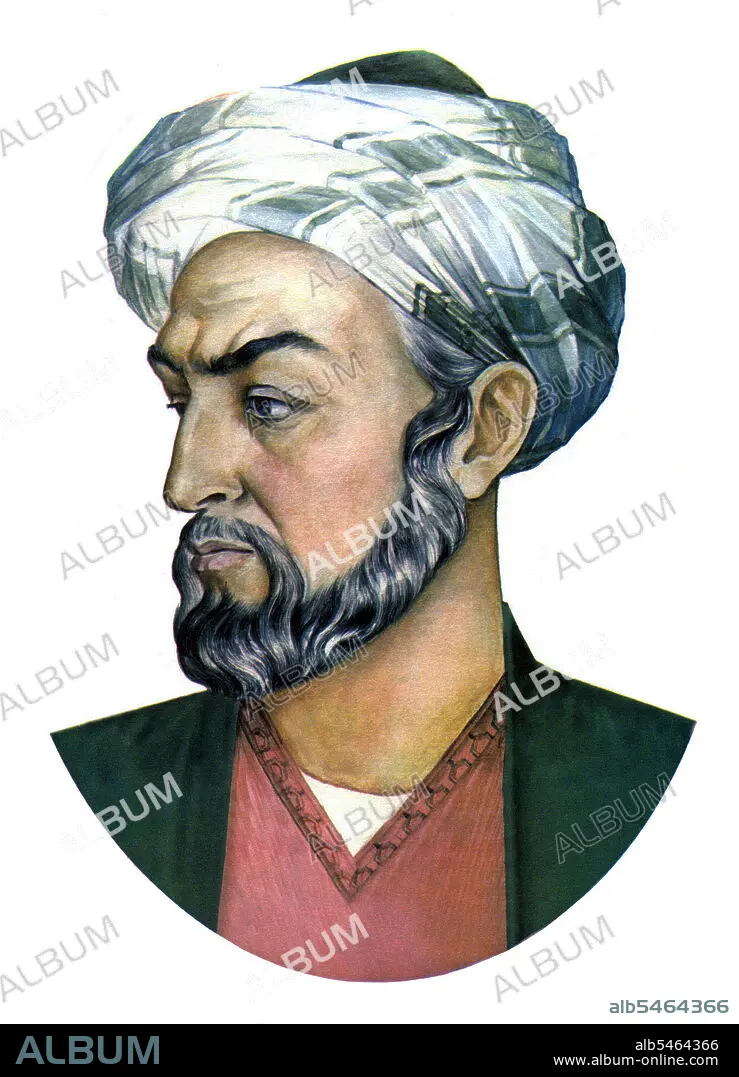
Abu aAli al-Husayn ibn aAbd Allah ibn Sina, commonly known as Ibn Sina or by his Latinized name Avicenna.
| Share |
|---|
 Pinterest Pinterest |
 Twitter Twitter |
 Facebook Facebook |
 Copy link Copy link |
 Email Email |
|
Add to another lightbox |
|
Add to another lightbox |


Buy this image.
Select the use:

Title: Abu aAli al-Husayn ibn aAbd Allah ibn Sina, commonly known as Ibn Sina or by his Latinized name Avicenna.
Caption: Abu aAli al-Husayn ibn aAbd Allah ibn Sina, commonly known as Ibn Sina or by his Latinized name Avicenna, was a Persian polymath, who wrote almost 450 treatises on a wide range of subjects, of which around 240 have survived. In particular, 150 of his surviving treatises concentrate on philosophy and 40 of them concentrate on medicine. His most famous works are 'The Book of Healing', a vast philosophical and scientific encyclopaedia, and 'The Canon of Medicine', which was a standard medical text at many medieval universities. 'The Canon of Medicine' was used as a text-book in the universities of Montpellier and Leuven as late as 1650. Ibn Sina's 'Canon of Medicine' provides a complete system of medicine according to the principles of Galen (and Hippocrates). His corpus also includes writing on philosophy, astronomy, alchemy, geology, psychology, Islamic theology, logic, mathematics, physics, as well as poetry. He is regarded as the most famous and influential polymath of the Islamic Golden Age.
Credit: Album / Pictures From History/Universal Images Group
Releases: ? Model Release: No - ? Property Release: No
Rights questions?
Rights questions?
Image size: 3600 × 4989 px | 51.4 MB
Print size: 30.5 × 42.2 cm | 1417.3 × 1964.2 in (300 dpi)
Keywords: ANT. OR.: IRAN • ART • ARTS • AVICENNA • CIENCIA • DOCTOR • DRUGS • IBN SINA • IRAN • IRANIAN • ISLAM • ISLAMIC CULTURE • ISLAMISM • LEGEND • MEDICAL • MEDICINE • MEDICO • MUSLIM • MYTH: PERSIAN • PERSIA • PERSIAN ART • PERSIAN MYTH • PERSIAN • PHILOSOPHER • PHYSICAL • PHYSICIAN • PHYSICIST • PHYSICS • PHYSIQUE • PLILOSOPHY • POLYMATH • SCIENCE • SCIENCES • UZBEK • UZBEKISTAN
