

alb8366907
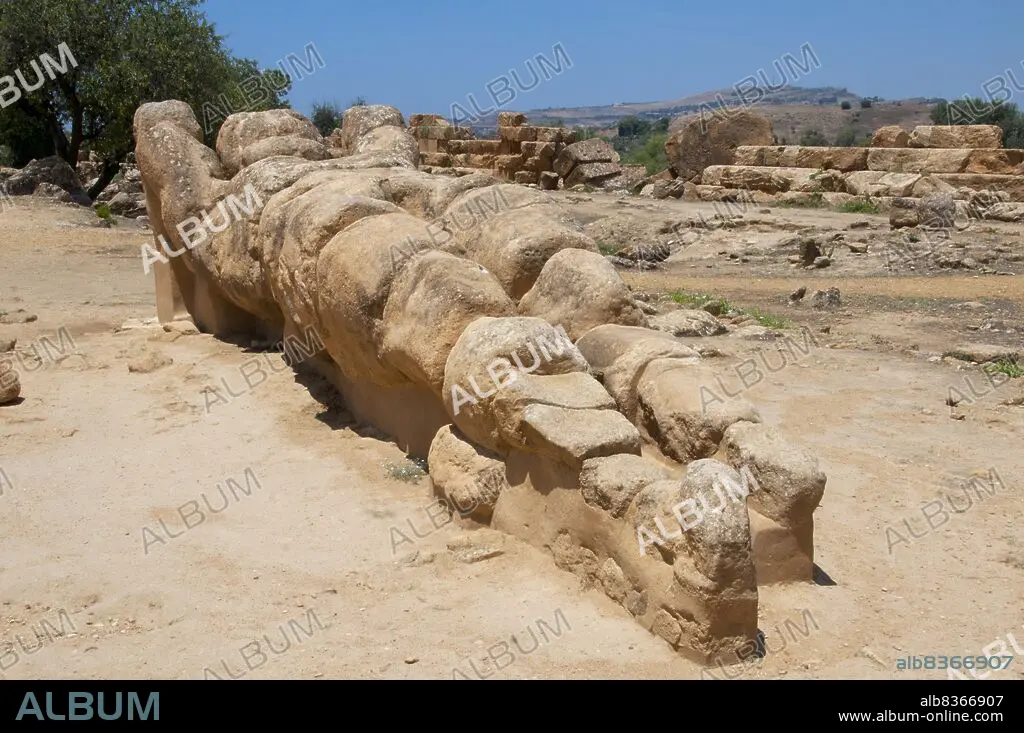
Italy: A fallen atlas (architectural support in the form of a man) at the Temple of Olympian Zeus (5th century BCE), Valley of the Temples (Valle dei Templi), Agrigento, Sicily
| Share |
|---|
 Pinterest Pinterest |
 Twitter Twitter |
 Facebook Facebook |
 Copy link Copy link |
 Email Email |
|
Add to another lightbox |
|
Add to another lightbox |


Buy this image.
Select the use:

Title: Italy: A fallen atlas (architectural support in the form of a man) at the Temple of Olympian Zeus (5th century BCE), Valley of the Temples (Valle dei Templi), Agrigento, Sicily
Caption: Agrigento was founded on a plateau overlooking the sea, with two nearby rivers, the Hypsas and the Akragas, and a ridge to the north offering a degree of natural fortification. Its establishment took place around 582580 BCE and is attributed to Greek colonists from Gela, who named it 'Akragas'.
. Akragas grew rapidly, becoming one of the richest and most famous of the Greek colonies of Magna Graecia (Greater Greece). It came to prominence under the 6th-century tyrants Phalaris and Theron, and became a democracy after the overthrow of Theron's son Thrasydaeus.
. Although the city remained neutral in the conflict between Athens and Syracuse, its democracy was overthrown when the city was sacked by the Carthaginians in 406 BCE. Akragas never fully recovered its former status, though it revived to some extent under Timoleon in the latter part of the 4th century.
. Akragas grew rapidly, becoming one of the richest and most famous of the Greek colonies of Magna Graecia (Greater Greece). It came to prominence under the 6th-century tyrants Phalaris and Theron, and became a democracy after the overthrow of Theron's son Thrasydaeus.
. Although the city remained neutral in the conflict between Athens and Syracuse, its democracy was overthrown when the city was sacked by the Carthaginians in 406 BCE. Akragas never fully recovered its former status, though it revived to some extent under Timoleon in the latter part of the 4th century.
Credit: Album / Universal Images Group / David Henley / Pictures From History
Releases: ? Model Release: No - ? Property Release: No
Rights questions?
Rights questions?
Image size: 5100 × 3388 px | 49.4 MB
Print size: 43.2 × 28.7 cm | 2007.9 × 1333.9 in (300 dpi)
Keywords: 5TH CENTURY AD • 5TH CENTURY BC • 5TH CENTURY • 5TH • ACRAGAS • AGRIGENTO • AGRIGENTUM • AKRAGAS • ANCIENT • ANTIQUE • ARCHITECTURAL • ARCHITECTURE • ARCHITECTURE. • ATLANT • ATLANTID • ATLAS • CITIES • CITY • CIUDAD • COLUMN • COLUMNAR • COLUMNS • DAVID HENLEY • DORIC • EUROPA • EUROPE • EUROPEA • EUROPEAN • EUROPEANS • GRECO • GREECE • GREEK • GREEKS • HELENICO • HELENISTICO • HELLENIC • HELLENISTIC • ITALIA • ITALIAN • ITALY • JIRJENT • JUPITER • KIRKENT • MAGNA GRAECIA • MAGNA GRECIA • MAN • MEN • OLD • OLYMPEION • OLYMPIAN • PILAR • PILLAR • RUIN • RUINS • S. V • SICILIAN • SICILY • TELAMON • TEMPERA • TEMPLE • TEMPLES • TITAN • TOWN • TOWNS • UNESCO WORLD HERITAGE SITE
