alb9435346
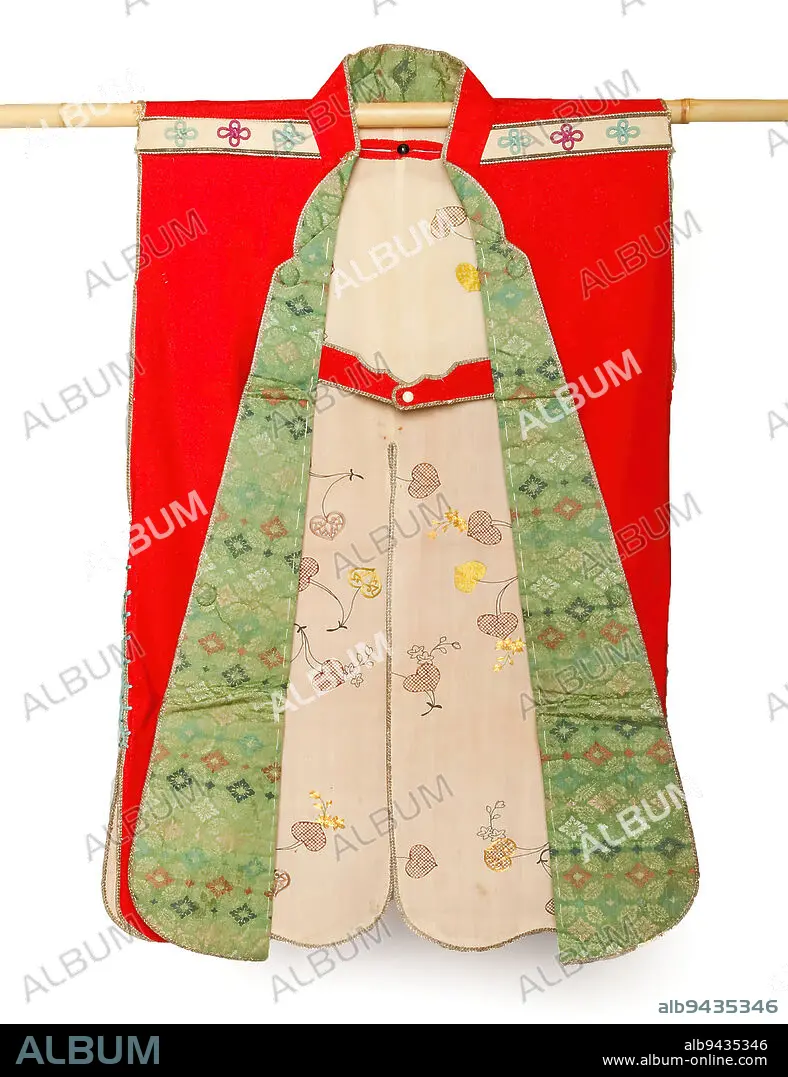
Red Surcoat with Floral Design, late 19th century, Unknown Japanese, 25 1/4 × 38 1/2 in. (64.14 × 97.79 cm), Red felt with silk design, 19th century, This jinbaori is made of rasha, a precious material only available to the wealthy and powerful. Wool fabrics had to be imported from Europe, as Japan did not produce wool. The cut, a standard form in the late Edo-period, also shows European influences, as the A-line can be considered reminiscent of a Portuguese mantle. This sleeveless surcoat has a standing collar, large armholes, and a long opening on the back for better mobility when worn over the armor and rounded corners. The flaring lapel and the collar lining is made of green silk, patterned with colorful iridescent ornaments. The beige silk lining is embroidered with flower and leaf designs, and the shoulder is decorated with wool-colored felt strips applied with ornament made of diamond knurl. The vest is held in place with a waling. The back features a family crest designed in colored wool and red felt. It shows two bars in a ring (maru ni futatsubiki) and was carried by several families, most of them descendants of the Minamoto clan. This surcoat most likely was a Noh costume.
| Share |
|---|
 Pinterest Pinterest |
 Twitter Twitter |
 Facebook Facebook |
 Copy link Copy link |
 Email Email |
|
Add to another lightbox |
|
Add to another lightbox |


Buy this image.
Select the use:

Caption:
Red Surcoat with Floral Design, late 19th century, Unknown Japanese, 25 1/4 × 38 1/2 in. (64.14 × 97.79 cm), Red felt with silk design, 19th century, This jinbaori is made of rasha, a precious material only available to the wealthy and powerful. Wool fabrics had to be imported from Europe, as Japan did not produce wool. The cut, a standard form in the late Edo-period, also shows European influences, as the A-line can be considered reminiscent of a Portuguese mantle. This sleeveless surcoat has a standing collar, large armholes, and a long opening on the back for better mobility when worn over the armor and rounded corners. The flaring lapel and the collar lining is made of green silk, patterned with colorful iridescent ornaments. The beige silk lining is embroidered with flower and leaf designs, and the shoulder is decorated with wool-colored felt strips applied with ornament made of diamond knurl. The vest is held in place with a waling. The back features a family crest designed in colored wool and red felt. It shows two bars in a ring (maru ni futatsubiki) and was carried by several families, most of them descendants of the Minamoto clan. This surcoat most likely was a Noh costume.
Personalities:
Credit:
Album / quintlox
Releases:
Image size:
2646 x 3438 px | 26.0 MB
Print size:
22.4 x 29.1 cm | 8.8 x 11.5 in (300 dpi)
Keywords:
(JAPAN) • 19 CENTURY • 19TH CENTURY • 19TH CENTURY. • 19TH • 19TH-CENTURY • A-LINE • ARMOR • AVAILABLE • BACK FEATURES • BACK • BEIGE SILK LINING • BETTER MOBILITY • BLOOM • BLOSSOM • CARRIED • CARVING • COLLAR LINING • COLORED WOOL • COLORFUL IRIDESCENT ORNAMENTS • CONSIDERED REMINISCENT • COURTYARD • CUT (TAILORING) • CUT • CUTAWAY • CUTTING • DECOR • DECORATED • DECORATION • DECORATIONS • DECORATIVE • DESCENDANTS • DESIGN: FLORAL • DIAMOND KNURL • EMBROIDERED • EUROPA • EUROPE • EUROPEAN INFLUENCES • FAMILY CREST DESIGNED • FLARING LAPEL • FLEUR • FLORAL DESIGN • FLOWER • FLOWERS • GREEN SILK • HELD • IMPORTED • JAPAN • JAPAN. • JAPANESE • JINBAORI • KNICK-KNACKS • LARGE ARMHOLES • LATE 19TH CENTURY • LATE EDO-PERIOD • LEAF DESIGNS • LONG OPENING • MARU NI FUTATSUBIKI • MINAMOTO CLAN • MORNING COAT • NINETEENTH CENTURY • NOH COSTUME • OFFSPRING • ORNAMENT • ORNAMENTATION • ORNAMENTS • PATTERNED • PLACE • PORTUGUESE MANTLE • POWERFUL • PRECIOUS MATERIAL • PRODUCE WOOL • PRUNING • RASHA • RED FELT • RED SURCOAT • RING • ROUNDED CORNERS • SEVERAL FAMILIES • SHOULDER • SILK DESIGN • SLEEVELESS SURCOAT • SLICING • STANDARD FORM • STANDING COLLAR • SURCOAT • TWO BARS • UNKNOWN JAPANESE • VEST • WALING • WALK • WALKING • WEALTHY • WOOL FABRICS • WOOL-COLORED FELT STRIPS APPLIED • WORN • XIX CENTURY
