

alb5476509
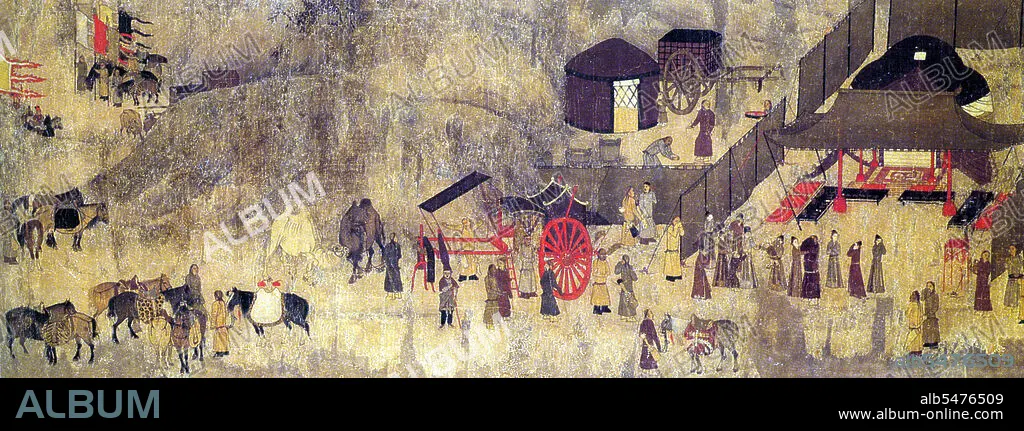
Cai Wenji (touching her baby) leaves her husband (head covered in grief) to return to the imperial capital. Painting on silk c. 1125-1150.
| Share |
|---|
 Pinterest Pinterest |
 Twitter Twitter |
 Facebook Facebook |
 Copy link Copy link |
 Email Email |
|
Add to another lightbox |
|
Add to another lightbox |


Buy this image.
Select the use:

Title: Cai Wenji (touching her baby) leaves her husband (head covered in grief) to return to the imperial capital. Painting on silk c. 1125-1150.
Caption: Cai Wenji was born shortly before 178 CE in what is now Qi County, Kaifeng, Henan. In 195, the chaos after Chancellor Dong Zhuo's death brought Xiongnu nomads into the Chinese capital and Cai Wenji was taken as prisoner to the northern lands. During her captivity, she became the wife of the Xiongnu chieftain Liu Bao and bore him two sons. It was not until twelve years later that Cao Cao, the new Chancellor of Han, ransomed her in the name of her father. When Cai Wenji returned to her homeland, she left her children behind at the frontier. The reason Cao Cao needed her back, was that she was the only one remaining of her clan and he needed her to placate the spirits of her ancestors. Cai Wenji's father Cai Yong was an established writer, but his works were lost in the ravages of war. At Cao Cao's request, Cai Wenji was able to recite from memory up to four hundred out of four thousand of her father's lost works. Later in her life, she wrote two poems describing her turbulent years. Her year of death is unknown. Contemporary (20th century) painting.
Credit: Album / Pictures From History/Universal Images Group
Releases: ? Model Release: No - ? Property Release: No
Rights questions?
Rights questions?
Image size: 7000 × 2583 px | 51.7 MB
Print size: 59.3 × 21.9 cm | 2755.9 × 1016.9 in (300 dpi)
Keywords: ART • ARTS • ASIA • ASIAN • CAO WENJI • CHINA • CHINE • CHINESE • EQUUS CABALLUS • FEMALES • HISTORIA UNIVERSAL • HISTORIA • HISTORICAL • HISTORY • HISTORY. • HORSE'S • HORSE • HORSES HORSE • HORSES • HUN • HUNS • KAIFENG • LETTERS • LITERATURA • LITERATURE • MONGOL • MONGOLIA • MONGOLIAN TRIBES • MONGOLIANS • MUJER • MUJERES • NOMAD • PAINT • PAINTING • PAINTINGS • POET • PORCELAIN • RIDING • SILK ROAD • SILK ROUTE • WOMAN WOMEN • WOMAN'S • WOMAN • WOMAN. • WOMANS • WOMEN'S • WOMEN • WOMENS • WRITER • XIONGNU
