

alb3798300
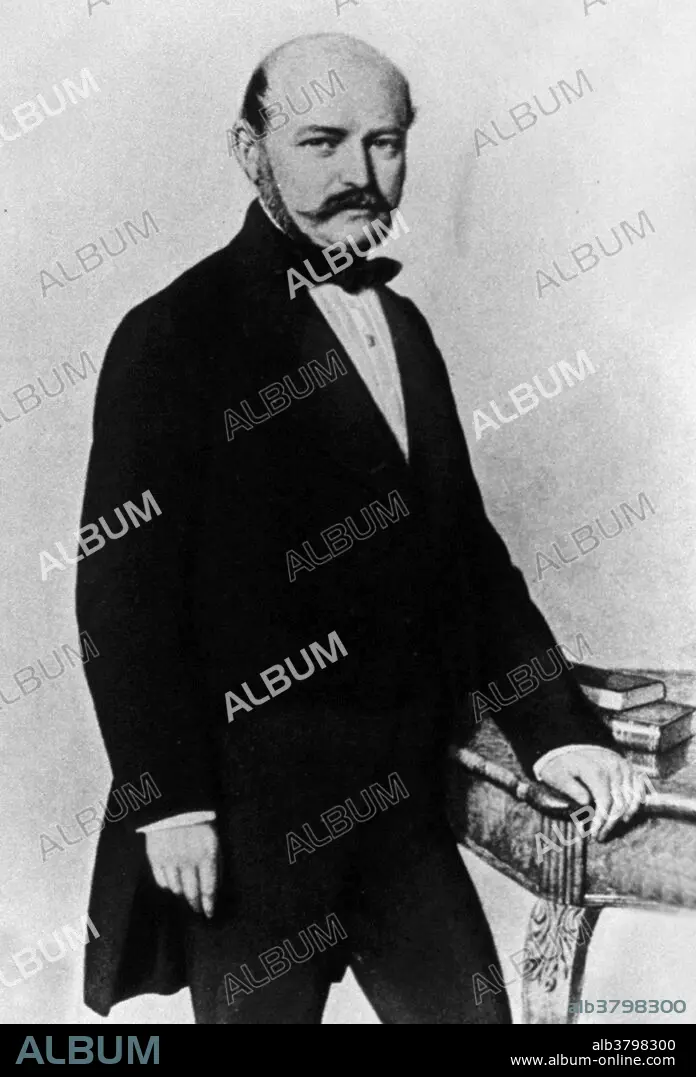
Ignaz Semmelweis, Hungarian Obstetrician and Antiseptic Pioneer
| Share |
|---|
 Pinterest Pinterest |
 Twitter Twitter |
 Facebook Facebook |
 Copy link Copy link |
 Email Email |
|
Add to another lightbox |
|
Add to another lightbox |


Buy this image.
Select the use:

Title: Ignaz Semmelweis, Hungarian Obstetrician and Antiseptic Pioneer
Caption: Ignaz Philipp Semmelweis (July 1, 1818 - August 13, 1865) was a Hungarian physician and an early pioneer of antiseptic procedures. He discovered that cases of puerperal fever, a form of septicemia, could be cut drastically if doctors washed their hands in a chlorine solution before examinations. In 1848, Semmelweis widened the scope of his washing protocol to include all instruments coming in contact with patients in labor, and used mortality rate time series to document his success in virtually eliminating puerperal fever from the hospital ward. He published a book of his findings in Etiology, Concept and Prophylaxis of Childbed Fever, but his ideas were rejected by the medical community. His views were more favorably received in England than on the continent, but he was more often cited than understood. Semmelweis suffered from severe depression and became excessively absentminded. In 1865, he was committed to an asylum. He was severely beaten by several guards, secured in a straitjacket and confined to a darkened cell. He died after two weeks from a gangrenous wound. The autopsy revealed extensive internal injuries, the cause of death septicemia. He was 47 years old.
Category: Science: Personalities
Credit: Album / NLM/Science Source
Releases: ? Model Release: No - ? Property Release: No
Rights questions?
Rights questions?
Image size: 2550 × 3752 px | 27.4 MB
Print size: 21.6 × 31.8 cm | 1003.9 × 1477.2 in (300 dpi)
Keywords: 1818 • 1865 • 19TH CENTURY • ACCOUCHEUR (MALE) • ANTISEPTIC PROCEDURES • ANTISEPTICS • ART • ARTWORK • BW • CAUSE OF DEATH SEPTICEMIA • CELEBRITIES • CELEBRITY • CHILDBED FEVER • COMMITTED TO ASYLUM • DRAWING • EUROPEA • EUROPEAN • EUROPEANS • FAMOUS PEOPLE • FAMOUS • FIGURE • HISTORIC • HISTORICAL DOCTOR • HISTORICAL PHYSICIAN • HISTORICAL • HISTORY • HUNGARIAN • IGNAZ P. SEMMELWEIS • IGNAZ PHILIPP SEMMELWEIS • IGNAZ SEMMELWEIS • ILLUSTRATION • ILLUSTRATIONS • ILUSTRATION • IMPORTANT • MALE • MAN • MEDICAL • MEDICINAL • MEN • MIDWIFE • NOTABLE • OBSTETRICIAN • PEOPLE • PERSON • PERSONALITIES • PERSONALITY • PORTAIT • PORTRAIT • POTRAIT • PUERPERAL FEVER • SCIENCE • SCIENCE: PERSONALITIES • SEMMELWEIS • SEPSIS • SEPTICAEMIA • SEPTICEMIA • SEVERE DEPRESSION • WASHING PROTOCOL • WASHING SURGICAL INSTRUMENTS • WELL-KNOWN
