

alb3619561
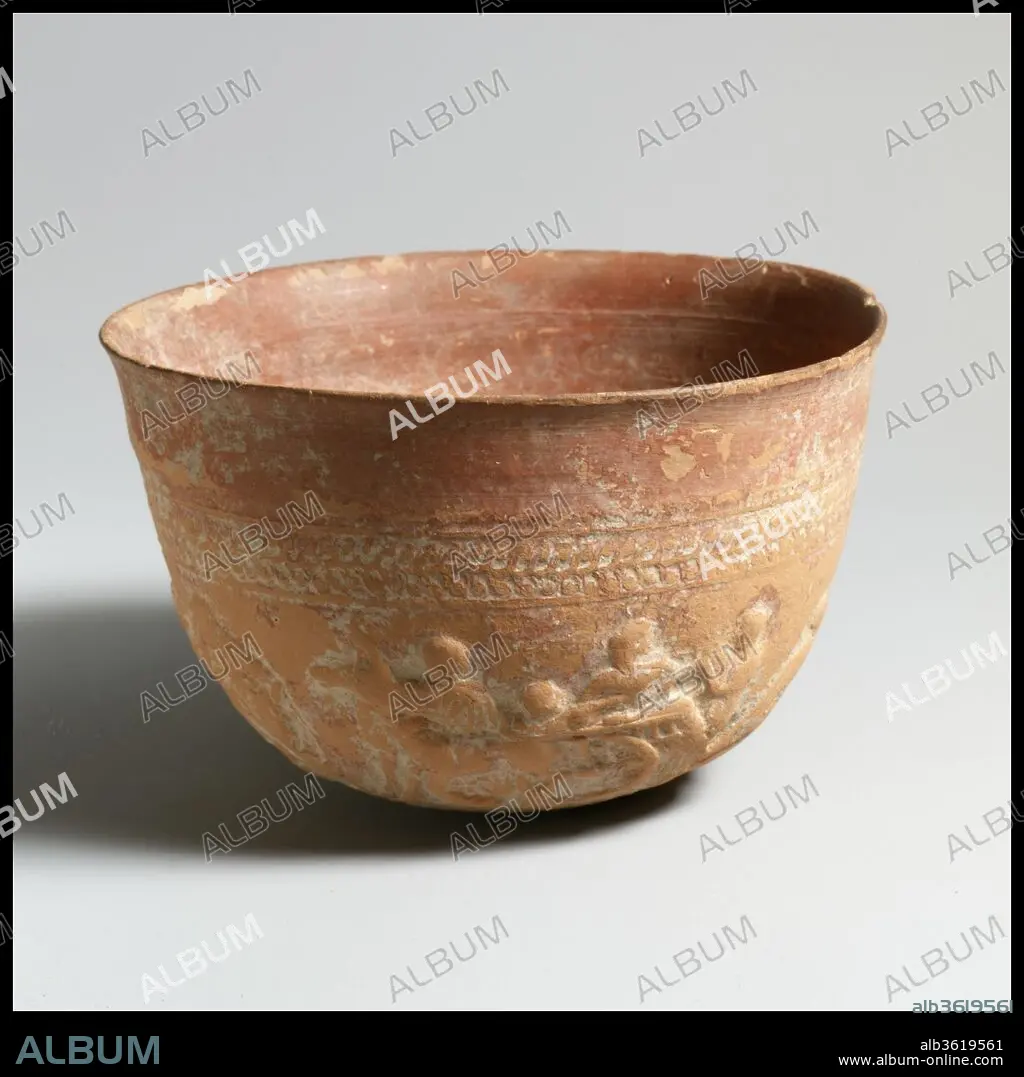
Terracotta Megarian bowl
| Share |
|---|
 Pinterest Pinterest |
 Twitter Twitter |
 Facebook Facebook |
 Copy link Copy link |
 Email Email |
|
Add to another lightbox |
|
Add to another lightbox |


Buy this image.
Select the use:

Title: Terracotta Megarian bowl
Caption: Terracotta Megarian bowl. Culture: Greek, Boeotian. Dimensions: h. 3 1/4 in. (8.3 cm); w. 5 1/2 in. (14 cm). Date: 2nd century B.C..
This vase belongs to a select group of bowls decorated in relief with scenes from epic poetry and from Classical Greek tragedy. Depicted here are five scenes from Euripides's play Iphigenia at Aulis, including inscriptions that identify the figures. Represented are: Agamemnon, who has weakened in his resolve to sacrifice his daughter to Artemis, biding his slave to take a letter to his wife, Clytemnestra, instructing her not to send her daughter to Aulis; Menelaos, Agamemnon's brother, taking the letter from the messenger by force; Menelaos, with the letter in hand, blaming Agamemnon for refusing to go through with the sacrifice; a messenger, bringing news to Agamemnon that Iphigenia has arrived; and the cart that has come from Argos, bearing Queen Clytemnestra and her children, Iphigenia and the little Orestes. The story continued on a second bowl, examples of which are preserved, again with five episodes, concluding with Iphigenia's meeting with Achilles. It is likely that a third bowl brought the story to its conclusion with Iphigenia's sacrifice.
Technique/material: TERRACOTTA
Period: Hellenistic
Museum: Metropolitan Museum of Art, New York, USA
Credit: Album
Releases: ? Model Release: No - ? Property Release: No
Rights questions?
Rights questions?
Image size: 2458 × 2458 px | 17.3 MB
Print size: 20.8 × 20.8 cm | 967.7 × 967.7 in (300 dpi)
Keywords: BOWLS • CLAY • EUROPE • GREECE • GREEK AND ROMAN ART • HELLENISTIC • MEGARIAN • METROPOLITAN MUSEUM OF ART, NEW YORK, USA • TERRACOTTA • VASES • VESSELS
