

alb10719110
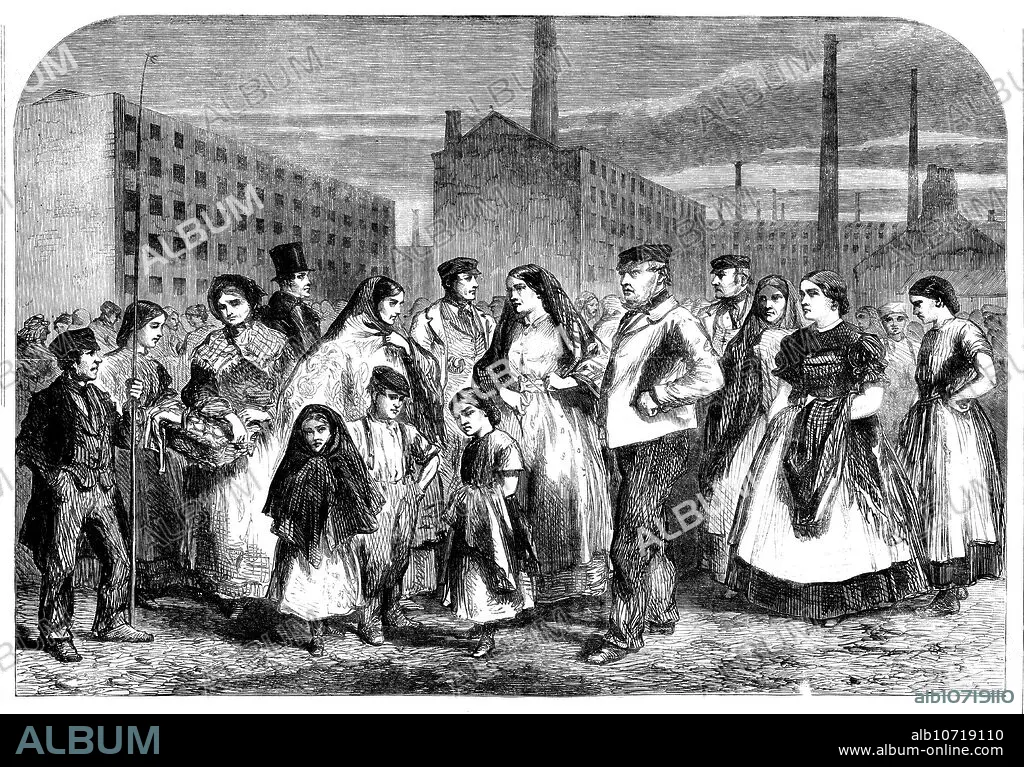
The Cotton Famine: group of mill operatives at Manchester, 1862. Creator: Unknown.
| Share |
|---|
 Pinterest Pinterest |
 Twitter Twitter |
 Facebook Facebook |
 Copy link Copy link |
 Email Email |
|
Add to another lightbox |
|
Add to another lightbox |


Buy this image.
Select the use:

Title: The Cotton Famine: group of mill operatives at Manchester, 1862. Creator: Unknown.
Caption: The Cotton Famine: group of mill operatives at Manchester, 1862. Lancashire Textile workers. 'The Carder's business is to see that machinery is kept in perfect working order...The Jack Tenter is a girl whose duty consists in taking charge of the roving frames...The business of the Hand-mule Spinner is to take the cotton rovings from the Carder and Jack Tenter, and make a thread so fine as scarcely to be seen by the naked eye, as well as threads so coarse it would require a great effort of strength to break them. The Throstle Spinner looks after throstle-frames, which produce warp-threads. She has an assistant, called the Throstle Doffer, a little girl or boy...The duty of Half-timers is to clean the machinery...that of the Power-loom Weaver consists in taking the warp and weft from the spinners and making them into cloth. The Hot-water Woman is one who provides the mill-hands with jugs and hot water for their breakfasts and dinners. The duty of the Knockers-up is to awake the factory operatives in the morning: they receive 2d. a week from each hand they knock up. The Overlooker to Self-acting Mules is one who superintends the machinery of that department...The Power-loom Overlooker superintends the machinery of the power-loom department'. From "Illustrated London News", 1862.
Credit: Album / The Print Collector/Heritage Images
Releases: ? Model Release: No - ? Property Release: No
Rights questions?
Rights questions?
Image size: 5614 × 3913 px | 62.8 MB
Print size: 47.5 × 33.1 cm | 2210.2 × 1540.6 in (300 dpi)
Keywords: 19 CENTURY • 19TH CENTURY • 19TH CENTURY. • 19TH • 19TH-CENTURY • AMERICAN CIVIL WAR • APPAREL • ART • ARTS • B & W • B / W • B W • B&W • BLACK & WHITE • BLACK AND WHITE • BOY • BOYS • BRITAIN • BRITISH • BUILDING • CENTURY • CHANGING ROOM • CHILD LABOR • CHILD LABOUR • CHILD • CHILDREN • CHIMNEY • CHIMNEYS • CLASS • CLOTHES • CLOTHING & DRESS • CLOTHING • COLOR • COLOUR • CONCEPT • COSTUME • COTTON FAMINE • COTTON INDUSTRY • COTTON • DRESS • DRESSED • EMPLOYMENT • ENGLAND • ENGRAVED • ENGRAVING • FACTORY WORKER • FACTORY WORKERS • FACTORY • FAMINE • FASHION & CLOTHING • FEMALE • FLUSH • FOLK COSTUME • GARMENT • GIRL • GIRLS • GUY • HABIT • ILLUSTRATED LONDON NEWS • ILN • INDUSTRIAL • INDUSTRY • JOB • LANCASHIRE • MALE • MAN • MANUFACTURING • MEN • MENSWEAR • MILL • MILLS • NATIONAL DRESS • NEWSPAPER • NEWSPAPERS • NINETEENTH CENTURY • OCCUPATION • PEOPLE • POOR • POVERTY • PRESS • PRINT COLLECTOR, THE • PRINT • PROFESSION • ROBE • SHAWL • SHAWLS • SHORTAGE • SHORTAGES • SMOKE • SOCIAL CLASS • SUIT • TAILOR • TEXTILE INDUSTRY • TEXTILE MILL • TEXTILE WORKER • TEXTILE WORKERS • TEXTILES WORKER • TEXTILES WORKERS • TEXTILES • TRADE • TRADITIONAL COSTUME • TRADITIONAL DRESS • UNEMPLOYED • UNEMPLOYMENT • WAR • WARTIME • WHITE AND BLACK • WOMAN • WOMEN • WORK • WORKER • WORKERS • WORKING CLASS • WORKING-CLASS • XIX CENTURY
