

alb5469270
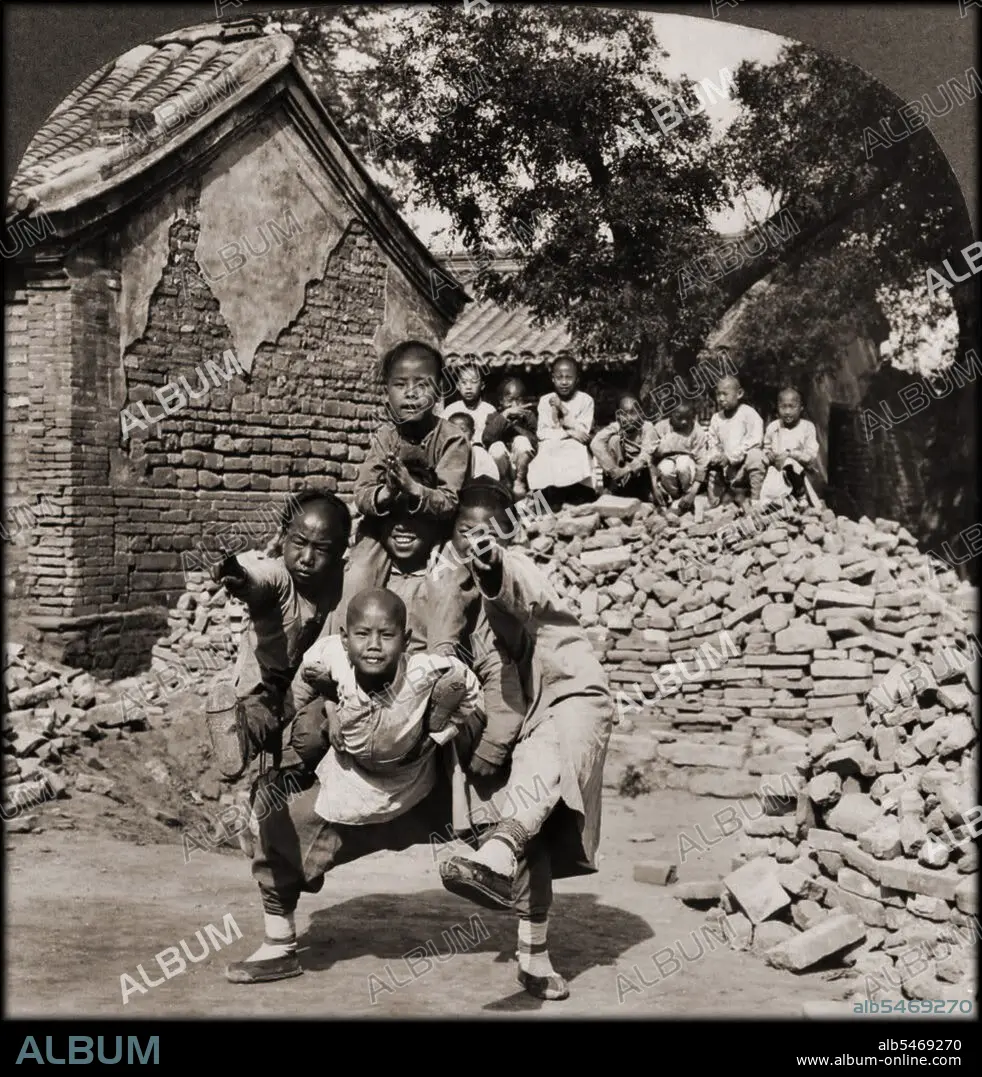
Five children at play forming a 'dragon's head' posture.
| Share |
|---|
 Pinterest Pinterest |
 Twitter Twitter |
 Facebook Facebook |
 Copy link Copy link |
 Email Email |
|
Add to another lightbox |
|
Add to another lightbox |


Buy this image.
Select the use:

Title: Five children at play forming a 'dragon's head' posture.
Caption: The Qing Dynasty (1644-1911) was founded after the Manchus defeated the Ming, the last Han Chinese dynasty. The Manchus introduced a 'queue order', forcing the Han Chinese to adopt the Manchu queue hairstyle and Manchu-style clothing. The Qing consolidated control of some areas originally under the Ming, including Yunnan. They also stretched their sphere of influence over Xinjiang, Tibet and Mongolia. But during the 19th century, Qing control weakened. Britain's desire to continue its opium trade with China collided with imperial edicts prohibiting the addictive drug, and the First Opium War erupted in 1840. Hong Kong was ceded to Britain in 1842 under the Treaty of Nanking. At the start of the 20th century, the Boxer Rebellion threatened northern China. This was a conservative anti-imperialist movement that sought to return China to old ways. The Empress Dowager, probably seeking to ensure her continued grip on power, sided with the Boxers when they advanced on Beijing. But an Eight-Nation Alliance of foreign powers defeated the Boxers and demanded further concessions from the Qing government. A revolutionary military uprising, the Wuchang Uprising, began on October 10, 1911 in Wuhan against the Qing Dynasty. The provisional government of the Republic of China was formed in Nanjing on March 12, 1912, with Sun Yat-sen as President.
Credit: Album / Pictures From History/Universal Images Group
Releases: ? Model Release: No - ? Property Release: No
Rights questions?
Rights questions?
Image size: 4100 × 4276 px | 50.2 MB
Print size: 34.7 × 36.2 cm | 1614.2 × 1683.5 in (300 dpi)
Keywords: ADOLESCENCE • ASIA • ASIAN • BOY • BOYS • CHILD • CHILDHOOD • CHILDREN'S • CHILDREN • CHILDRENS • CHILDS • CHINA • CHINE • CHINESE • CULT • DRAGON • GIRL BOY • GIRL • HISTORIA UNIVERSAL • HISTORIA • HISTORICAL • HISTORY • HISTORY. • INFANT • INFANTS • KID'S • KID • KIDS • LITTLE GIRL • MYTHOLOGICAL CREATURE • MYTHOLOGY • OFFSPRING • PLAY • PORCELAIN • QING • RITE • RITUAL • WATER • YOUTH
