

alb3823115
Georges Claude, French Engineer
| Share |
|---|
 Pinterest Pinterest |
 Twitter Twitter |
 Facebook Facebook |
 Copy link Copy link |
 Email Email |
|
Add to another lightbox |
|
Add to another lightbox |


Buy this image.
Select the use:

Title: Georges Claude, French Engineer
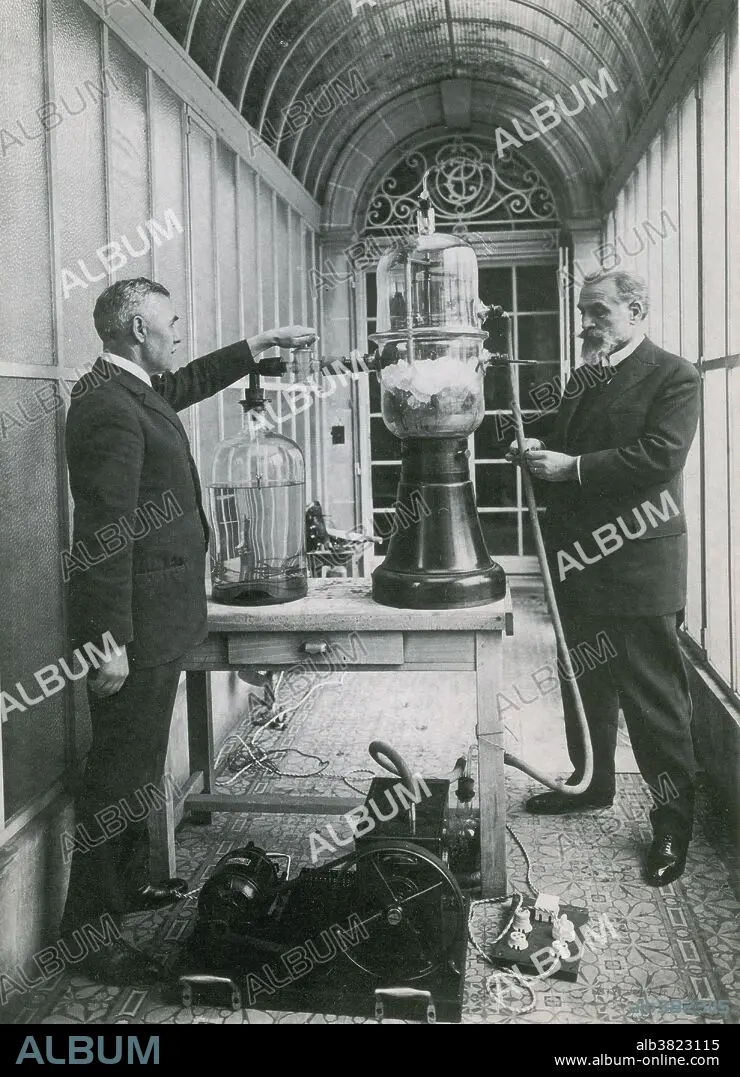
Caption: Claude in laboratory with unidentified assistant, 1926. Georges Claude (September 24, 1870 - May 23, 1960) was a French engineer and inventor. He is noted for his early work on the industrial liquefaction of air. The system enabled the production of industrial quantities of liquid nitrogen, oxygen, and argon. He developed neon tube lighting to exploit the neon that was produced as a byproduct of his air liquefaction business. He developed techniques for purifying the inert gases within a completely sealed glass tube and a design for minimizing the degradation of the electrodes that transfer electrical current from the external power supply to the glowing gases within the sign. Neon lighting quickly became a popular fixture in outdoor advertising. Visible even in daylight, people would stop and stare at the first neon signs for hours, dubbed "liquid fire." He also experimented on generating energy by pumping cold seawater up from the depths. Considered by some to be "the Edison of France", he was an active collaborator with the German occupiers of France during the Second World War. He was condemned to life imprisonment, and was imprisoned. In 1950 he was released from prison, with acknowledgment of his research on ocean thermal energy conversion. He died in 1960 at the age of 89.
Category: Science: Personalities • History: Personalities
Credit: Album / Science Source / New York Public Library
Releases: ? Model Release: No - ? Property Release: No
Rights questions?
Rights questions?
Image size: 3208 × 4440 px | 40.8 MB
Print size: 27.2 × 37.6 cm | 1263.0 × 1748.0 in (300 dpi)
Keywords: 1926 • 19TH CENTURY • 20 20TH XX XXTH TWENTIETH CENTURY • 20 XX TWENTIETH CENTURY • 20TH CENTURY • 20TH • BW • CELEBRITIES • CELEBRITY • CLAUDE • DISCOVERER • EDISON OF FRANCE • ENGINEER • EUROPEA • EUROPEAN • EUROPEANS • EXPLORER • FAMOUS PEOPLE • FAMOUS • FIGURE • FRENCH • GEORGES CLAUDE • HISTORIC • HISTORICAL • HISTORY • HISTORY: PERSONALITIES • IMPORTANT • INDUSTRIAL LIQUEFACTION OF AIR • INVENTION • INVENTOR (MALE) • INVENTOR • LIQUEFACTION OF AIR • MALE • MAN • MEN • NAZI COLLABORATOR • NEON LIGHT • NEON LIGHTING • NEON SIGNS • NOTABLE • OCEAN THERMAL ENERGY CONVERSION • PEOPLE • PERSON • PERSONALITIES • PERSONALITY • PURIFYING THE INERT GASES • RESEARCH • RESEARCHER (MALE) • RESEARCHER • SCIENCE • SCIENCE: PERSONALITIES • TWENTIETH CENTURY • WELL-KNOWN
