

alb5145300
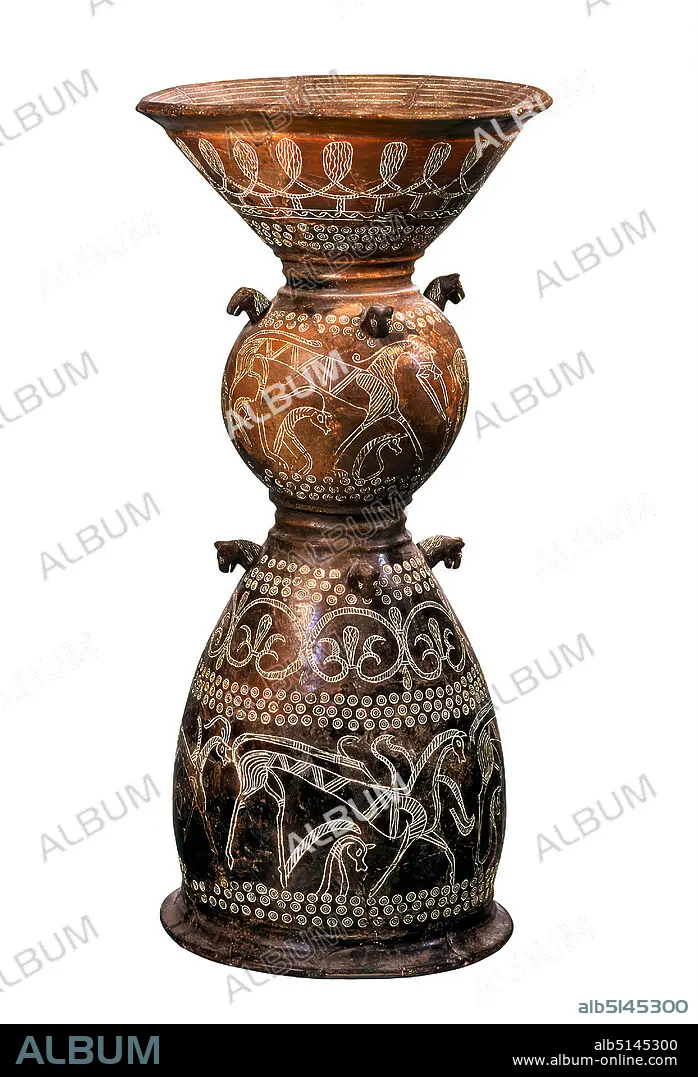
Holmos, Formerly Johannes W. F. Collection Reimers (Hamburg), clay, slowly turned, hand-modeled, fired (ceramic), clay, Total: Height: 81.5 cm; Diameter: 37 cm, ceramic, mythical creatures, monsters, legendary figures, mythical animals (hoofed animals), fabulous creatures (predators), ornaments, plant ornaments, animals as ornament, antiquity, Characteristic for a so-called Holmos is its shape with a widely projecting funnel, small spherical middle part and bell-shaped lower part. The vessel almost looks like a strongly abstracted human body, on whose head a bowl is balanced. This holmos has a richly incised and stamped decoration, which decorates the vessel stand in several registers. Animal and ornamental friezes are separated from each other by three rows of concentric circles with a central point. Four plastic animal heads each surround the middle and lower part. Depicted are horses, mythical animals with wings or horns, cat-like animals and in the open spaces animal protoms. Distinctive are the overlength slender legs, the stylized bodies and the small head. The design of the animals and mythical creatures is strongly reminiscent of the Orientalizing phase that began in Greece at the beginning of the 7th century B.C, in which angular geometric art was replaced by curved forms and enriched with interior decorations, flower motifs and supernatural beings such as the sphinx. The Holmos is an impressive Italian creation. It served as a vessel stand for a large cauldron in which wine and water were probably mixed and served to guests at a feast. Oriental metal stands and cauldrons from the Syrian-Urartian region served as models. Named after a site near Bologna, the Villanova culture had developed and spread in pre-Roman Italy from the 9th century BC onwards. Tuscany was an important center of this early culture. Characteristic features included cremation burials in vessel urns, the addition of bronze weapons and armour, and a brownish ceramic known as impasto ware.
| Compartir |
|---|
 Pinterest Pinterest |
 Twitter Twitter |
 Facebook Facebook |
 Copiar enlace Copiar enlace |
 Email Email |
|
Añadir a otro lightbox |
|
Añadir a otro lightbox |


¿Ya tienes cuenta? Iniciar sesión
¿No tienes cuenta? Regístrate
Compra esta imagen.
Selecciona el uso:

Descripción: Ver traducción automática
Holmos, Formerly Johannes W. F. Collection Reimers (Hamburg), clay, slowly turned, hand-modeled, fired (ceramic), clay, Total: Height: 81.5 cm; Diameter: 37 cm, ceramic, mythical creatures, monsters, legendary figures, mythical animals (hoofed animals), fabulous creatures (predators), ornaments, plant ornaments, animals as ornament, antiquity, Characteristic for a so-called Holmos is its shape with a widely projecting funnel, small spherical middle part and bell-shaped lower part. The vessel almost looks like a strongly abstracted human body, on whose head a bowl is balanced. This holmos has a richly incised and stamped decoration, which decorates the vessel stand in several registers. Animal and ornamental friezes are separated from each other by three rows of concentric circles with a central point. Four plastic animal heads each surround the middle and lower part. Depicted are horses, mythical animals with wings or horns, cat-like animals and in the open spaces animal protoms. Distinctive are the overlength slender legs, the stylized bodies and the small head. The design of the animals and mythical creatures is strongly reminiscent of the Orientalizing phase that began in Greece at the beginning of the 7th century B.C, in which angular geometric art was replaced by curved forms and enriched with interior decorations, flower motifs and supernatural beings such as the sphinx. The Holmos is an impressive Italian creation. It served as a vessel stand for a large cauldron in which wine and water were probably mixed and served to guests at a feast. Oriental metal stands and cauldrons from the Syrian-Urartian region served as models. Named after a site near Bologna, the Villanova culture had developed and spread in pre-Roman Italy from the 9th century BC onwards. Tuscany was an important center of this early culture. Characteristic features included cremation burials in vessel urns, the addition of bronze weapons and armour, and a brownish ceramic known as impasto ware.
Holmos, Formerly Johannes W. F. Collection Reimers (Hamburg), clay, slowly turned, hand-modeled, fired (ceramic), clay, Total: Height: 81.5 cm; Diameter: 37 cm, ceramic, mythical creatures, monsters, legendary figures, mythical animals (hoofed animals), fabulous creatures (predators), ornaments, plant ornaments, animals as ornament, antiquity, Characteristic for a so-called Holmos is its shape with a widely projecting funnel, small spherical middle part and bell-shaped lower part. The vessel almost looks like a strongly abstracted human body, on whose head a bowl is balanced. This holmos has a richly incised and stamped decoration, which decorates the vessel stand in several registers. Animal and ornamental friezes are separated from each other by three rows of concentric circles with a central point. Four plastic animal heads each surround the middle and lower part. Depicted are horses, mythical animals with wings or horns, cat-like animals and in the open spaces animal protoms. Distinctive are the overlength slender legs, the stylized bodies and the small head. The design of the animals and mythical creatures is strongly reminiscent of the Orientalizing phase that began in Greece at the beginning of the 7th century B.C, in which angular geometric art was replaced by curved forms and enriched with interior decorations, flower motifs and supernatural beings such as the sphinx. The Holmos is an impressive Italian creation. It served as a vessel stand for a large cauldron in which wine and water were probably mixed and served to guests at a feast. Oriental metal stands and cauldrons from the Syrian-Urartian region served as models. Named after a site near Bologna, the Villanova culture had developed and spread in pre-Roman Italy from the 9th century BC onwards. Tuscany was an important center of this early culture. Characteristic features included cremation burials in vessel urns, the addition of bronze weapons and armour, and a brownish ceramic known as impasto ware.
Crédito: Album / quintlox
Autorizaciones: ? Cesión de modelo: No - ? Cesión de propiedad: No
¿Preguntas relacionadas con los derechos?
¿Preguntas relacionadas con los derechos?
Tamaño imagen: 2945 × 4320 px | 36.4 MB
Tamaño impresión: 24.9 × 36.6 cm | 1159.4 × 1700.8 in (300 dpi)
Palabras clave: ADAPTADOS • ADICION • ADORNO • AGUA • AGUAS • ALAS • ALFARERIA • ANIMAL • ANIMALES • ANTIGÜEDAD • ANTIGÜEDADES • ANTIQUITY • ARCILLA • ARMADURA • ARMADURAS • AVES • BANQUETE • BOLONIA • BUQUE • CABALLO • CABALLOS • CABEZA • CALDEROS • CARACTERÍSTICAS • CERÁMICA • CERÁMICO • CIRCULOS CONCENTRICOS • CONDICION • CORAZA • CUENCO • CUERNOS • CULTURA VILLANOVA • DECORACION ESTAMPILLADA • DECORACION • DECORATIVO • DIAMETRO • DISEÑO • DISPARARON • EN • EQUILIBRADA • ESFINGE • FENICIOS • FIGURA • FORMA • GRECIA • GRIEGOS • HAMBURGO • IMAGENES • LLENA • MEDIA • MENA • MIDDLE • MIXED • MIXTOS • MODELOS • OBJETO DE ARCILLA • OBJETO DE CERAMICA • ORNAMENTACIÓN • ORNAMENTO • ORNAMENTOS • PENSAMIENTOS • PLACE • REFORZAR • S. VII AC • SEPARADOS • SHAPE • SIGLO VII A. C. • SIGLO VII AC • SIGLO VIII A. C. • SÍTIO • TAZON • TERRACOTA • TERRACOTTA • TIEMPO, EL • TOSCANA • TRADICIONES • TRANSFORMADO • VIDRIO • VINO • YESO
