

alb3664185
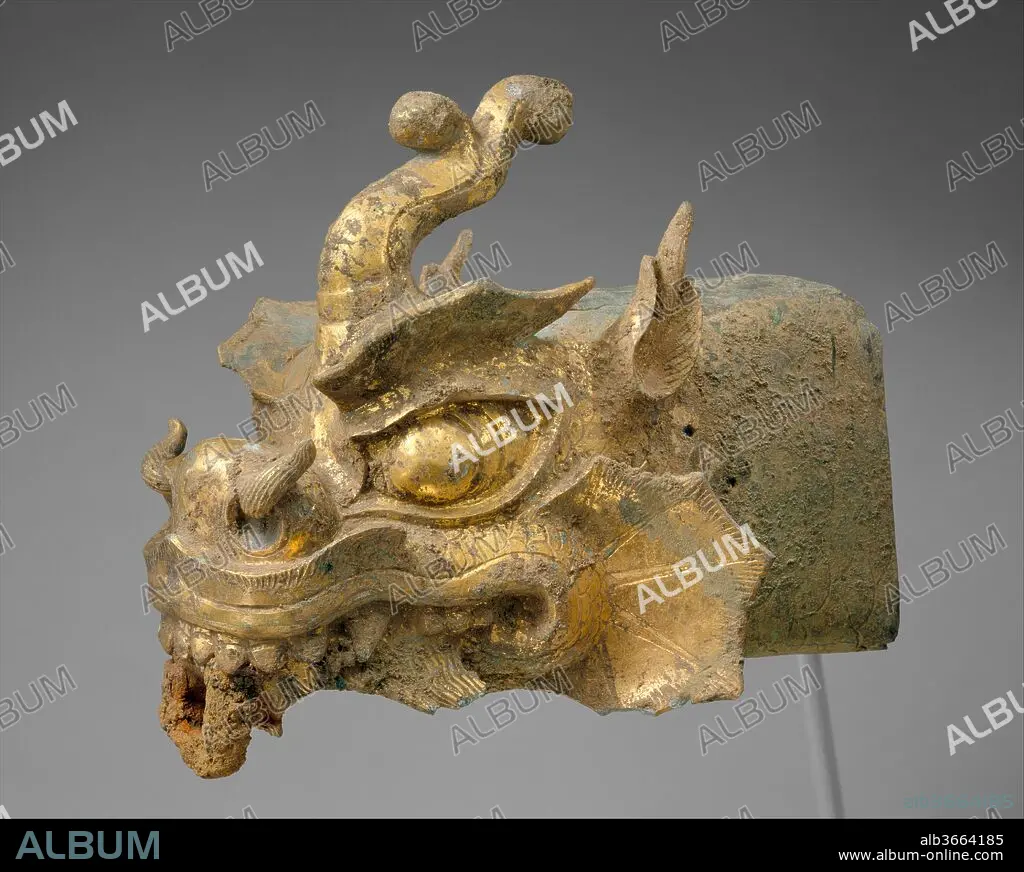
Rafter finial in the shape of a dragon's head and wind chime
| Compartir |
|---|
 Pinterest Pinterest |
 Twitter Twitter |
 Facebook Facebook |
 Copiar enlace Copiar enlace |
 Email Email |
|
Añadir a otro lightbox |
|
Añadir a otro lightbox |


¿Ya tienes cuenta? Iniciar sesión
¿No tienes cuenta? Regístrate
Compra esta imagen.
Selecciona el uso:

Título: Rafter finial in the shape of a dragon's head and wind chime
Descripción: Ver traducción automática
Rafter finial in the shape of a dragon's head and wind chime. Culture: Korea. Dimensions: Finial: L. 15 1/2 in. (39.4 cm); H. 11 3/4 in. (29.8 cm); W. 9 in. (22.9 cm); Chime: H. 15 1/4 in. (38.7 cm); W. 7 1/4 in. (18.4 cm). Date: 10th century. This finial in the shape of a dragon's head would originally have been attached to a corner rafter of a royal hall or a Buddhist temple building (see, for example, the photograph to the left of a model pagoda that replicates a full-size wood structure from the Goryeo dynasty). The beast's bulging eyes, flaring nostrils, and elaborate scales convey the fierceness and invincibility of this auspicious creature. The small holes at the sides of the neck were probably used to secure the heavy object to the roof. The bell, which functioned as a wind chime, once had a metal-plate clapper inside. The bell would have been suspended from the loop at the mouth of the dragon by a hook. The decorative panels on the lower halves of both faces of the bell feature a swastika (an ancient symbol associated with the Buddha) within a lotus-flower platform. A nearly identical set of a dragon's head and wind chime, the only other comparable extant example, is in the collection of the Leeum, Samsung Museum of Art in Seoul.
Rafter finial in the shape of a dragon's head and wind chime. Culture: Korea. Dimensions: Finial: L. 15 1/2 in. (39.4 cm); H. 11 3/4 in. (29.8 cm); W. 9 in. (22.9 cm); Chime: H. 15 1/4 in. (38.7 cm); W. 7 1/4 in. (18.4 cm). Date: 10th century. This finial in the shape of a dragon's head would originally have been attached to a corner rafter of a royal hall or a Buddhist temple building (see, for example, the photograph to the left of a model pagoda that replicates a full-size wood structure from the Goryeo dynasty). The beast's bulging eyes, flaring nostrils, and elaborate scales convey the fierceness and invincibility of this auspicious creature. The small holes at the sides of the neck were probably used to secure the heavy object to the roof. The bell, which functioned as a wind chime, once had a metal-plate clapper inside. The bell would have been suspended from the loop at the mouth of the dragon by a hook. The decorative panels on the lower halves of both faces of the bell feature a swastika (an ancient symbol associated with the Buddha) within a lotus-flower platform. A nearly identical set of a dragon's head and wind chime, the only other comparable extant example, is in the collection of the Leeum, Samsung Museum of Art in Seoul.
Técnica/material: gilt bronze
Periodo: early Goryeo dynasty (918-1392)
Museo: Metropolitan Museum of Art, New York, USA
Crédito: Album
Autorizaciones: ? Cesión de modelo: No - ? Cesión de propiedad: No
¿Preguntas relacionadas con los derechos?
¿Preguntas relacionadas con los derechos?
Tamaño imagen: 4192 × 3354 px | 40.2 MB
Tamaño impresión: 35.5 × 28.4 cm | 1650.4 × 1320.5 in (300 dpi)
Palabras clave: ALEACIÓN DE COBRE • ARTE ASIATICO • ASIA • BRONCE DORADO • BRONCE • BRONZE • COREA • DORADO • ESCULTURA • METAL • METROPOLITAN MUSEUM OF ART, NEW YORK, USA • OBRA DE BRONCE • PLATO
