

alb3822320
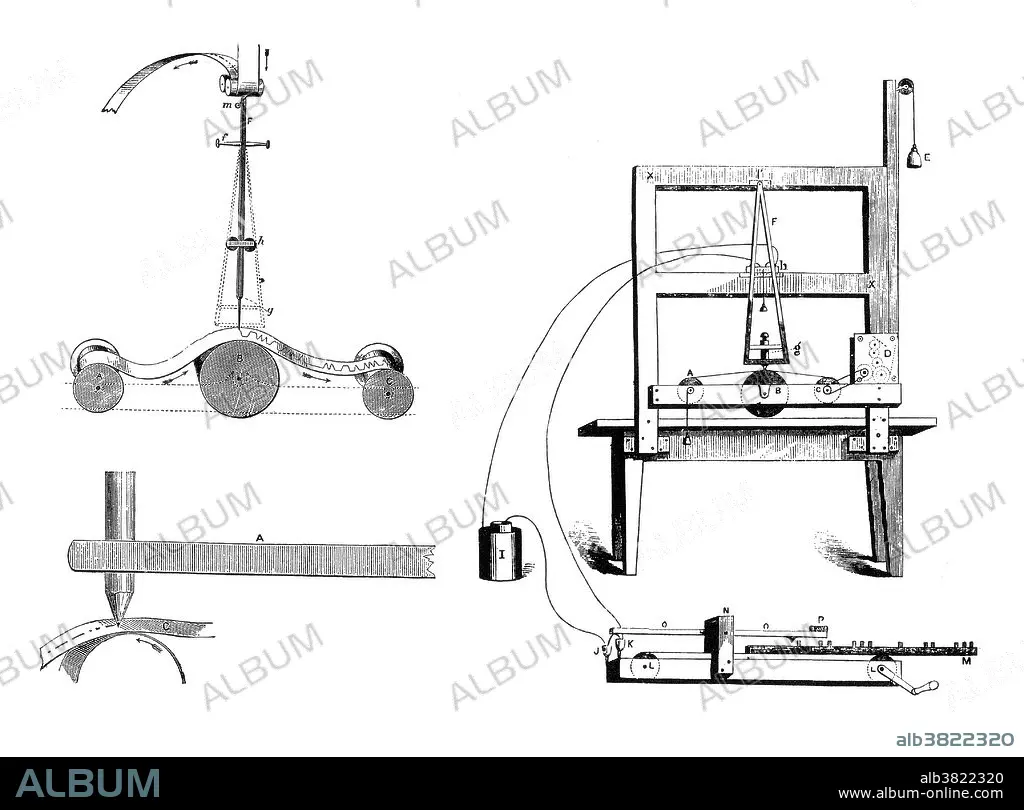
Samuel Morse, Original Telegraph Receiver
| Compartir |
|---|
 Pinterest Pinterest |
 Twitter Twitter |
 Facebook Facebook |
 Copiar enlace Copiar enlace |
 Email Email |
|
Añadir a otro lightbox |
|
Añadir a otro lightbox |


¿Ya tienes cuenta? Iniciar sesión
¿No tienes cuenta? Regístrate
Compra esta imagen.
Selecciona el uso:

Título: Samuel Morse, Original Telegraph Receiver
Descripción: Ver traducción automática
An electrical telegraph was independently developed and patented in the United States in 1837 by Samuel Morse. Morse's first telegraph receiver made from a modified canvas stretcher. The original receiver was an electromagnet which actuated a pencil pressing down on a moving strip of tape. Each pulse from the sender made the pendulum swing. The paper tape then showed a series of sawtooth marks that corresponded with the ridges of the original slug and the message could be deciphered from the paper strip. Morse's original plan did not include a key. Instead, he copied the early printer's use of a composing stick. Slugs of metal wire were ridge along one face and each slug represented a letter. The entire message was mounted in a line of slugs and pushed along beneath a wooden finger that made and broke the circuit. His original code was too complicated to be memorized.
An electrical telegraph was independently developed and patented in the United States in 1837 by Samuel Morse. Morse's first telegraph receiver made from a modified canvas stretcher. The original receiver was an electromagnet which actuated a pencil pressing down on a moving strip of tape. Each pulse from the sender made the pendulum swing. The paper tape then showed a series of sawtooth marks that corresponded with the ridges of the original slug and the message could be deciphered from the paper strip. Morse's original plan did not include a key. Instead, he copied the early printer's use of a composing stick. Slugs of metal wire were ridge along one face and each slug represented a letter. The entire message was mounted in a line of slugs and pushed along beneath a wooden finger that made and broke the circuit. His original code was too complicated to be memorized.
Personas: SAMUEL FINLEY BREESE MORSE
Crédito: Album / NYPL/Science Source
Autorizaciones: ? Cesión de modelo: No - ? Cesión de propiedad: No
¿Preguntas relacionadas con los derechos?
¿Preguntas relacionadas con los derechos?
Tamaño imagen: 4350 × 3217 px | 40.0 MB
Tamaño impresión: 36.8 × 27.2 cm | 1712.6 × 1266.5 in (300 dpi)
Palabras clave: 1837 • AMERICA • AMERICANO • ARTE • BLANCO Y NEGRO • CIENCIA • COMUNICACION • DIAGRAMA • DIBUJO • ELECTRICIDAD • ESTADOS UNIDOS DE AMERICA • ESTADOS UNIDOS • FAMOSA • FAMOSO • FAMOSOS • HISTORIA • HISTORICO • ILUSTRACION • ILUSTRACIONES • IMPORTANTE • INVENCION • MORSE • OBRA DE ARTE • ORIGINAL • PRIMERO • SAMUEL FINLEY BREESE MORSE • SAMUEL MORSE • SIGLO XIX • TECNOLOGÍA • TECNOLÓGICA • TRANSMISION
