

alb4874863
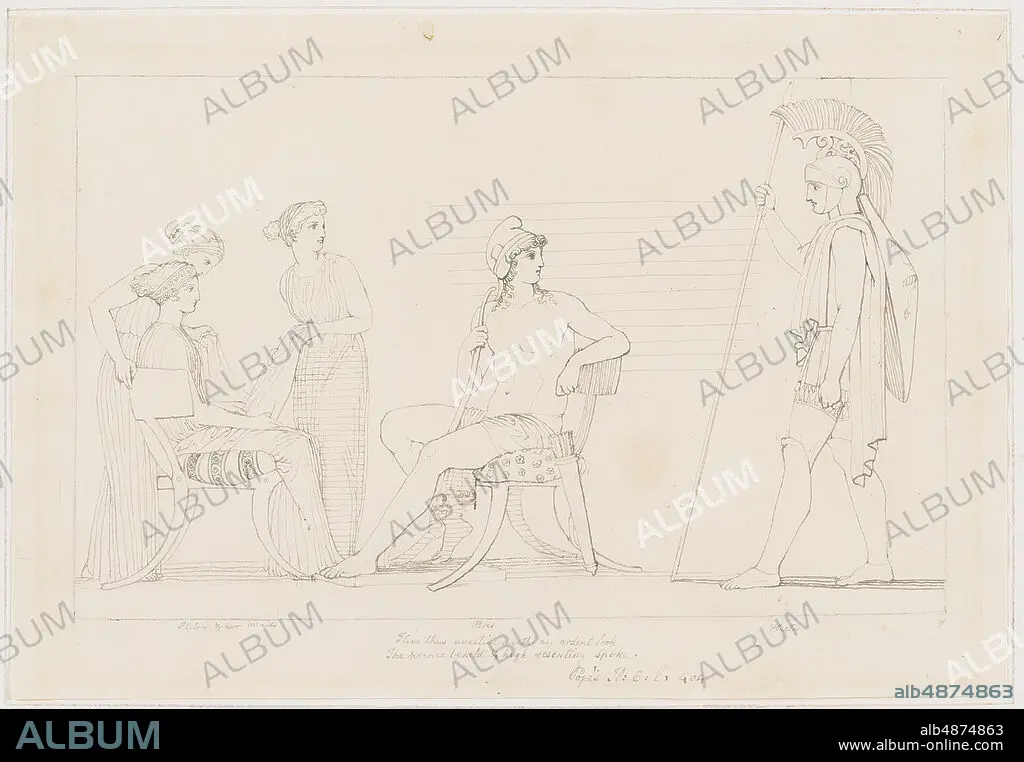
John Flaxman, Hector Chiding Paris, 1792-1793, pen and grey ink, brush and black ink over graphite on wove paper, 8 3/8 in. x 12 1/8 in. (21.27 cm. x 30.8 cm.), This drawing by the English Neoclassical sculptor and illustrator John Flaxman conjures a scene from Homer's 'Iliad', the first book the artist illustrated to great acclaim. (His later projects included Dante's 'Divine Comedy,' and Aeschylus.) Commissioned by Mrs. Hare-Naylor in 1792 or 1793 and created in Rome, Flaxman's drawing for the 'Iliad' shows the Trojan leader Hector chastising Paris for defending Troy haphazardly. Flaxman used this drawing as a preparatory study for the published engraving of the encounter. The final work is simplified even further, as it drops Helen's maids and presents the nude, effeminate Paris resting on a bow, his head lowered in shame. Flaxman's drawings of classical scenes and his designs for Josiah Wedgwood's ceramic wares sparked a craze throughout Europe for his silhouetted figures, which Flaxman had developed from engravings of Greek vases.
| Compartir |
|---|
 Pinterest Pinterest |
 Twitter Twitter |
 Facebook Facebook |
 Copiar enlace Copiar enlace |
 Email Email |
|
Añadir a otro lightbox |
|
Añadir a otro lightbox |


¿Ya tienes cuenta? Iniciar sesión
¿No tienes cuenta? Regístrate
Compra esta imagen.
Selecciona el uso:

Descripción: Ver traducción automática
John Flaxman, Hector Chiding Paris, 1792-1793, pen and grey ink, brush and black ink over graphite on wove paper, 8 3/8 in. x 12 1/8 in. (21.27 cm. x 30.8 cm.), This drawing by the English Neoclassical sculptor and illustrator John Flaxman conjures a scene from Homer's 'Iliad', the first book the artist illustrated to great acclaim. (His later projects included Dante's 'Divine Comedy,' and Aeschylus.) Commissioned by Mrs. Hare-Naylor in 1792 or 1793 and created in Rome, Flaxman's drawing for the 'Iliad' shows the Trojan leader Hector chastising Paris for defending Troy haphazardly. Flaxman used this drawing as a preparatory study for the published engraving of the encounter. The final work is simplified even further, as it drops Helen's maids and presents the nude, effeminate Paris resting on a bow, his head lowered in shame. Flaxman's drawings of classical scenes and his designs for Josiah Wedgwood's ceramic wares sparked a craze throughout Europe for his silhouetted figures, which Flaxman had developed from engravings of Greek vases.
John Flaxman, Hector Chiding Paris, 1792-1793, pen and grey ink, brush and black ink over graphite on wove paper, 8 3/8 in. x 12 1/8 in. (21.27 cm. x 30.8 cm.), This drawing by the English Neoclassical sculptor and illustrator John Flaxman conjures a scene from Homer's 'Iliad', the first book the artist illustrated to great acclaim. (His later projects included Dante's 'Divine Comedy,' and Aeschylus.) Commissioned by Mrs. Hare-Naylor in 1792 or 1793 and created in Rome, Flaxman's drawing for the 'Iliad' shows the Trojan leader Hector chastising Paris for defending Troy haphazardly. Flaxman used this drawing as a preparatory study for the published engraving of the encounter. The final work is simplified even further, as it drops Helen's maids and presents the nude, effeminate Paris resting on a bow, his head lowered in shame. Flaxman's drawings of classical scenes and his designs for Josiah Wedgwood's ceramic wares sparked a craze throughout Europe for his silhouetted figures, which Flaxman had developed from engravings of Greek vases.
Personas: JOHN FLAXMAN
Crédito: Album / quintlox
Autorizaciones: ? Cesión de modelo: No - ? Cesión de propiedad: No
¿Preguntas relacionadas con los derechos?
¿Preguntas relacionadas con los derechos?
Tamaño imagen: 6000 × 4152 px | 71.3 MB
Tamaño impresión: 50.8 × 35.2 cm | 2362.2 × 1634.6 in (300 dpi)
Palabras clave: 1792 • 1793 • AGUAFUERTE • BOLIGRAFO • DESNUDA • DESNUDAS • DESNUDO • DESNUDOS • DIBUJO • DISEÑOS • ENGRAVING • ESCENA • ESTUDIO PREPARATORIO • EUROPA • GRABADO • GRABADOS • GRAFITO • JOHN FLAXMAN • PAPEL PERGAMINO • ROMA • TINTA NEGRA
