

alb3669824
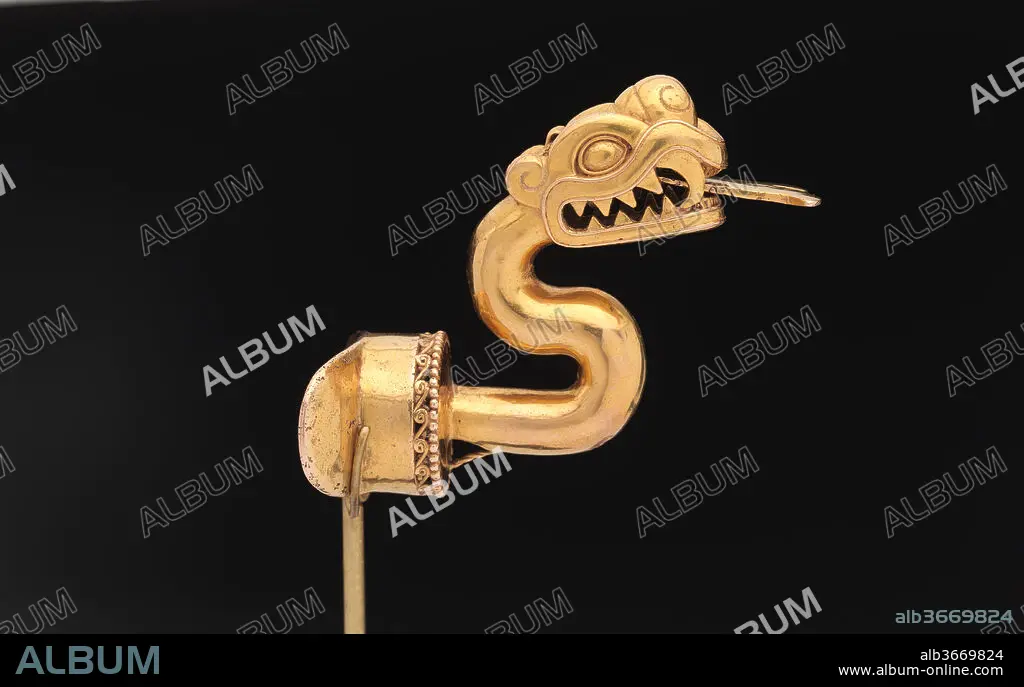
Serpent Labret with Articulated Tongue
| Compartir |
|---|
 Pinterest Pinterest |
 Twitter Twitter |
 Facebook Facebook |
 Copiar enlace Copiar enlace |
 Email Email |
|
Añadir a otro lightbox |
|
Añadir a otro lightbox |


¿Ya tienes cuenta? Iniciar sesión
¿No tienes cuenta? Regístrate
Compra esta imagen.
Selecciona el uso:

Título: Serpent Labret with Articulated Tongue
Descripción:
Traducción automática: Labret con lengua articulada en forma de serpiente. Cultura: Azteca. Dimensiones: Alto 2 5/8 × Ancho 1 3/4 × Profundidad 2 5/8 in. (6,67 × 4,45 × 6,67 cm) Peso 1,81 oz (51,35 g). Fecha: 1300-1521 d. C. Elaborado con la forma de una serpiente lista para atacar, este labret (tapón para labios) fue ingeniosamente fundido en dos piezas separadas, de modo que la lengua bifurcada móvil pudiera retraerse o dejarse oscilar de un lado a otro cuando el usuario se moviera. La ceja y el hocico enroscados y el tocado de plumas pueden marcar a esta criatura como Xiuhcoatl, la poderosa serpiente de fuego y arma animada del dios del sol, Huitzilopochtli. Los labrets eran insignias de poder militar y político, y se otorgaban tipos específicos en función de los logros en el campo de batalla. Este bezote estupendamente elaborado en forma de lista de serpientes para el ataque, fue fundido en dos partes separadas: la lengua bifurcada amovible podía ser retractada, o podía moverse de lado a lado con el movimiento de la persona que lo llevaba puesto. Los bezotes eran insignias de poder militar y político. Algunos tipos específicos de bezotes fueron atribuidos según los logros en el campo de batalla. Las cejas y el hocico curvos y el tocado de plumas permiten identificar a este ser, aunque no de manera segura, como Xiuhcóatl, la poderosa serpiente de fuego, y animar al dios del sol, Huitzilopochtli. Magníficamente elaborado con la forma de una serpiente lista para atacar, este labret (un tipo de tapón que se inserta a través de un piercing debajo del labio inferior) es una rara supervivencia de lo que alguna vez fue una próspera tradición de trabajo en oro en el Imperio Azteca. El oro, en la creencia azteca, era teocuitlatl , un excremento divino, estrechamente asociado con el poder del sol, y los gobernantes y nobles aztecas usaban adornos hechos de él. Las fuentes históricas describen una variedad de objetos hechos de oro, incluido un labret de serpiente enviado por Hernán Cortés como regalo al emperador del Sacro Imperio Romano Germánico, Carlos V, pero casi todos estos objetos fueron fundidos en la época de la Conquista y poco después, convertidos en lingotes de oro para facilitar el transporte y el comercio. La cabeza de la serpiente presenta una poderosa mandíbula con dientes dentados y dos colmillos prominentes. Las escamas están representadas en delicado relieve en la parte inferior de la mandíbula inferior. Un hocico prominente con fosas nasales redondeadas se eleva por encima de las fauces de la serpiente, y los ojos están coronados por una pronunciada placa supraorbital que termina en rizos. En la coronilla de la cabeza, un anillo de diez pequeñas esferas y tres bucles realizados con la técnica de falsa filigrana representa un tocado de plumas con cuentas. La lengua bifurcada, ingeniosamente moldeada como una pieza móvil, podía retraerse o balancearse de un lado a otro, tal vez moviéndose con los movimientos del portador. La forma sinuosa del cuerpo de la serpiente se une a un cilindro o tapón basal rodeado por una banda de esferas diminutas y una banda de espirales onduladas. El borde liso y extendido habría mantenido el labret en su lugar dentro de la boca del portador. Los labrets, llamados tentel en náhuatl, la lengua de los aztecas, eran manifestaciones de poder político. El Códice Ixtlilxochitl, un manuscrito del período colonial temprano que ahora se encuentra en la Biblioteca Nacional de Francia, París, incluye un retrato del gobernante Nezahualcóyotl con atuendo guerrero completo, completo con un labret de oro en forma de raptor (fol. 106r). Nezahualcóyotl era el señor de Texcoco, una de las tres ciudades que formaban la Triple Alianza, la unión en el centro del Imperio Azteca formada por los mexicas de Tenochtitlan, los alcolhuas de Texcoco y los tepanecas de Tlacopan. El título azteca para el cargo real era huey tlahtoani , o "gran orador", y el adorno de la boca era altamente simbólico. Según Patrick Hajovsky, un estudioso del arte azteca, los labrets eran los marcadores visuales del discurso elocuente y veraz que se esperaba de la realeza y la nobleza. Elaborado a partir de un material sagrado, un labret como este habría subrayado la autoridad divinamente sancionada del gobernante y afirmado su posición como el individuo que podía hablar en nombre de un imperio. No es sorprendente, por lo tanto, que la inserción de un labret fuera parte de la ceremonia de ascenso de un gobernante. Los labrets también estaban estrechamente asociados con la destreza militar. Se otorgaban tipos específicos de labrets a los guerreros en función de ciertos logros. Sin embargo, los adornos de oro parecen haber estado restringidos a la realeza y los rangos más altos de la nobleza, aunque en ocasiones el rey podía regalar adornos de oro a los gobernantes provinciales. Debido a su impermeabilidad a la descomposición, el oro habría sido un material apropiado para sugerir el poder perdurable de los gobernantes. Estos labrets no se habrían usado a diario, sino como parte del atuendo ceremonial o de batalla que se usaba en ocasiones específicas. Usado en ocasiones rituales y en el campo de batalla, este labret, como su portador, una serpiente lista para atacar a su presa, habría sido una vista aterradora. Las serpientes han sido un tema favorito en el arte mesoamericano desde al menos el segundo milenio a. C. Como criaturas que podían moverse entre diferentes reinos, como la tierra, el agua y el cielo, se consideraban símbolos particularmente apropiados para gobernantes y héroes mitológicos como Quetzalcóatl, la legendaria "serpiente emplumada". La combinación de la ceja y el hocico enroscados, junto con el tocado de plumas, puede marcar a esta criatura como Xiuhcoatl, una poderosa serpiente de fuego concebida como un arma animada del dios del sol azteca, Huitzilopochtli. Estilísticamente, este labret tiene mucho en común con obras en otros medios, desde esculturas monumentales de piedra hasta un pectoral de serpiente de dos cabezas de mosaico turquesa que ahora se encuentra en el Museo Británico (AOA AM 94-634). Aunque el trabajo del oro se desarrolló relativamente tarde en Mesoamérica (después del 600 d. C.), los orfebres desarrollaron enfoques innovadores en diferentes regiones y produjeron obras de gran maestría y sofisticación técnica. Oaxaca, una de las principales fuentes de oro, también fue considerada durante mucho tiempo uno de los principales centros de producción de objetos de oro. Sin embargo, investigaciones recientes de Leonardo López Luján y José Luis Ruvalcaba Sil han revelado una importante tradición de trabajo del oro en la Cuenca de México. En el Templo Mayor de la Ciudad de México, el centro sagrado del Imperio Azteca, se han descubierto pequeñas campanillas de oro fundido y adornos de chapa martillada. Entre los hallazgos se encuentran una lengua bifurcada hecha de chapa de oro y campanillas de oro fundido que alguna vez adornaron a un lobo y un águila, animales que fueron sacrificados y colocados en uno de los escondites dedicatorios del Templo Mayor. Fuera de los hallazgos del Templo Mayor, la mayoría de las obras aztecas en oro que han sobrevivido, incluido este labret, son adornos para el cuerpo real o noble. La mayoría de los labrets aztecas son simples tapones de obsidiana o piedra verde (véase, por ejemplo, MMA 1979.206.1090-1092), aunque se hicieron ejemplos excepcionales en forma de aves rapaces como las águilas (MMA 1978.412.218; Saint Louis Art Museum 275:1978; Museo Civico di Arte Antica, Turín; véase también uno en jadeíta, MMA 02.18.308). Otro labret de serpiente, posiblemente de Ejutla, Oaxaca, se encuentra ahora en el Museo Nacional del Indio Americano en Washington, DC (18/756). Este labret de serpiente, tal vez el mejor adorno de oro azteca que sobrevivió a los crisoles del siglo XVI, es un testimonio extremadamente raro de la brillantez de los antiguos orfebres mexicanos. La escultura monumental en piedra, las vasijas de cerámica y otras formas más duraderas de producción cultural arrojan luz sobre aspectos clave del ritual azteca y la vida cotidiana. Pero el oro, en su infinita capacidad de ser transformado, fundido y retrabajado, siempre podía rehacerse para satisfacer las necesidades actuales, y por eso rara vez sobrevive de la antigüedad. Aunque pequeña, esta obra maestra abre una ventana a la cultura azteca en su nivel más alto, un mundo casi completamente aniquilado cuando Hernán Cortés llegó a las costas de México en 1519. Joanne Pillsbury, 2016 Andrall E. Pearson Curadora de Artes de las Américas Antiguas
Serpent Labret with Articulated Tongue. Culture: Aztec. Dimensions: H. 2 5/8 × W.1 3/4 × D. 2 5/8 in. (6.67 × 4.45 × 6.67 cm)
Wt. 1.81 oz (51.35 g). Date: A.D. 1300-1521.
Crafted in the shape of a serpent ready to strike, this labret (lip plug) was ingeniously cast as two separate pieces, so that the movable bifurcated tongue could be retracted or allowed to swing from side to side as the wearer moved. The curled eyebrow and snout and the feathered headdress may mark this creature as Xiuhcoatl, the mighty fire serpent and animate weapon of the Sun God, Huitzilopochtli. Labrets were insignia of military and political power, and specific types were awarded based on achievement on the battlefield.
Este bezote estupendamente elaborado en forma de serpiente lista para el ataque, fue fundido en dos partes separadas: la lengua bifurcada amovible podía ser retractada, o podía moverse de lado a lado con el movimiento de la persona que lo llevaba puesto. Los bezotes eran insignias de poder militar y político. Algunos tipos específicos de bezotes eran atribuidos según los logros en el campo de batalla. Las cejas y el hocico curvos y el tocado de plumas permiten identificar a este ser, aunque no de manera certera, como Xiuhcoatl, la poderosa serpiente de fuego, y animar al dios del sol, Huitzilopochtli.
Superbly crafted in the shape of a serpent ready to strike, this labret--a type of plug inserted through a piercing below the lower lip--is a rare survival of what was once a thriving tradition of gold-working in the Aztec Empire. Gold, in Aztec belief, was teocuitlatl, a godly excrement, closely associated with the sun's power, and ornaments made of it were worn by Aztec rulers and nobles. Historical sources describe a variety of objects made of gold, including a serpent labret sent by Hernán Cortés as a gift to the Holy Roman Emperor, Charles V, yet nearly all of these objects were melted down at the time of the Conquest and shortly thereafter, converted to gold ingots for ease of transport and trade.
The serpent's head features a powerful jaw with serrated teeth and two prominent fangs. Scales are represented in delicate relief on the underside of the lower jaw. A prominent snout with rounded nostrils rises above the maw of the serpent, and the eyes are surmounted by a pronounced supraorbital plate terminating in curls. On the crown of the head, a ring of ten small spheres and three loops rendered using the technique of false filigree represents a feather headdress with beads. The bifurcated tongue, ingeniously cast as a moveable piece, could be retracted, or swung from side to side, perhaps moving with the wearer's movements. The sinuous form of the serpent's body attaches to a cylinder or basal plug ringed with a band of tiny spheres and a band of wavelike spirals. The plain, extended flange would have held the labret in place within the wearer's mouth.
Labrets, called tentetl in Nahuatl, the language of the Aztecs, were manifestations of political power. The Codex Ixtlilxochitl, an early colonial-period manuscript now in the Bibliothèque Nationale de France, Paris, includes a portrait of the ruler Nezahualcoyotl in full warrior attire, complete with a gold raptor labret (fol. 106r). Nezahualcoyotl was the lord of Texcoco, one of the three cities that formed the Triple Alliance, the union at the core of the Aztec Empire formed by the Mexica of Tenochtitlan, the Alcolhua of Texcoco, and the Tepaneca of Tlacopan. The Aztec title for the royal office was huey tlahtoani, or "great speaker," and the adornment of the mouth was highly symbolic. According to Patrick Hajovsky, a scholar of Aztec art, labrets were the visual markers of the eloquent, truthful speech expected of royalty and the nobility. Crafted from a sacred material, a labret such as this would have underscored the ruler's divinely sanctioned authority, and asserted his position as the individual who could speak for an empire. Not surprisingly, therefore, the insertion of a labret was part of a ruler's accession ceremony.
Labrets were also closely associated with military prowess. Specific types of labrets were awarded to warriors based on certain achievements. Gold ornaments, however, appear to have been restricted to royalty and the highest ranks of the nobility, although on occasion gold ornaments could be given by the king as gifts to provincial rulers. Because of its imperviousness to decay, gold would have been an appropriate material to suggest the enduring power of rulers. Such labrets would not have been worn on a daily basis, but rather as part of ceremonial or battle attire donned on specific occasions. Worn on ritual occasions and on the battlefield, this labret, like its wearer, a serpent ready to strike its prey, would have been a terrifying sight.
Serpents have been a favored subject in Mesoamerican art from at least the second millennium B.C. As creatures that could move between different realms, such as earth, water, and sky, they were considered particularly appropriate symbols for rulers and mythological heroes such as Quetzalcoatl, the legendary "feathered serpent." The combination of the curled eyebrow and snout, along with the feathered headdress, may mark this creature as Xiuhcoatl, a mighty fire serpent conceived of as an animate weapon of the Aztec sun god, Huitzilopochtli. Stylistically, this labret has much in common with works in other media, from monumental stone sculptures to a turquoise mosaic double-headed serpent pectoral now in the British Museum (AOA AM 94-634).
Although gold working developed relatively late in Mesoamerica (after AD 600), metalsmiths developed innovative approaches in different regions and produced works of great artistry and technical sophistication. Oaxaca, one of the major sources for gold, was also long considered one of the primary centers for the production of gold objects. Recent research by Leonardo López Luján and José Luis Ruvalcaba Sil, however, has revealed an important gold working tradition in the Basin of Mexico. Small cast gold bells and ornaments of hammered sheet metal have been excavated at Mexico City's Templo Mayor, or Great Temple, the sacred center at the heart of the Aztec Empire. The finds there include a bifurcated tongue fashioned from sheet gold, and cast-gold bells that once adorned a wolf and an eagle, animals that were sacrificed and placed in one of the Templo Mayor's dedicatory caches.
Outside of the Templo Mayor finds, the majority of the Aztec works in gold that have survived--including this labret--are ornaments for the royal or noble body. Most Aztec labrets are plain obsidian or greenstone plugs (see, for example, MMA 1979.206.1090-1092), although exceptional examples were made in the form of raptors such as eagles (MMA 1978.412.218; Saint Louis Art Museum 275:1978; Museo Civico di Arte Antica, Turin; see also one in jadeite, MMA 02.18.308). Another serpent labret, possibly from Ejutla, Oaxaca, is now in the National Museum of the American Indian in Washington, D.C. (18/756).
This serpent labret, perhaps the finest Aztec gold ornament to survive the crucibles of the sixteenth century, is an exceedingly rare testament to the brilliance of ancient Mexican metalsmiths. Monumental sculpture in stone, ceramic vessels, and other more durable forms of cultural production shed light on key aspects of Aztec ritual and daily life. But gold, in its infinite ability to be transformed, melted and re-worked, could always be remade to suit current needs, and thus rarely survives from antiquity. Though small, this masterpiece opens a window into Aztec culture at the very highest level, a world almost entirely obliterated when Hernán Cortés arrived on the shores of Mexico in 1519.
Joanne Pillsbury, 2016
Andrall E. Pearson Curator
Arts of the Ancient Americas
Técnica/material: ORO
Museo: Metropolitan Museum of Art, New York, USA
Crédito: Album
Autorizaciones: ? Cesión de modelo: No - ? Cesión de propiedad: No
¿Preguntas relacionadas con los derechos?
¿Preguntas relacionadas con los derechos?
Tamaño imagen: 4400 × 2726 px | 34.3 MB
Tamaño impresión: 37.3 × 23.1 cm | 1732.3 × 1073.2 in (300 dpi)
Palabras clave: ESCULTURA • JOYERIA • METAL • METROPOLITAN MUSEUM OF ART, NEW YORK, USA • MEXICO • MEXICO, CENTRAL MEXICO • NORTH AND CENTRAL AMERICA • ORO
