

alb5533140
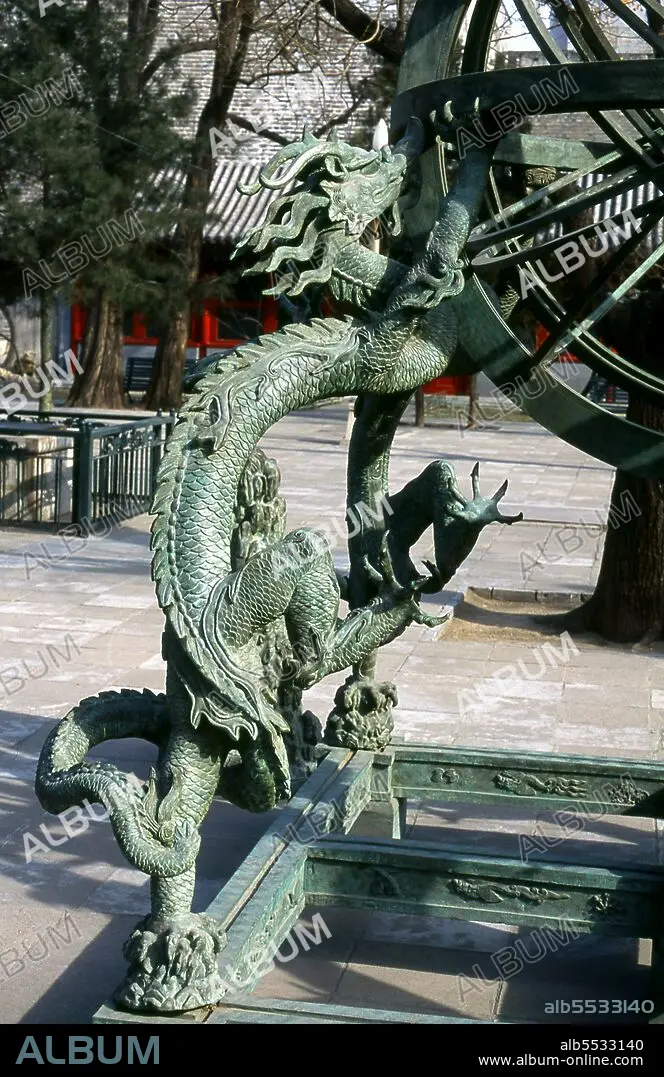
China: A dragon holding an armillary sphere in the courtyard at the Ancient Observatory (Gu Guanxiangtai), Beijing.
| Compartir |
|---|
 Pinterest Pinterest |
 Twitter Twitter |
 Facebook Facebook |
 Copiar enlace Copiar enlace |
 Email Email |
|
Añadir a otro lightbox |
|
Añadir a otro lightbox |


¿Ya tienes cuenta? Iniciar sesión
¿No tienes cuenta? Regístrate
Compra esta imagen.
Selecciona el uso:

Título: China: A dragon holding an armillary sphere in the courtyard at the Ancient Observatory (Gu Guanxiangtai), Beijing.
Descripción: Ver traducción automática
An armillary sphere (variations are known as spherical astrolabe, armilla, or armil) is a model of objects in the sky (in the celestial sphere), consisting of a spherical framework of rings, centred on Earth, that represent lines of celestial longitude and latitude and other astronomically important features such as the ecliptic. As such, it differs from a celestial globe, which is a smooth sphere whose principal purpose is to map the constellations. Beijing's Ancient Observatory was built in 1442 during the Ming Dynasty and is one of the world's oldest. It served the Ming and Qing astronomers in their star-gazing reports for the Emperor. As he was considered the Son of Heaven, the movements of the heavenly bodies were an important affair. Another function was to assist sea navigation, with Muslim scholars recruited for their expertise in the area.
An armillary sphere (variations are known as spherical astrolabe, armilla, or armil) is a model of objects in the sky (in the celestial sphere), consisting of a spherical framework of rings, centred on Earth, that represent lines of celestial longitude and latitude and other astronomically important features such as the ecliptic. As such, it differs from a celestial globe, which is a smooth sphere whose principal purpose is to map the constellations. Beijing's Ancient Observatory was built in 1442 during the Ming Dynasty and is one of the world's oldest. It served the Ming and Qing astronomers in their star-gazing reports for the Emperor. As he was considered the Son of Heaven, the movements of the heavenly bodies were an important affair. Another function was to assist sea navigation, with Muslim scholars recruited for their expertise in the area.
Crédito: Album / David Henley/Pictures from History/Universal Images Group
Autorizaciones: ? Cesión de modelo: No - ? Cesión de propiedad: No
¿Preguntas relacionadas con los derechos?
¿Preguntas relacionadas con los derechos?
Tamaño imagen: 3309 × 5100 px | 48.3 MB
Tamaño impresión: 28.0 × 43.2 cm | 1302.8 × 2007.9 in (300 dpi)
Palabras clave: ASIA • ASIATICO • ASTROLABIO • ASTRONOMIA • CHINA • CHINO • CIENCIA • CIENCIAS • DRAGON • HISTORIA • HISTORICO • OBSERVATORIO • PEKIN • PEQUIN • PLANETARIO • PLANETARIOS • PORCELANA
