

alb3836127
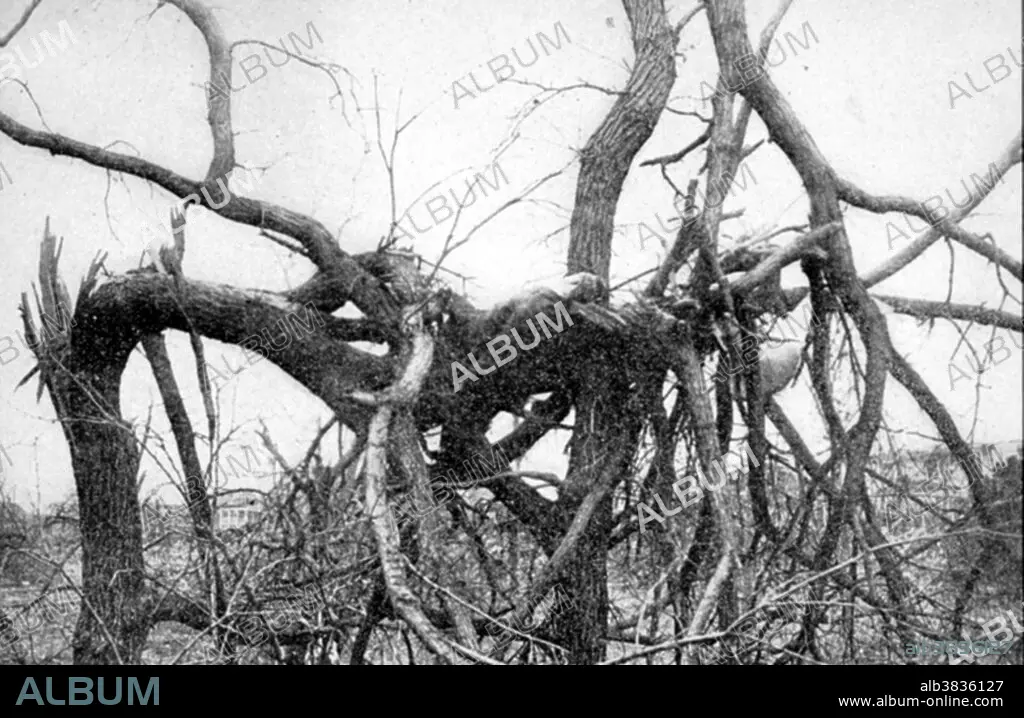
Tornado Victim, 1913
| Compartir |
|---|
 Pinterest Pinterest |
 Twitter Twitter |
 Facebook Facebook |
 Copiar enlace Copiar enlace |
 Email Email |
|
Añadir a otro lightbox |
|
Añadir a otro lightbox |


¿Ya tienes cuenta? Iniciar sesión
¿No tienes cuenta? Regístrate
Compra esta imagen.
Selecciona el uso:

Título: Tornado Victim, 1913
Descripción: Ver traducción automática
A tornado victim at Omaha found in a tree. It is possible that this was a posed shot as the victim is relatively clean and there are no apparent tears in his clothes. Omaha, Nebraska, March 23, 1913. A tornado is a violent, dangerous, rotating column of air that is in contact with both the surface of the earth and a cumulonimbus cloud or, in rare cases, the base of a cumulus cloud. They are often referred to as a twister or a cyclone, although the word cyclone is used in meteorology in a wider sense, to name any closed low pressure circulation. Tornadoes come in many shapes and sizes, but are typically in the form of a visible condensation funnel, whose narrow end touches the earth and is often encircled by a cloud of debris and dust. Most tornadoes have wind speeds less than 110 miles per hour (177 km/h), are approximately 250 feet (80 m) across, and travel a few miles (several kilometers) before dissipating. The most extreme tornadoes can attain wind speeds of more than 300 mph (480 km/h), stretch more than two miles (3 km) across, and stay on the ground for dozens of miles (more than 100 km).
A tornado victim at Omaha found in a tree. It is possible that this was a posed shot as the victim is relatively clean and there are no apparent tears in his clothes. Omaha, Nebraska, March 23, 1913. A tornado is a violent, dangerous, rotating column of air that is in contact with both the surface of the earth and a cumulonimbus cloud or, in rare cases, the base of a cumulus cloud. They are often referred to as a twister or a cyclone, although the word cyclone is used in meteorology in a wider sense, to name any closed low pressure circulation. Tornadoes come in many shapes and sizes, but are typically in the form of a visible condensation funnel, whose narrow end touches the earth and is often encircled by a cloud of debris and dust. Most tornadoes have wind speeds less than 110 miles per hour (177 km/h), are approximately 250 feet (80 m) across, and travel a few miles (several kilometers) before dissipating. The most extreme tornadoes can attain wind speeds of more than 300 mph (480 km/h), stretch more than two miles (3 km) across, and stay on the ground for dozens of miles (more than 100 km).
Crédito: Album / NOAA/Science Source
Autorizaciones: ? Cesión de modelo: No - ? Cesión de propiedad: No
¿Preguntas relacionadas con los derechos?
¿Preguntas relacionadas con los derechos?
Tamaño imagen: 3900 × 2532 px | 28.3 MB
Tamaño impresión: 33.0 × 21.4 cm | 1535.4 × 996.9 in (300 dpi)
Palabras clave: 1913 • AMERICA • AMERICANO • ATMOSFERICO • AZADA • BLANCO Y NEGRO • CIENCIA • CLIMA • CUCHARA • DAÑO • DAÑOS • DESASTRE NATURAL • DESTROZOS • DESTRUCCION • DESTRUÍDO • DEVASTACION • ESTADOS UNIDOS DE AMERICA • ESTADOS UNIDOS • FENÓMENO NATURAL • FENOMENOS NATURALES • HISTORIA • HISTORICO • METEOROLOGÍA • METEOROLÓGICO • METEREOLOGIA • METEREOLÓGICOS • MUERTO • NEBRASKA • OMAHA • PALA • S. XX • SECUELAS • SIGLO XX • TORMENTA • TORNADOS • VICTIMA • VIOLENTOS
